
A Copilot Studio agent tells sales staff the current stock level and price of products, but its answers come from facts pasted into its instructions months ago and are now wrong. The live values are maintained in Dataverse tables. What should the developer do?
Select an answer to reveal the explanation.
Short Explanation
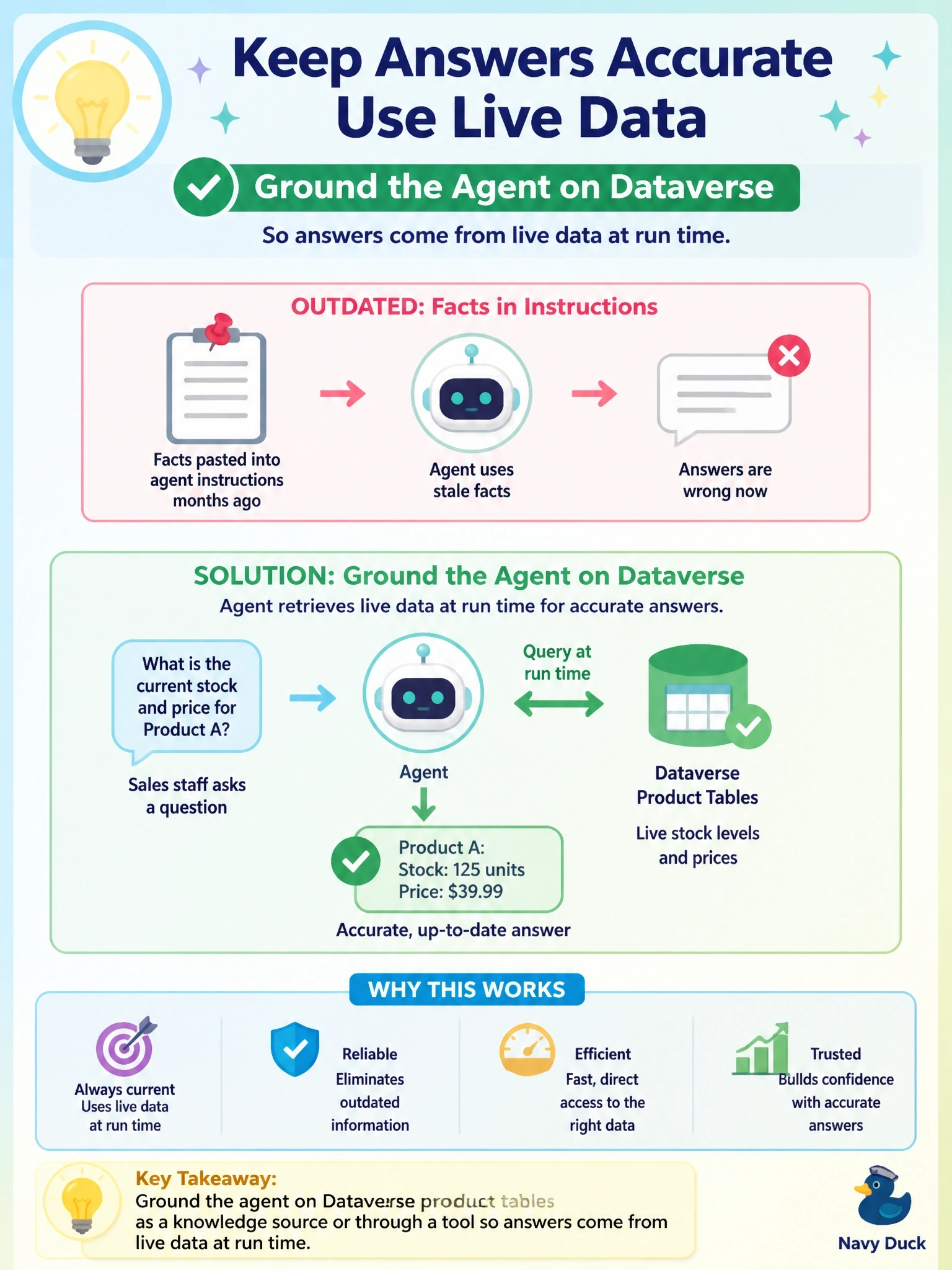
Think of the pasted facts as a printed price list taped to the wall: it's out of date the day after you print it. Grounding on Dataverse is like checking the live system every time someone asks. The trap is swapping models, which won't magically know your inventory.
Full Explanation
Agents give accurate business answers when they retrieve data at run time from the system of record rather than relying on static text. In Copilot Studio, Dataverse tables can be added as a knowledge source, or the agent can call a tool such as a Dataverse connector action or a flow that queries the tables, so each answer is built from current stock and price values and respects the user's access. Static facts in instructions become stale as soon as data changes, and updating them manually every week still leaves the agent wrong between updates while bloating the instructions. A larger model has no access to private business data; it may reason better, but it cannot know inventory levels it never sees. General knowledge draws on the model's training data, which has no knowledge of the company's products and may introduce plausible but incorrect values, making the problem worse. Exam caveat: choose knowledge for question answering over data and tools when the agent needs exact lookups or must perform actions; in both cases the data stays in Dataverse. Operational check: change a product's price in Dataverse, ask the agent about that product, and confirm the new value appears without any edit to the agent.