
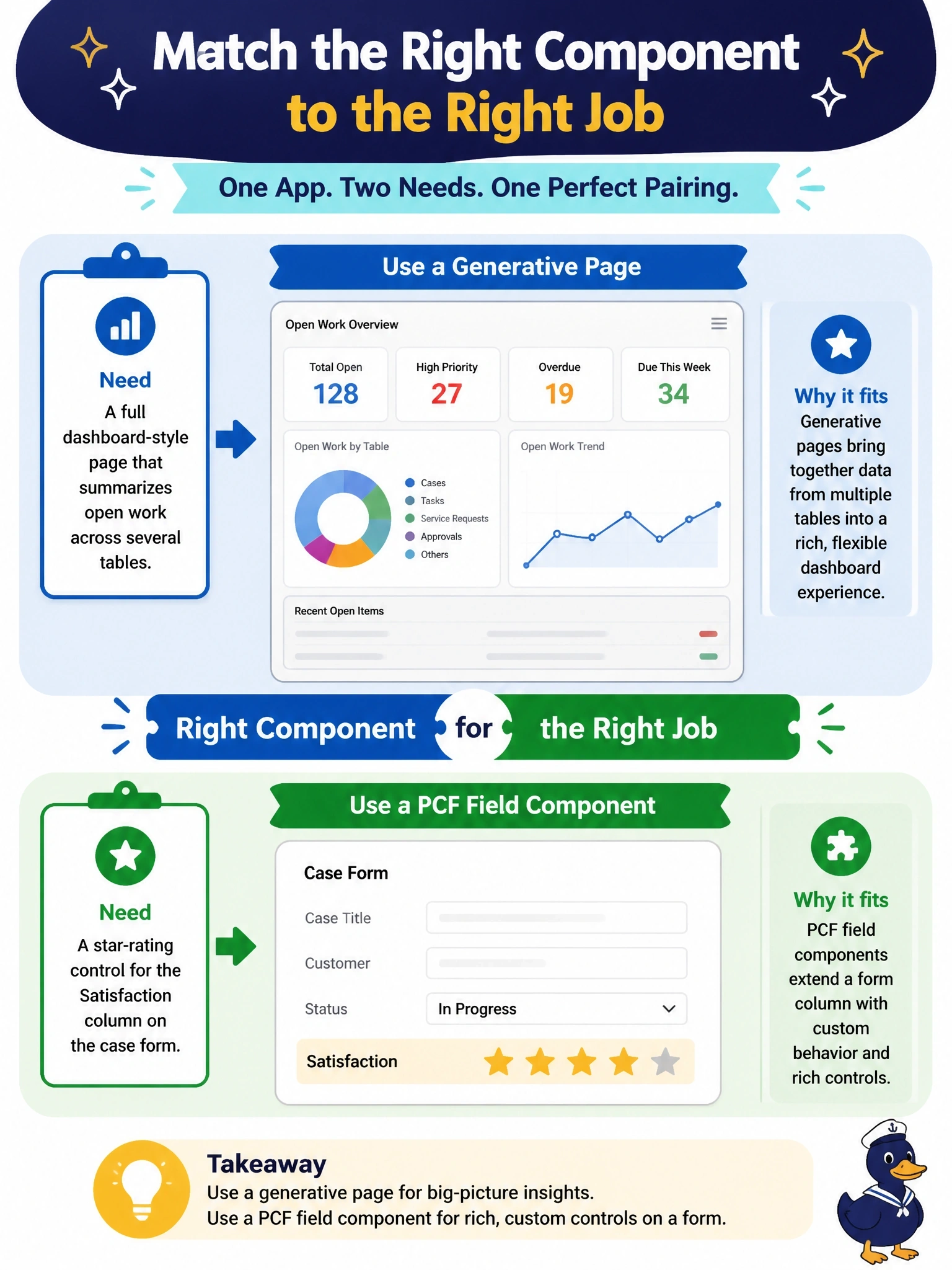
Two requirements arrive for the same model-driven app: a full dashboard-style page that summarizes open work across several tables, and a star-rating control for the Satisfaction column on the case form. Which pairing of component types best matches the scope of each requirement?
Select an answer to reveal the explanation.
Short Explanation
Think of scope like choosing between building a room and installing a light switch. A whole page that pulls together several tables is a room, so a generative page fits; a rating widget on one column is a switch, so a PCF field component fits. The trap is when you force one tool to do both jobs.
Full Explanation
Matching scope to component is a core design skill. Generative pages create an entire page within a model-driven app from a natural language description, which suits a dashboard-style summary that combines data from several tables. A PCF field component binds to a single column and replaces its standard control on a form, which is exactly the shape of a star-rating input for Satisfaction. A PCF dataset component renders a view or subgrid of rows from one data set; it is a control within a page rather than a whole multi-table page, so it fits the dashboard poorly. Using a second generative page for the rating forces users to leave the case form to set one value and loses the native binding, dirty tracking and save behaviour of a field control. An HTML web resource can display content but needs custom code for every data call and layout, and a code app is an entire application, far larger than a single column control and unable to sit inside the form as one. Exam caveat: the deciding factors are the unit of user experience, page versus control versus application, and who will build and maintain it. Operational check: confirm the generative page appears in the app's navigation and the rating component is configured on the Satisfaction column of the case form.