
Makers across several departments need to call an internal REST API, which has an OpenAPI definition, from canvas apps and cloud flows. IT wants authentication configured once, the integration shipped in solutions, and its use governed by data policies. Which integration design should the developer deliver?
Select an answer to reveal the explanation.
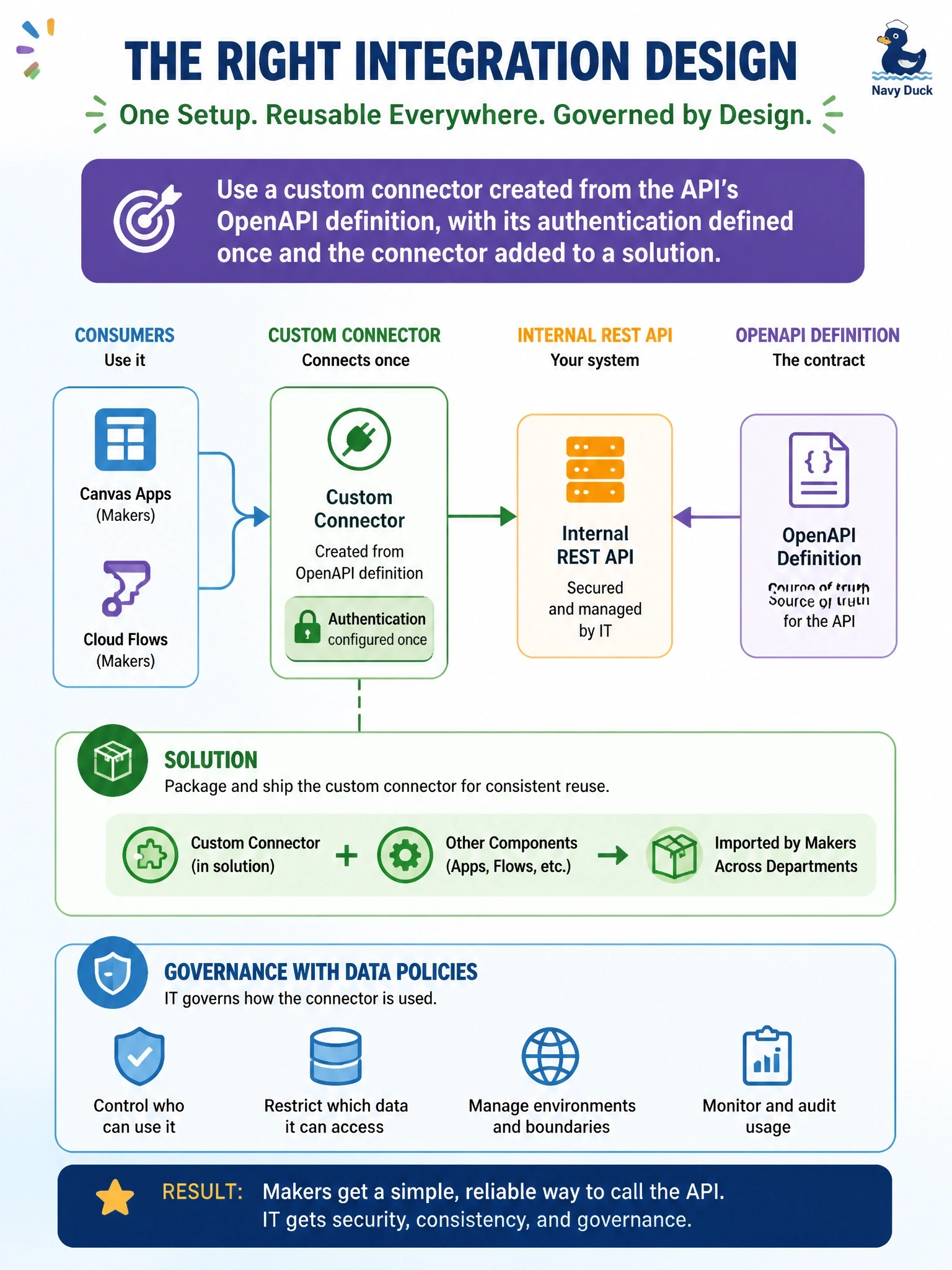
Short Explanation
Think of a custom connector as a universal power adapter: you build it once from the API's OpenAPI file, and every app and flow plugs into it the same way. Data policies can see it and classify it, too. The trap is the raw HTTP action, where every maker ends up pasting credentials into their own flow.
Full Explanation
A custom connector wraps a REST API in a reusable definition that apps, flows and agents use just like Microsoft's built-in connectors. Importing the API's OpenAPI definition creates the operations, parameters and responses, and the security configuration is defined once in the connector, so each maker creates a connection rather than handling credentials. Custom connectors are solution-aware, so they move through ALM with the apps and flows that use them, and they appear in data policies, where administrators can classify them into Business or Non-business groups and restrict their use. HTTP actions with typed credentials scatter secrets across many flows, are invisible as a distinct connector for governance, and must be updated one by one when anything changes; canvas apps also cannot simply call another flow's HTTP action as an API. A code app is a user interface, not an integration surface that other apps and flows consume. Per-department Azure functions multiply the code to maintain, still require each flow to call them over HTTP, and fragment authentication. Exam caveat: the same API could also be exposed as an MCP server when the main consumers are agents; for apps and flows the custom connector is the standard design. Operational check: import the connector into a test environment with its solution and confirm the data policy lists it.