
Several tables' forms need the same helper functions for formatting phone numbers and validating postal codes. The developer wants one maintainable client-scripting design that avoids global name collisions with other solutions' scripts. Which design should the developer use?
Select an answer to reveal the explanation.
Short Explanation
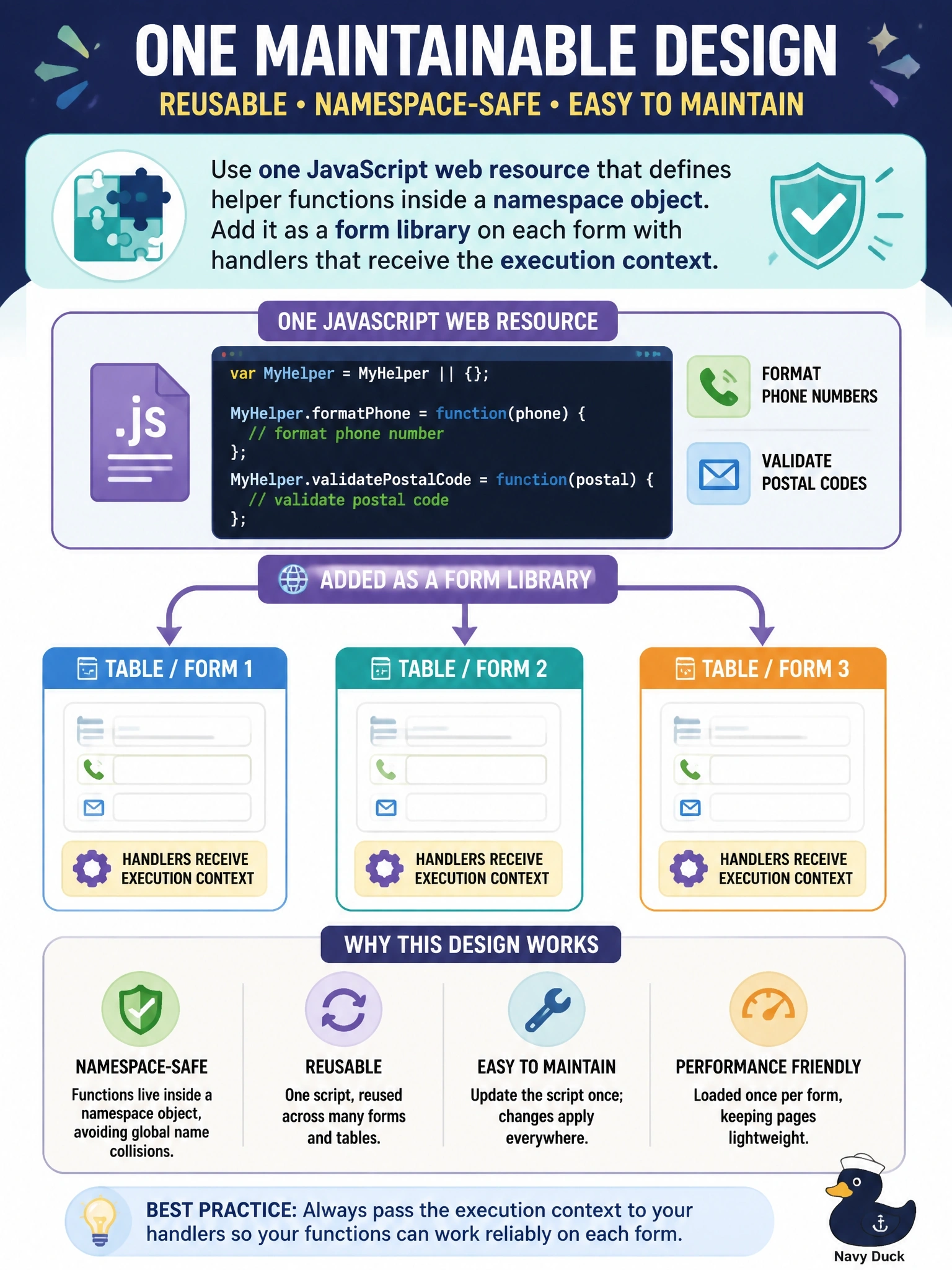
Think of a namespace as putting your name on your lunch in the shared office fridge. One library, one namespace, added to every form that needs it, and nobody else's code eats your functions. The trap is the old Xrm.Page habit, which is deprecated.
Full Explanation
The recommended client-scripting pattern is a single JavaScript web resource that wraps its functions in a unique namespace object, for example a publisher-prefixed object, so its names cannot collide with scripts from other solutions loaded on the same form. Each form adds the web resource as a form library and registers event handlers that point to the namespaced functions with the option to pass the execution context; the functions then call getFormContext on it to work with the current form. A change to the library is deployed once and applies everywhere. Copying the functions into each form's script recreates the drift problem, and declaring them globally invites collisions across libraries. Xrm.Page is deprecated in favour of the form context obtained from the execution context, so storing helpers there and avoiding the context builds on an unsupported pattern. Downloading code from an external URL and running it with eval bypasses solution management, breaks ALM and introduces a security risk. Exam caveat: libraries load asynchronously in the order defined, so dependent libraries should be listed accordingly, and functions should not assume another form's state. Operational check: add the library to two tables' forms, register the handlers with the execution context passed, and confirm both forms call the same function.