
A pro-code engineering team is building an agent that must use a specific model deployment they choose, run custom orchestration logic written in Python, and be hosted and scaled under their own Azure governance. Power Platform data will be reached later through tools. Which platform best fits?
Select an answer to reveal the explanation.
Short Explanation
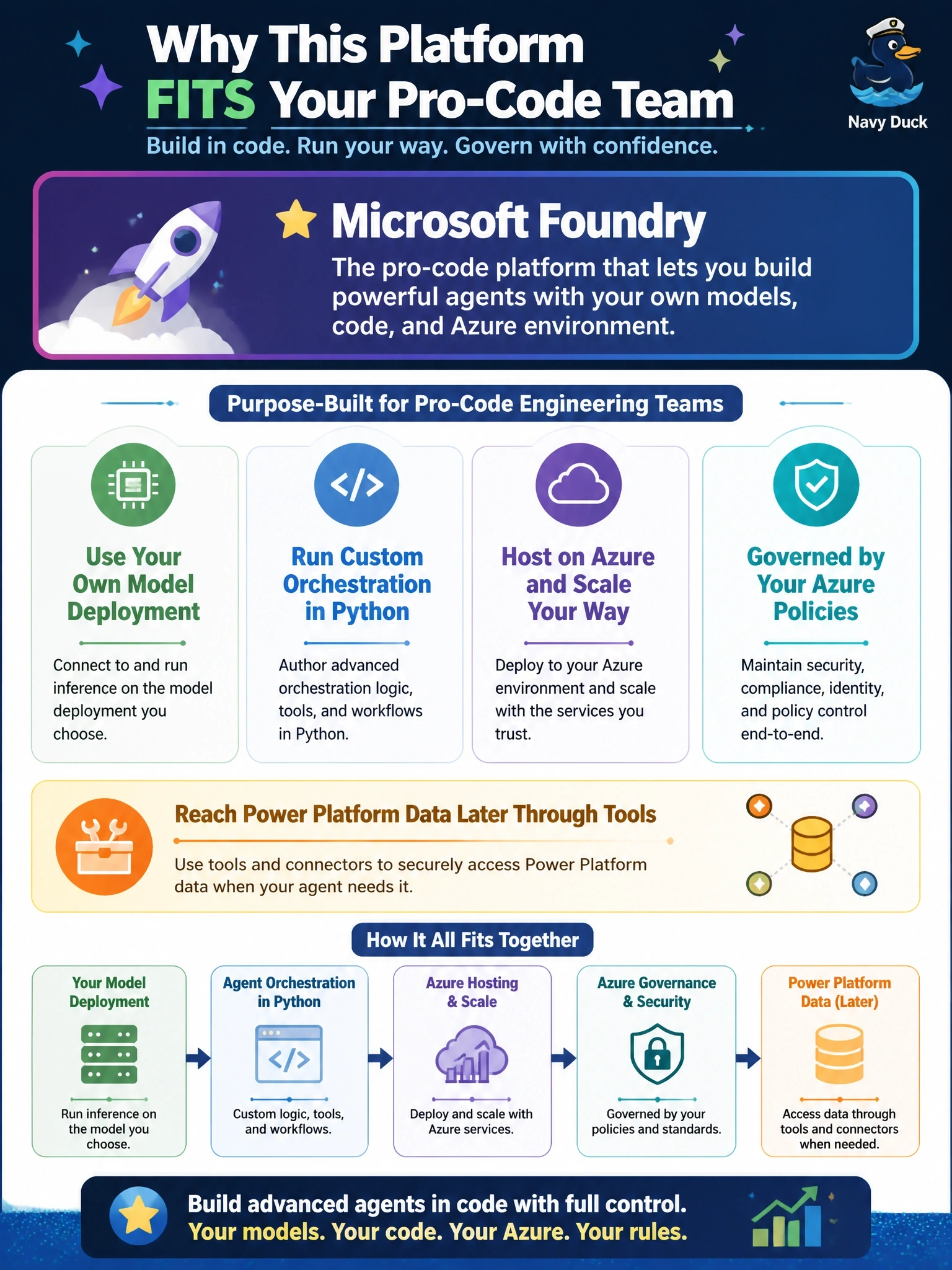
Think of Foundry as the workshop with every tool on the wall: you pick the model, you write the orchestration, and you run it in your own Azure house. When the stem says pro-code, custom model and your own hosting, that's your signal. The trap is assuming Copilot Studio can stretch to cover all of that.
Full Explanation
Microsoft Foundry is the code-first platform for building agents when developers need full control: they select and deploy models, write orchestration in languages such as Python or C#, integrate their own tools, and host the solution within their Azure subscriptions, governance and monitoring. Power Platform data and actions can still be reached through tools such as MCP servers or APIs, which keeps the integration path open. Copilot Studio offers generative orchestration and model options inside a managed low-code service, but it is not a place to run arbitrary Python orchestration or to host the agent under the team's own Azure scaling model. A Copilot Studio workflow is a deterministic automation that an agent can call as a tool; chaining prompts in a workflow does not give the team a custom orchestration runtime or control over hosting. A PCF code component runs in the user's browser inside an app; calling a model from client code exposes credentials and provides no orchestration platform at all. Exam caveat: the decision is driven by who builds and maintains the agent and by control requirements, not by which product is newer. Operational check: confirm the team can deploy its chosen model, run the orchestration code locally and in Azure, and reach a test Dataverse tool from the agent.