
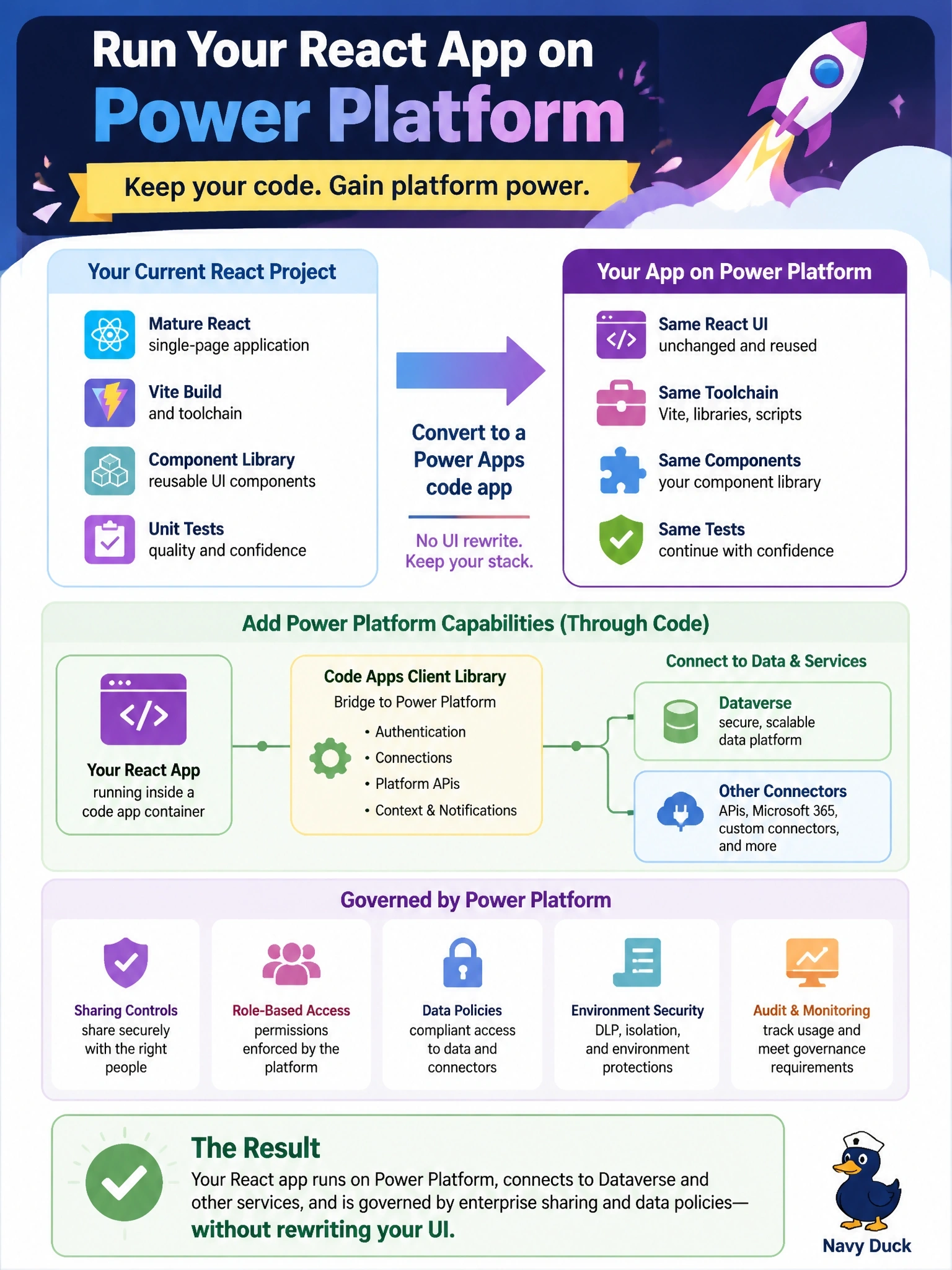
A team owns a mature React single-page application with its own Vite build, component library and unit tests. They want it to run on Power Platform, call Dataverse and other connectors, and be governed by the platform's sharing and data policy controls, without rewriting the UI. Which option should they choose?
Select an answer to reveal the explanation.
Short Explanation
Think of a code app as moving your existing house onto a managed lot, foundation and all: you keep your React code and your build, and you pick up Entra sign-in, connectors and governance from the platform. The trap is rebuilding in canvas, which throws away everything the team already has.
Full Explanation
Power Apps code apps let developers build business web apps in a code-first IDE with frameworks such as React or Vue and run them on Power Platform. The team keeps its toolchain and components, initializes the project as a code app, adds data sources such as Dataverse and other connectors that are then callable from TypeScript through the client library, and publishes it to an environment. The app gains Microsoft Entra authentication, connector access, and adherence to managed platform policies such as sharing limits, Conditional Access and data policies. Rebuilding in a canvas app discards the existing code and tests and changes the development model entirely. An HTML web resource can host static files inside a model-driven app, but it is not a governed app in its own right and cannot call connectors as a code app does. A PCF code component is meant for a field or dataset control within a form or page, not for hosting an entire application. Exam caveat: code apps need the environment setting that enables them and end users need a Power Apps Premium license or an equivalent option, so verify both before committing. Operational check: run the app locally against the environment, publish it, and confirm a test user can open it with connector consent and data policy enforcement.