
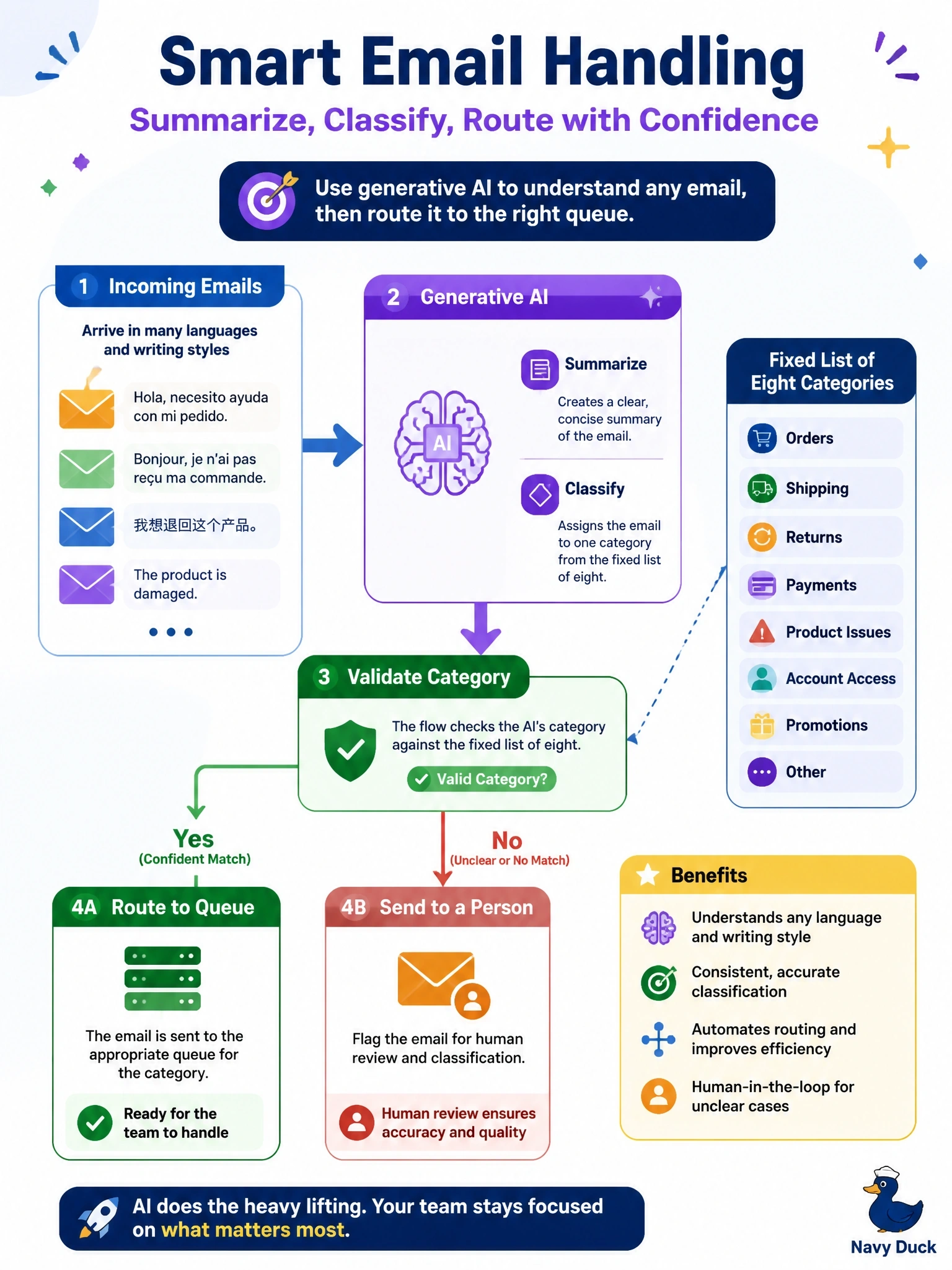
Incoming customer emails arrive in many languages and writing styles. Each must be summarized and assigned to one category from a fixed list of eight before a cloud flow routes it to a queue. Which design is most appropriate?
Select an answer to reveal the explanation.
Short Explanation
Think of a generative model as a sharp new hire who reads every email in any language, but whose work you still spot-check. It's the right tool for messy free text, as long as the flow checks the answer against your list and hands odd ones to a human. The trap is trusting the model as if it were deterministic.
Full Explanation
Interpreting unstructured, multilingual text is where non-deterministic generative AI fits: a prompt, for example an AI prompt used from a cloud flow, can summarize the message and propose a category even when wording varies widely. Because the output is not guaranteed to be identical or correct, the design wraps it with deterministic guardrails: the flow checks that the returned category is one of the eight allowed values, and invalid or low-confidence results go to a human review queue instead of being routed automatically. A business rule with contains conditions on the subject can only match literal strings, fails across languages and phrasing, and business rules cannot run on email descriptions in this way at scale. A Power Fx formula column evaluates deterministic expressions over column values; it cannot interpret meaning in free text. Routing directly on the model's output removes the guardrail and rests on a false premise, since generative output can vary between runs and can produce values outside the list. Exam caveat: use generative methods for interpretation and deterministic methods for enforcement, and combine them when both are needed. Operational check: run a test set of emails in several languages twice, measure agreement with expected categories, and confirm that an invalid category goes to review.