
A finance solution calculates tax on invoices. Auditors require that the same invoice inputs always produce exactly the same tax amount and that the logic behind each result can be reviewed line by line. How should the developer implement the calculation?
Select an answer to reveal the explanation.
Short Explanation
Think of a calculator versus a really smart friend: your friend's usually right, but the calculator's right the same way every single time. When auditors want identical results and a reviewable trail, you reach for deterministic code or formulas. The trap is believing a low temperature turns a language model into a calculator.
Full Explanation
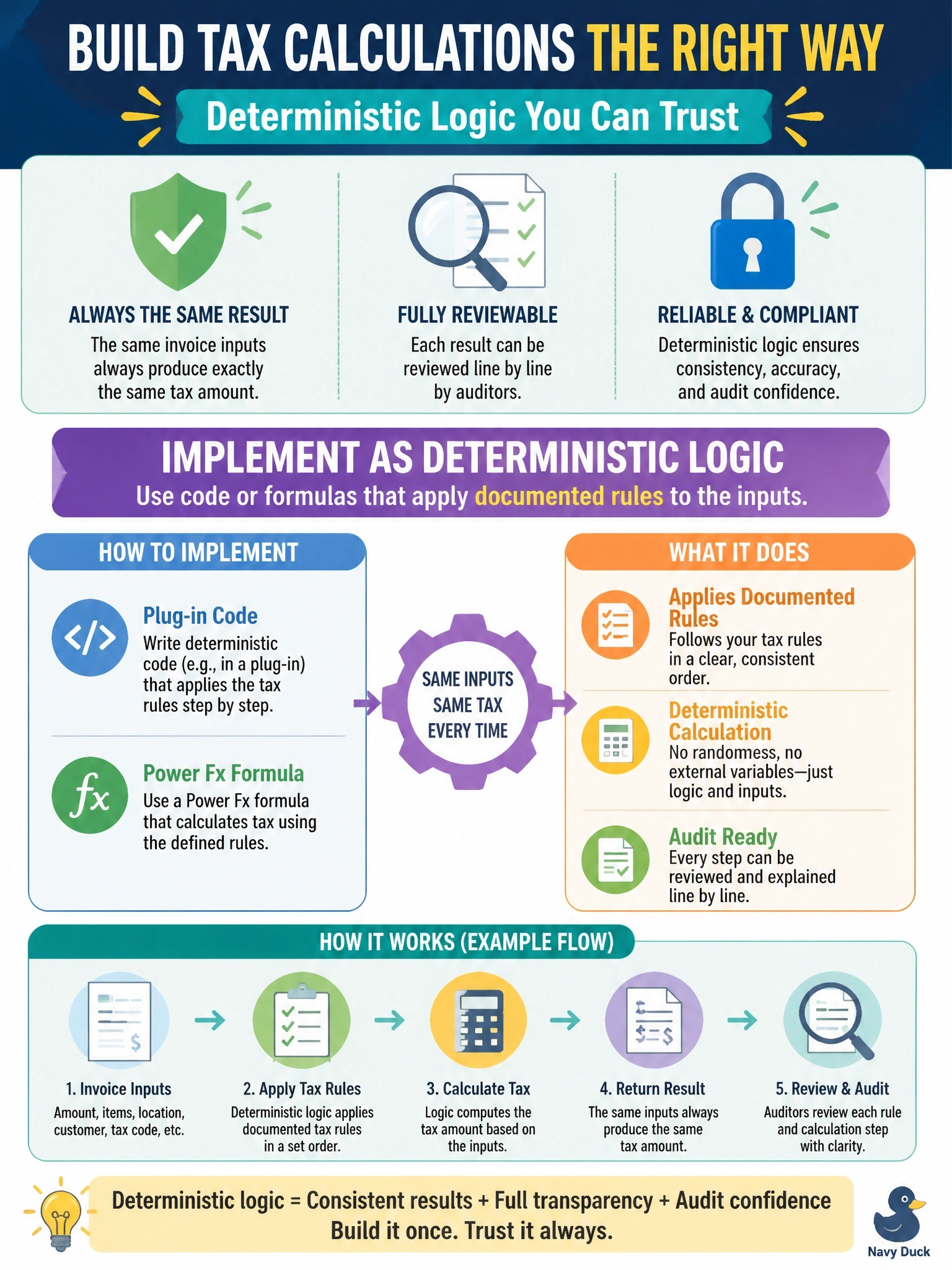
Deterministic logic produces the same output for the same input every time, and its behaviour is defined by code or formulas that can be read, versioned and tested. Tax calculation is a rule-based problem with a single correct answer and an audit requirement, so it belongs in plug-in code, a custom API, or a Power Fx formula whose rules are documented and covered by unit tests. Each result can then be traced to a specific version of the rules. A generative prompt is non-deterministic by nature; lowering the temperature reduces variation but does not guarantee identical output, and the model's reasoning cannot be audited line by line, so the rule becomes probabilistic. A Copilot Studio agent grounded on rate tables still relies on a language model to interpret and compute, which carries the same risk of variation and miscalculation. An AI Builder prediction model estimates outcomes from historical patterns; it is designed for probabilities, not for applying a statutory formula exactly. Exam caveat: generative AI can still help around the calculation, for example explaining an invoice, but the authoritative number must come from deterministic logic. Operational check: run the same invoice through the calculation repeatedly and through a test suite of known cases, and confirm identical results.