
A consultant configuring an account team's workspace is asked whether relationship insights will automatically identify the champion on a strategic opportunity as soon as someone on the account team manually sets a contact's role field to 'Champion.' What should the consultant explain?
Select an answer to reveal the explanation.
Short Explanation
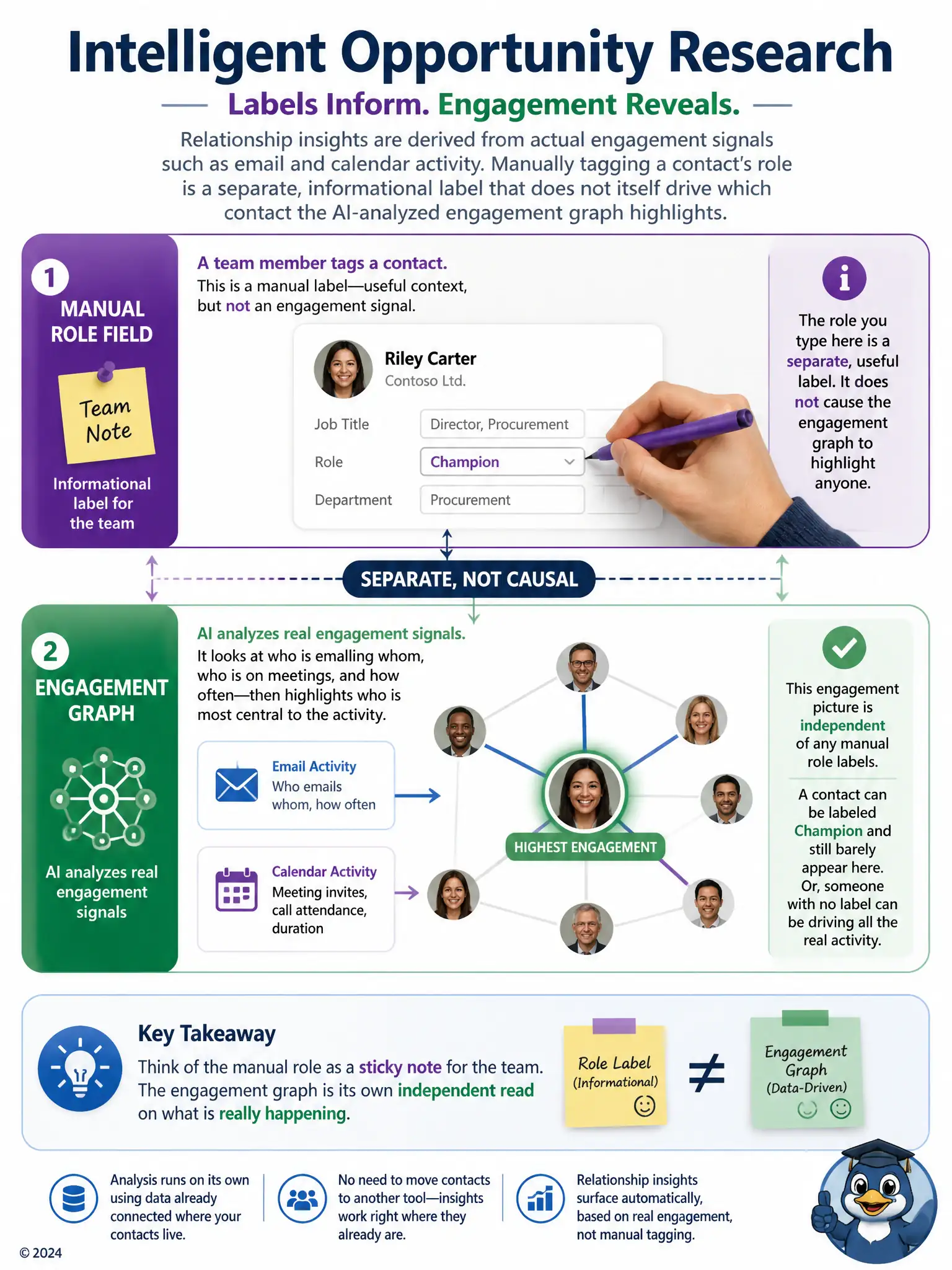
You don't tell the system who the champion is by typing Champion into a field. Relationship insights come from real engagement signals, like email and calendar activity, so the manual role label is just a helpful note for the team, not the driver of the engagement picture.
Full Explanation
The correct answer is the explanation that relationship insights are derived from actual engagement signals such as email and calendar activity, so manually tagging a contact's role is a separate, informational label that does not itself drive which contact the artificial-intelligence-analyzed engagement graph highlights. Relationship insights analyze real engagement activity, such as email exchanges and calendar interactions, to build a picture of who is actively involved on an account and how strongly. Manually setting a contact's role field to Champion is a useful label for the team's own reference, but it is not an input the engagement analysis reads from; the two live side by side rather than one driving the other. One contact could be manually tagged as champion and still show weak engagement signals, or the reverse, and the consultant should set that expectation clearly. The answer that confirms setting the role field is exactly how the system identifies which contact to treat as champion is incorrect because it reverses the relationship, implying the manual field feeds the automated analysis, when the analysis runs independently off engagement data regardless of what any field says. The answer that explains relationship insights will not function at all until every contact on the account has a manually assigned role is incorrect because it invents a hard prerequisite that does not exist; relationship insights can surface engagement patterns for an account even when no contact has been manually tagged with a role, since the underlying analysis does not depend on that field being populated. The answer that explains relationship insights require the client to migrate all contacts into a separate stakeholder-management application before any engagement analysis can run is incorrect because it adds a fictitious migration requirement; there is no need to move contacts into a separate application, since relationship insights work from data already connected through the account's engagement history. The manual field and the automated insight are related in purpose but separate in mechanism.