
A consultant is explaining to a sales manager how the relationship insights feature identifies which contacts on an opportunity are most engaged. Which TWO of the following accurately describe how the feature determines engagement? (Select TWO.)
Select all correct answers, then click Submit.
Short Explanation
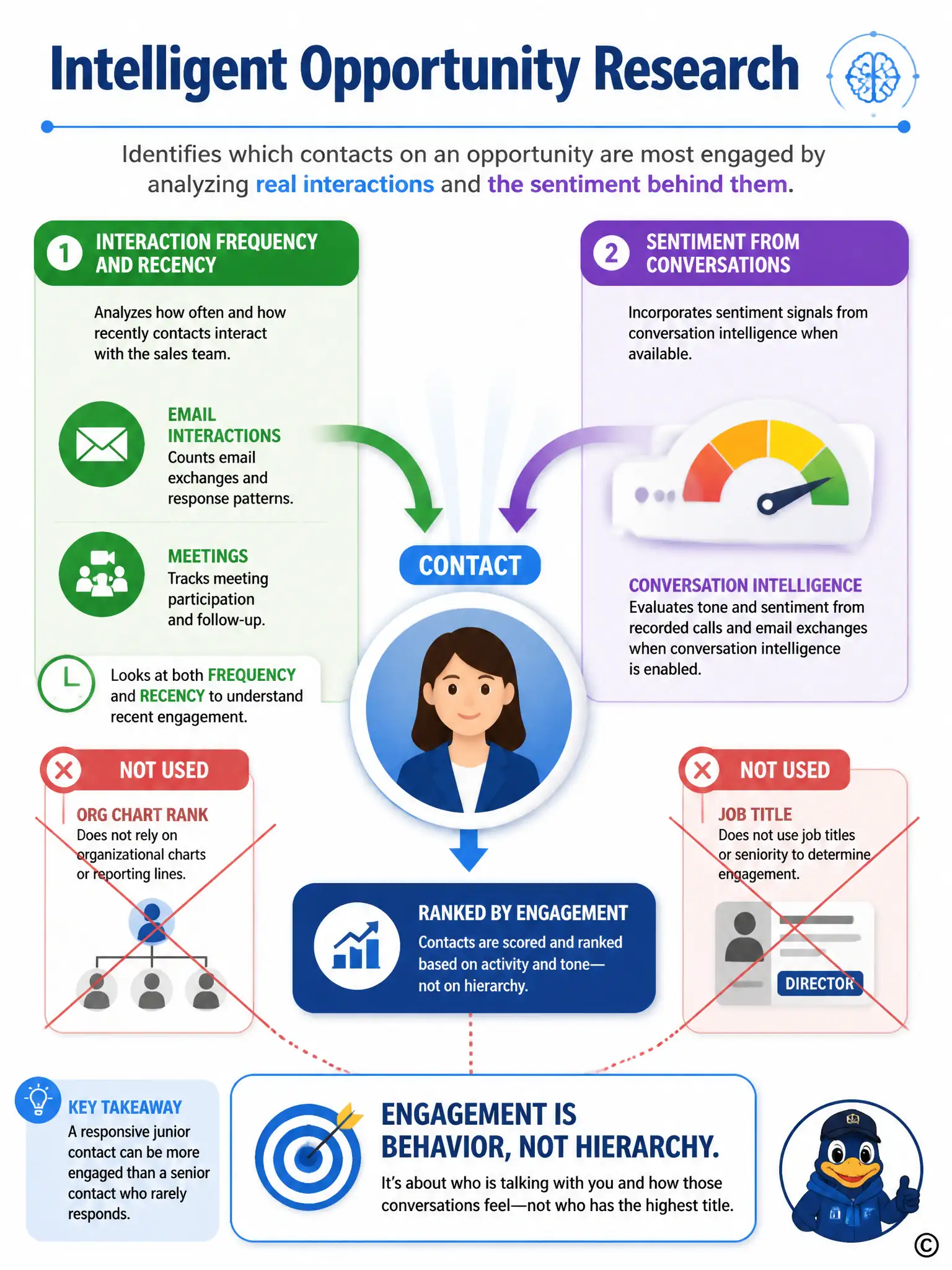
This feature is watching behavior, not job titles. It tracks how often and how recently contacts email and meet with the sales team, and when conversation intelligence is available, it also picks up sentiment from those interactions. It doesn't rely on a hand-maintained org chart or rank contacts by job-title seniority.
Full Explanation
The two accurate descriptions are the ones that say engagement comes from analyzing the frequency and recency of email and meeting interactions between the account's contacts and the sales team, and from incorporating sentiment signals drawn from conversation intelligence on recorded calls and email exchanges when available. Relationship insights derives engagement from the interaction data the sales team actually generates with each contact, giving a picture of both how active and how positive the relationship appears to be. The description involving a manually maintained org chart that reps update by hand is incorrect because the feature does not depend on a hand-updated authority ranking; it is generated from interaction data rather than a chart reps would need to keep current themselves. The description involving job title seniority pulled from a Dynamics 365 Sales record is incorrect because engagement, as the feature measures it, is not calculated from a contact's title or seniority field; a junior contact who interacts frequently can register as highly engaged regardless of title, since the underlying signal is behavioral activity, not organizational rank. Understanding this distinction matters in practice: a manager or rep who assumes relationship insights already accounts for seniority or seniority-adjacent authority risks over-trusting the feature to identify the actual decision-maker, when in fact it is measuring something narrower, who is actively interacting, not who holds the most influence. Consultants should frame the feature to clients as a measure of engagement activity, useful but distinct from a full stakeholder authority map.