
A consultant reviews a high predictive opportunity score on a renewal deal with a government agency. The client's Dynamics 365 Sales instance has years of closed-opportunity history, but almost all of it comes from commercial enterprise customers; government agency deals make up a small fraction of the historical data. A rep asks whether the high score can be relied on the same way as scores for commercial deals. How should the consultant respond?
Select an answer to reveal the explanation.
Short Explanation
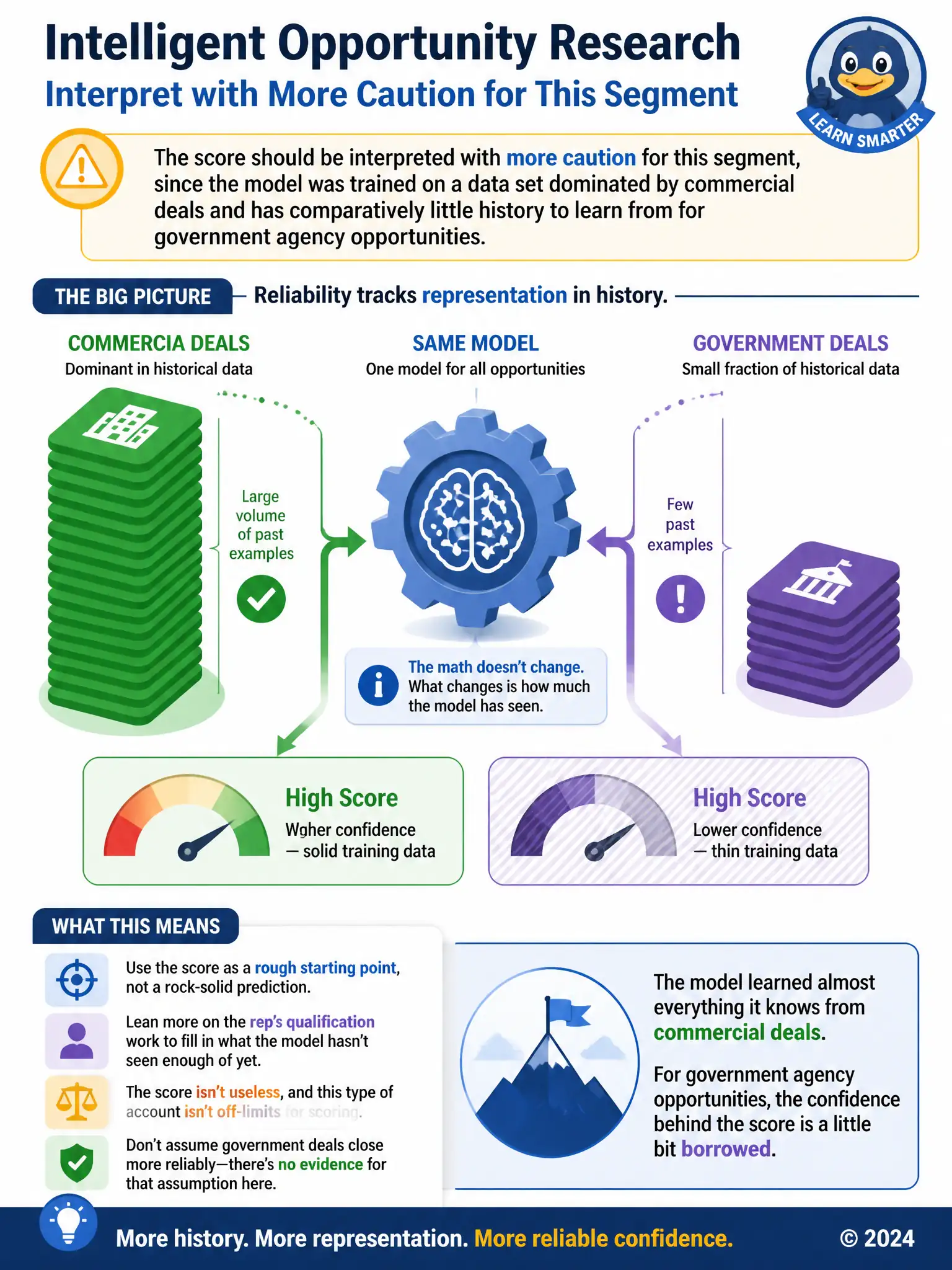
You should treat that high score with more caution because the model learned mostly from commercial deals and has only thin history for government agency opportunities. It’s still usable, but it’s a rougher read, so lean more on your own qualification work.
Full Explanation
The correct response is that the score should be interpreted with more caution for this segment, since the model was trained on a data set dominated by commercial deals and has comparatively little history to learn from for government agency opportunities. A predictive model’s reliability depends on having enough relevant historical examples to learn patterns from, and when one segment, here government agency deals, is only thinly represented compared to the bulk of the training data, the model has less basis for recognizing what distinguishes a likely win from a likely loss within that segment. The score is not meaningless, but it deserves more scrutiny and should be weighed alongside the rep’s own qualification work rather than treated with the same confidence as a score for a well-represented commercial deal. The response saying yes because predictive scoring uses the same calculation regardless of customer type, so segment representation in the training data has no effect on reliability, is incorrect because the underlying calculation does draw on patterns learned from historical data, and a segment with sparse representation gives the model less to learn from, which does affect reliability even though the scoring mechanism itself is applied consistently. The response saying no because predictive opportunity scoring cannot be used at all for government agency accounts is incorrect because nothing about the platform categorically excludes government agency accounts from predictive scoring; the concern is data volume and representativeness, not eligibility. The response saying yes because government agency deals always close at a higher rate than commercial deals, so a high score is even more dependable in this case, is incorrect because it invents a general claim about government close rates that is not supported by anything in the scenario and wrongly treats an assumption as a reason for greater confidence rather than caution. The practical guidance is to treat scores for underrepresented segments as a rougher estimate and lean more heavily on direct qualification for those deals.