
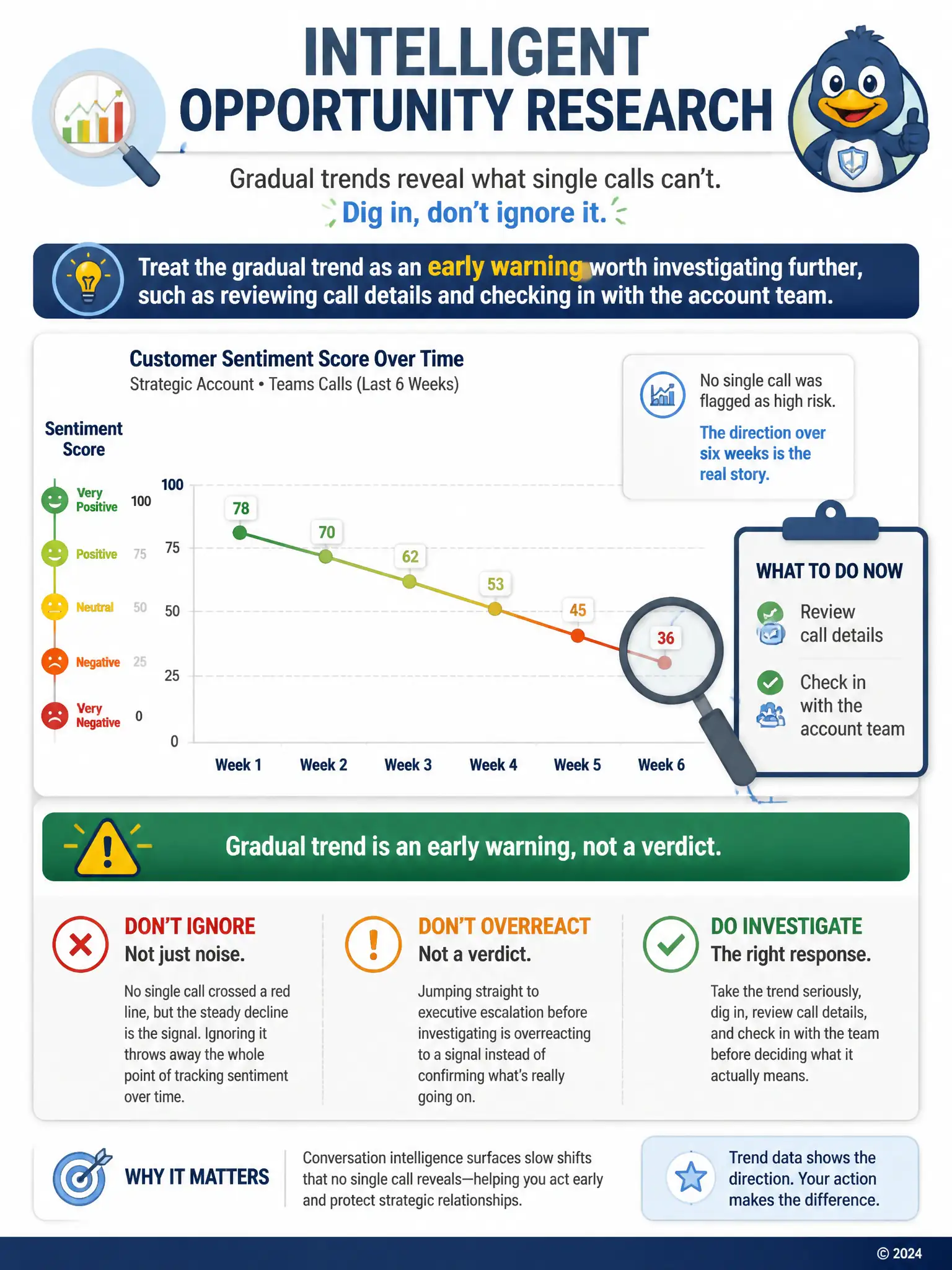
A sales manager reviews conversation intelligence reports for a strategic account and notices that customer sentiment scores across the account's recorded Teams calls have trended steadily more negative over the past six weeks, even though no single call was individually flagged as high risk. What should the manager do with this pattern?
Select an answer to reveal the explanation.
Short Explanation
No single call set off alarms, but the six-week slide is the story. Treat it as an early warning, pull the call details, and check with the account team before deciding what it means. Don't ignore it, don't jump to executive escalation, and don't write off sentiment scoring.
Full Explanation
The correct answer is the option that says to treat the gradual trend as an early warning worth investigating further, such as reviewing call details and checking in with the account team, because sentiment analysis can surface a slow shift that no single call reveals on its own. Conversation intelligence sentiment scoring is useful not only for catching a single alarming call but also for surfacing gradual shifts across a series of interactions that would not individually trip a high-risk threshold. The steady six-week decline is exactly the kind of pattern that rewards closer investigation, such as reviewing the underlying call details, talking with the account team, and confirming whether the relationship genuinely is deteriorating, rather than treating the number as either irrelevant or as conclusive proof by itself. The option that says to ignore the trend, since no individual call crossed the platform's high-risk threshold, is incorrect because dismissing the trend just because no single call crossed a threshold ignores the value of trend analysis, which is precisely to catch what a snapshot view of individual calls would miss. The option that says to immediately escalate the account to executive sponsorship without further review, since a negative trend alone confirms the deal is lost, is incorrect because escalating to executive sponsorship without any further review overreacts to a sentiment score, treating an early indicator as a certainty when it is only a signal that warrants confirmation. The option that says to disregard sentiment scoring for this account going forward, since it failed to flag any individual call as high risk despite the account clearly struggling, is incorrect because concluding that sentiment scoring has failed misreads what the data showed; the trend was in fact detected and is doing its job as an early indicator, it simply requires human follow-up rather than an automatic action. Sentiment trends work best as a prompt for the manager to look closer, not as a final verdict on the deal.