
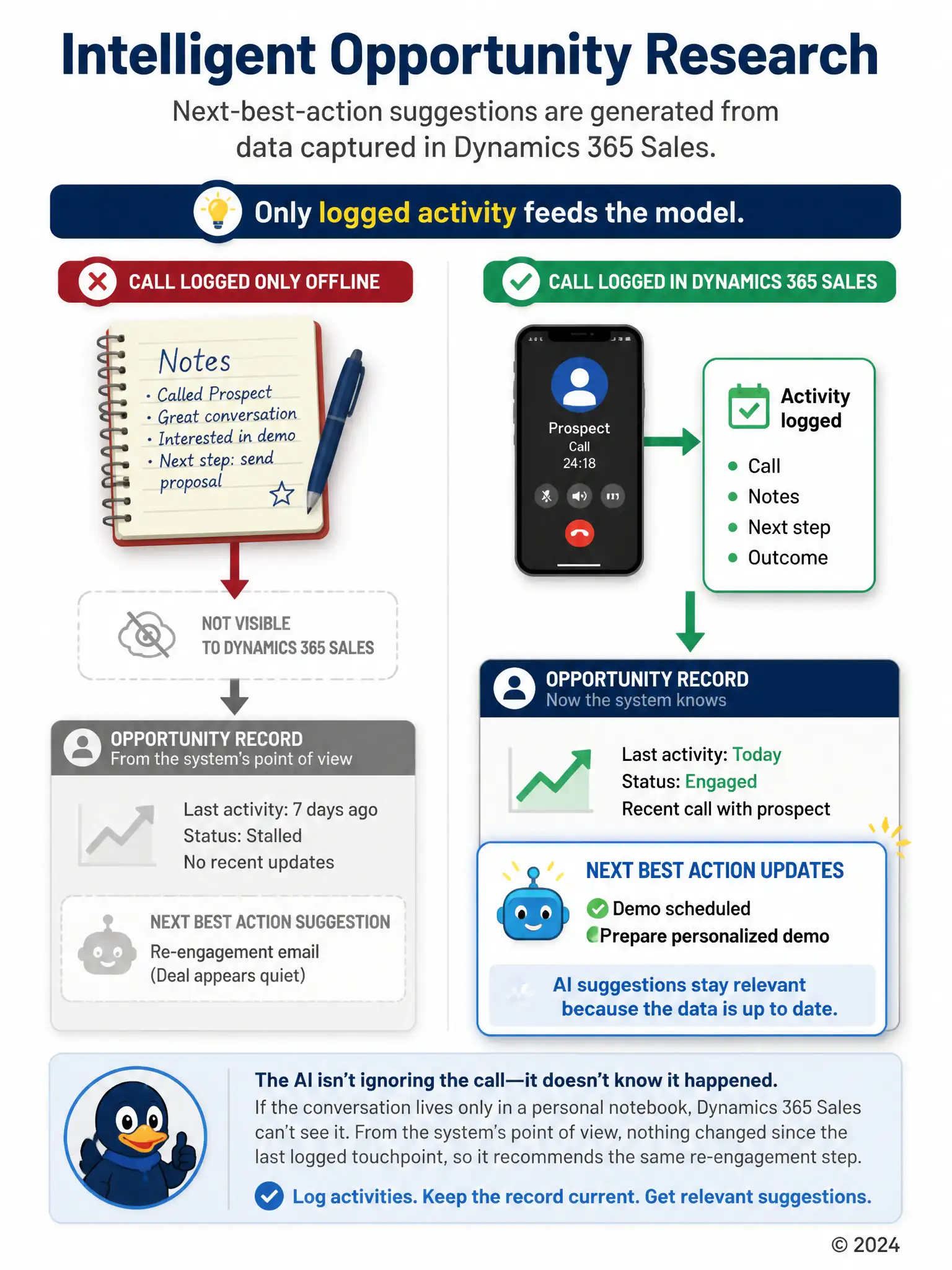
A rep called a stalled prospect and had a promising conversation, but only wrote about it in a personal notebook, without logging an activity or updating the opportunity in Dynamics 365 Sales. The next day, the AI-generated next-best-action suggestion still recommends a re-engagement email as if no contact had occurred. Why does the suggestion not reflect the recent call?
Select an answer to reveal the explanation.
Short Explanation
The model isn't ignoring the call; it genuinely doesn't know it happened, because the only record of that conversation lives in a personal notebook Dynamics 365 Sales can't see. From the system's point of view, nothing changed on the opportunity since the last logged touchpoint, so it keeps recommending the same re-engagement step. Logging the activity is what keeps the suggestions relevant.
Full Explanation
The correct choice is the one stating that next-best-action suggestions are generated from data captured in Dynamics 365 Sales, and a conversation recorded only outside the system is invisible to the model. Next-best-action recommendations are generated from the activity and interaction data recorded within Dynamics 365 Sales; the system has no visibility into information that exists only outside that record, such as a rep's personal notebook. Because the promising call was never logged as an activity or reflected in the opportunity, the model has no evidence that outreach already happened and continues to recommend the same re-engagement step it would suggest for any stalled deal with no recent contact. The claim that the suggestion engine only refreshes once per week regardless of any new activity logged on the record is incorrect because the engine is not on a fixed weekly cadence disconnected from record activity; it responds to changes in the data, but only when that data is actually entered into the system. The claim that next-best-action requires the rep to manually approve each suggestion before the system will consider new activity is incorrect because next-best-action suggestions are generated automatically based on opportunity signals and do not require a manual approval step before the system will factor in new activity. The claim that the call must have been misclassified as a personal activity type, which the model excludes from opportunity scoring, is incorrect because the issue here is not a misclassification of an activity type within Dynamics 365 Sales; it is that no activity was ever created in the system at all, so there is nothing for the model to classify. The practical takeaway is that the quality of model-driven recommendations depends on reps consistently logging their real-world interactions in the CRM.