
A consultant reviews an opportunity in early qualification stage and notices it already has a predictive opportunity score, even though several key fields, estimated close date, budget amount, and decision-maker contact, are still blank. A sales manager asks whether this early score can be trusted to prioritize the rep's day. How should the consultant respond?
Select an answer to reveal the explanation.
Short Explanation
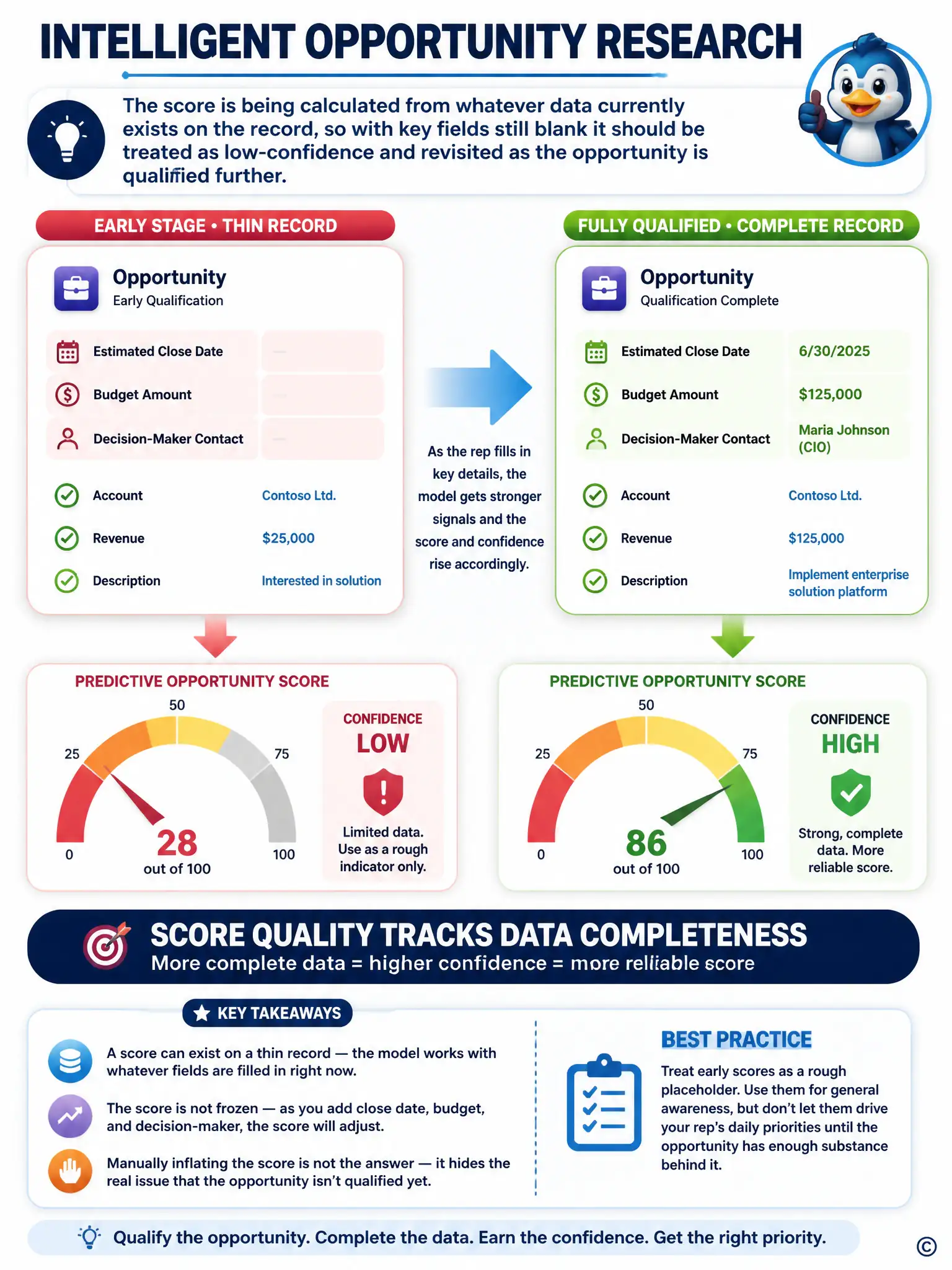
Scores can exist on thin records because the model just works with whatever's filled in. With close date, budget, and decision-maker blank, treat that number as low-confidence and revisit it as the rep qualifies the deal. Don't bet the rep's whole day on it yet.
Full Explanation
The correct response is the one stating that the score is being calculated from whatever data currently exists on the record, so with key fields still blank it should be treated as low-confidence and revisited as the opportunity is qualified further. Predictive opportunity scoring is generated from the data available on the record at the time it runs, and it recalculates as the record changes; when core qualification fields such as close date, budget, and decision-maker are still blank, the model has less signal to work with, so the resulting score reflects that incompleteness and should be treated as provisional rather than authoritative. The consultant should advise the manager to weight this score cautiously and expect it to firm up as the rep qualifies the deal and fills in those details. The response claiming the score cannot exist without those fields populated is incorrect because the platform does not require every field to be populated before it will generate a score; scoring runs on the data present, however sparse, which is exactly why an early-stage score can be low-confidence in the first place. The response saying the score is final once generated and will not change even after those fields are later completed is incorrect because predictive scores are not static snapshots; they update as underlying opportunity data changes, so completing the missing fields will affect future scores. The response recommending that the score should be manually set to the maximum value until the fields are filled in is incorrect because manually forcing a score to the maximum value regardless of the model's output defeats the purpose of the feature and could cause the rep to over-prioritize a deal that has not yet been qualified. The right posture is to read early scores as directional at best and to expect them to sharpen as the opportunity record fills out.