
An account executive reviews relationship insights on a strategic opportunity and sees a mid-level product manager flagged as the most engaged contact, based on frequent email and meeting activity. The rep also knows, from prior deals at similar companies, that a quieter but more senior VP on the same account typically makes the final budget decision. How should the rep use this information?
Select an answer to reveal the explanation.
Short Explanation
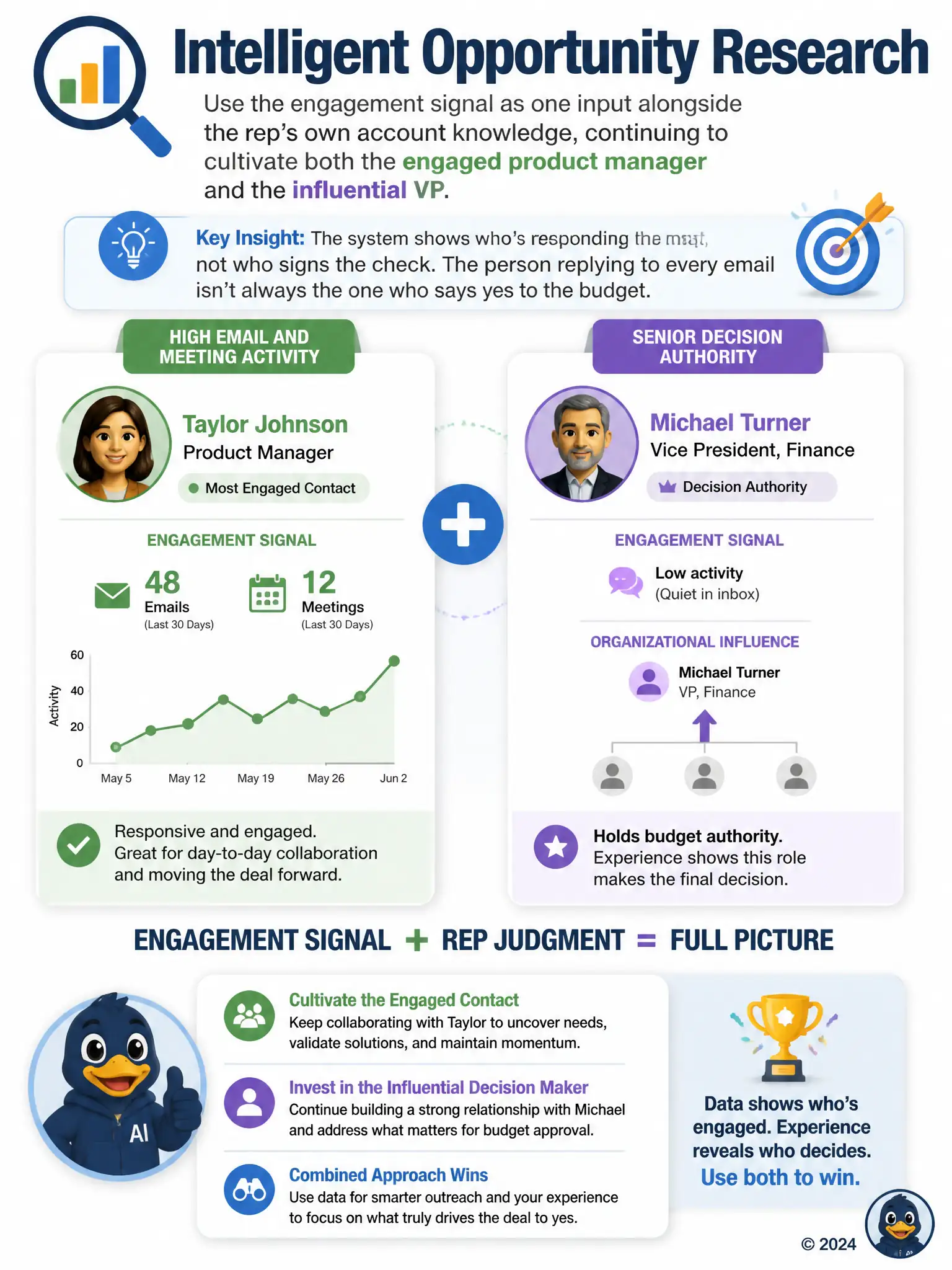
The system is telling you who's responding the most, not who signs the check. Use that engagement signal as one input, and keep working both the active product manager and the senior VP who likely owns the budget.
Full Explanation
The correct approach is to use the engagement signal as one input alongside the rep's own account knowledge, continuing to cultivate both the engaged product manager and the influential VP. Relationship insights surface a signal, engagement frequency drawn from email and meeting activity, and that signal is genuinely useful for spotting who is actively responsive, but it does not capture organizational authority or budget influence, which the rep has independently learned from experience with similar accounts. The sound approach is to combine both: keep engaging the responsive product manager while also continuing to build the relationship with the VP whose sign-off likely matters more for the final decision. Disregarding the VP entirely and focusing all further outreach on the product manager because the system identified them as the most engaged contact is incorrect because ignoring the VP based solely on an engagement metric risks missing the actual decision-maker, discarding real account knowledge the rep already has. Asking the consultant to manually reassign the champion label to the VP so the system reflects the rep's judgment is incorrect because relationship insights are generated from interaction data rather than a manually assignable label, and overriding it would misrepresent what the feature actually measures rather than adding useful information. Treating the flagged engagement as inaccurate and stopping reliance on relationship insights for this opportunity is incorrect because the engagement data is not wrong, the product manager genuinely is the most responsive contact, it is simply incomplete as a measure of who holds decision authority, so discarding the feature over this gap throws away a still-useful signal. Relationship insights work best as one input a rep weighs alongside their own judgment, not as a replacement for it.