
A seller updates a lead's annual revenue and employee count fields after a productive discovery call, expecting the predictive score to jump immediately so the lead moves up the prioritized work queue. Checking back an hour later, she finds the score unchanged. A consultant reviewing the configuration confirms predictive scoring is enabled and functioning correctly. What should the consultant tell her?
Select an answer to reveal the explanation.
Short Explanation
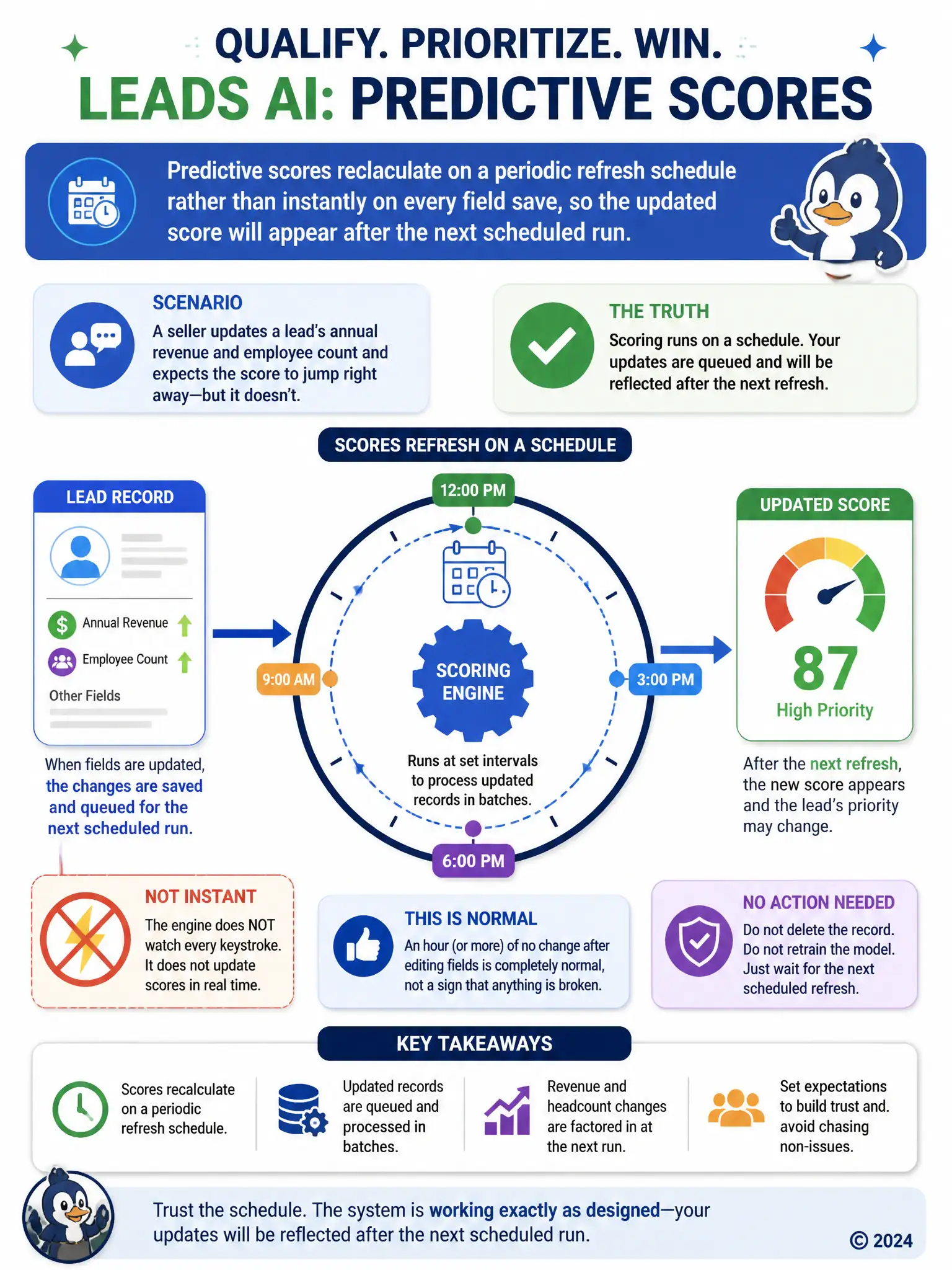
You don't need to panic. The predictive score updates on a scheduled refresh, not the moment she saves fields, so an hour of no change is normal. Just wait for the next run and check again.
Full Explanation
The correct answer is that predictive scores recalculate on a periodic refresh schedule rather than instantly on every field save, so the updated score will appear after the next scheduled run. In Dynamics 365 Sales, predictive lead scoring does not recompute a lead's score the instant a field is saved; the model processes records on a periodic refresh cycle, so a change made minutes ago will not be reflected until the next scheduled run completes. The consultant's job here is to set the seller's expectations correctly rather than treat this as a defect. The claim that the edited fields are not used by the scoring model is incorrect because revenue and employee count are exactly the kind of firmographic attributes predictive scoring commonly weighs, so ruling them out as irrelevant is unfounded and would mislead the seller about how the model works. The claim that predictive scoring only evaluates leads once at creation is incorrect because predictive scoring evaluates leads on an ongoing basis as data changes and refresh cycles run, not just once at creation, so recreating the record is unnecessary and would actually lose the lead's history. The claim that the scoring model has stopped functioning and must be retrained is incorrect because a delay before a refresh cycle completes is normal, expected behavior, not evidence of a broken or untrained model, and retraining is a disproportionate response to a timing question. Recognizing the refresh cadence keeps the consultant from chasing a non-issue and from prescribing unnecessary rework.