
A consultant is enabling the similar-opportunities recommendation for a distributor that recently created a new business unit selling a completely new product category in Dynamics 365 Sales. The parent company's core business unit has thousands of closed opportunities, but the new unit has closed only three opportunities so far. A rep in the new business unit opens an opportunity and finds the similar-opportunities panel empty. What is the most likely explanation?
Select an answer to reveal the explanation.
Short Explanation
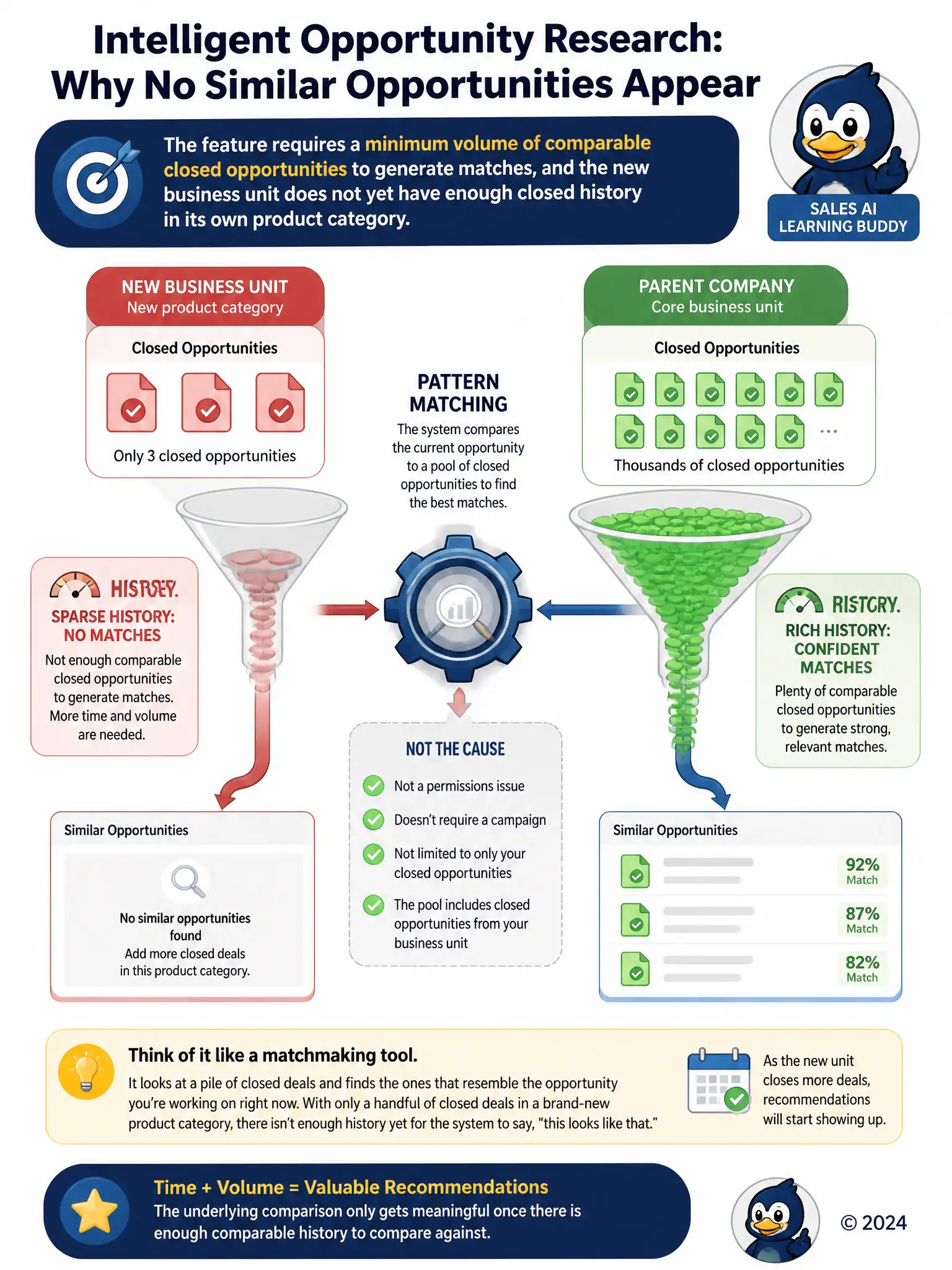
Think of similar-opportunities like matchmaking: it needs a decent pool of closed deals to compare against. You've got a brand-new business unit selling a new product category with only a few closed opportunities, so there isn't enough comparable history yet. It isn't a permissions issue, a campaign requirement, or limited to one rep's closed deals; it just needs time and volume.
Full Explanation
The correct explanation is that similar-opportunities recommendations are generated by comparing an open opportunity's attributes against a body of historical closed opportunities; when that history is thin, especially for a brand-new product category, there are not enough comparable records for the model to surface confident matches, so the panel stays empty. The explanation about the feature being blocked because the new business unit was created after the initial Dynamics 365 Sales deployment and was never re-indexed is incorrect because Dynamics 365 Sales does not require a manual re-indexing step tied to when a business unit was created; the feature evaluates whatever closed data exists at query time, and a lack of matches reflects data volume, not a missing index. The explanation that the feature only evaluates opportunities owned by the same rep is incorrect because the recommendation draws on closed opportunities across the accessible organizational scope, not only records owned by the individual rep, so one rep's personal close history is not the limiting factor. The explanation that the feature requires the opportunity to be linked to a marketing campaign is incorrect because similar-opportunities matching is based on opportunity attributes such as product, industry, and deal characteristics, not on whether the record is tied to a marketing campaign; campaign linkage plays no role in whether the feature returns results. Until the new business unit accumulates enough closed opportunities of its own kind, the consultant should set expectations that recommendations will be sparse or absent.