
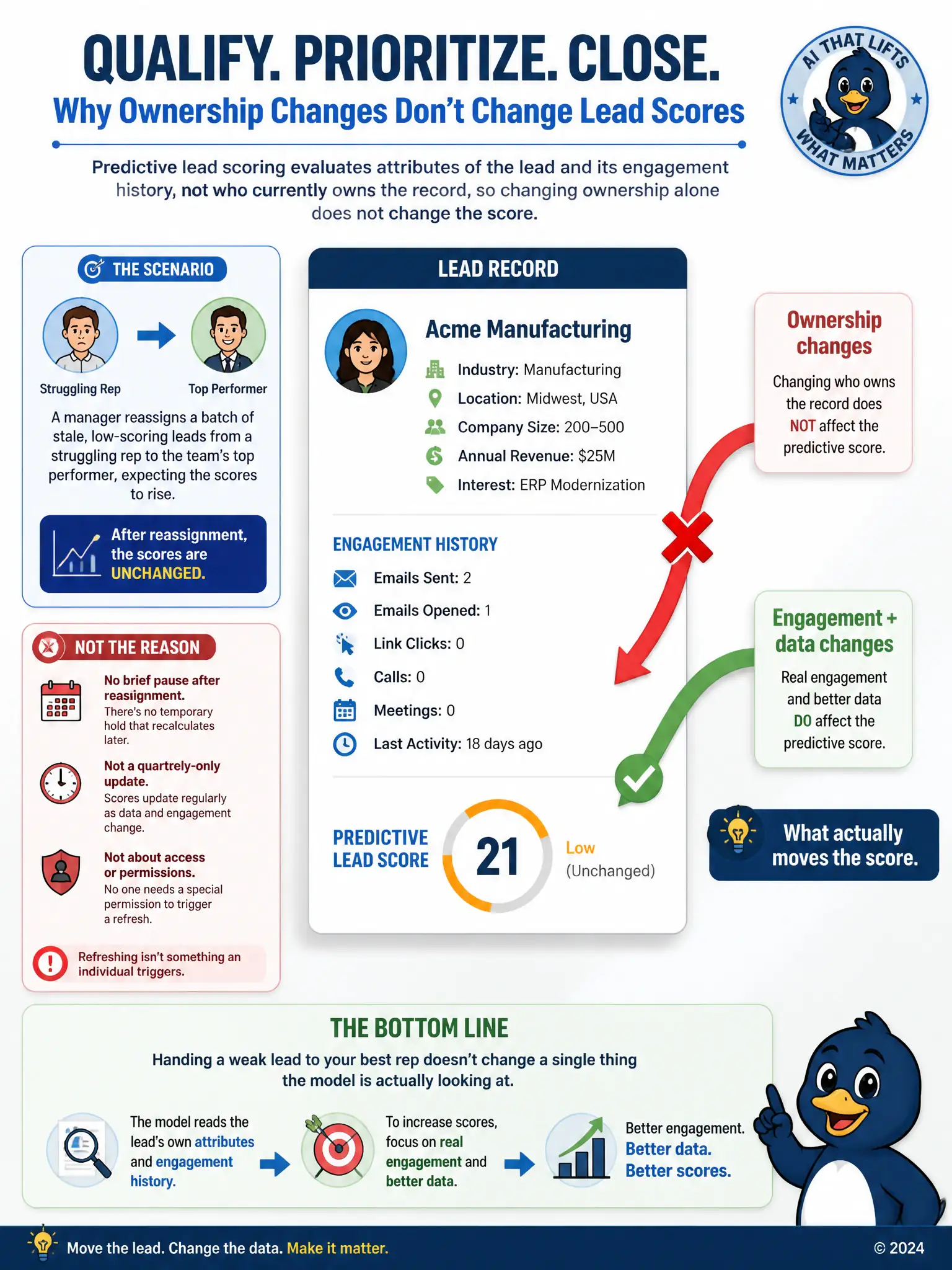
A sales manager reassigns a batch of stale, low-scoring leads from a struggling rep to the team's top performer, expecting the leads' predictive scores to rise now that a stronger seller owns them. After reassignment, the scores are unchanged. Why?
Select an answer to reveal the explanation.
Short Explanation
Handing a weak lead to your top rep doesn't change what the model sees. Predictive lead scoring reads the lead's own attributes and engagement history, not the name in the owner field, so reassignment alone won't move the score.
Full Explanation
Predictive lead scoring evaluates the attributes recorded on the lead and its history of engagement, not the identity or track record of whoever currently owns the record, so reassigning a batch of leads to a stronger performer changes who is working them without changing anything the model actually uses to calculate a score. The explanation that reassigning a lead pauses scoring for 24 hours while ownership history is recalculated is wrong because there is no 24-hour pause triggered by a change of ownership; reassignment is simply not an event the scoring process reacts to at all. The explanation that predictive scoring only recalculates once per fiscal quarter regardless of any change to the lead is wrong because scoring is not gated to a strictly quarterly cadence that ignores all other changes; while it may run on a periodic schedule rather than instantly, that schedule is not tied to fiscal quarters, and describing it as quarter-only misstates how the refresh works. The explanation that the top performer's security role does not include permission to trigger a score refresh is wrong because there is no permission-based mechanism by which a seller's security role determines whether a score refresh can be triggered; scores are calculated by the underlying system process, not initiated on demand by an individual user's access level. The manager's real lever for improving these leads' outcomes is better engagement and data quality, not reassignment alone.