
A seller logs a lengthy, promising phone call on a lead and immediately refreshes the record, expecting the predictive score to reflect the new interaction. The score is unchanged. The consultant explains this is expected because:
Select an answer to reveal the explanation.
Short Explanation
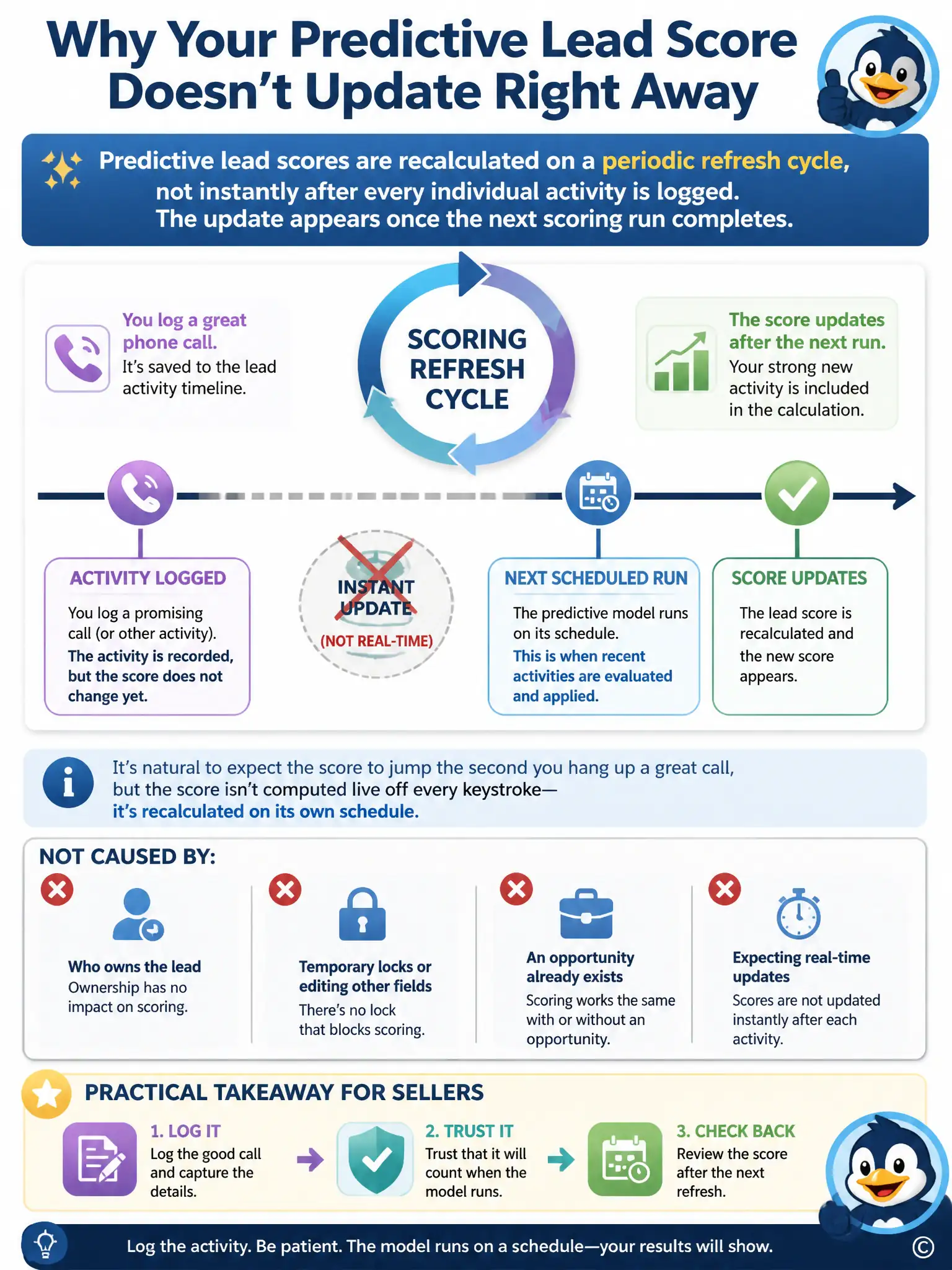
You can't expect the score to jump the second you hang up a great call. Predictive lead scores refresh on their own schedule, so the new activity gets folded in on the next scoring run. It doesn't depend on ownership, a Rating lock, or an open opportunity.
Full Explanation
The correct answer is the periodic refresh cycle explanation. Predictive lead scores are produced by a model that runs on a periodic refresh cycle rather than reacting instantly to every logged activity, so a promising phone call feeds into the next scheduled scoring run and the score updates then, not the moment the seller saves the activity. The owner-change-only claim is incorrect because reassigning ownership is not the trigger for recalculation; the model responds to changes in the underlying lead data and engagement signals over time, and an activity being logged is exactly the kind of signal that eventually factors in, just not instantaneously. The 48-hour lock after a manual Rating change is incorrect because no such lock is tied to manual Rating changes; the seller in this scenario never touched the Rating field at all, and no such lock mechanism governs when predictive scores can update. The instant-recalculation-only-with-open-opportunity claim is incorrect because predictive scoring is not gated behind the presence of an associated open opportunity; leads are scored independently of whether they have progressed that far, and the refresh timing is the same regardless. Understanding the refresh cadence helps the consultant set correct expectations with sellers who assume every action produces an immediate visible change.