
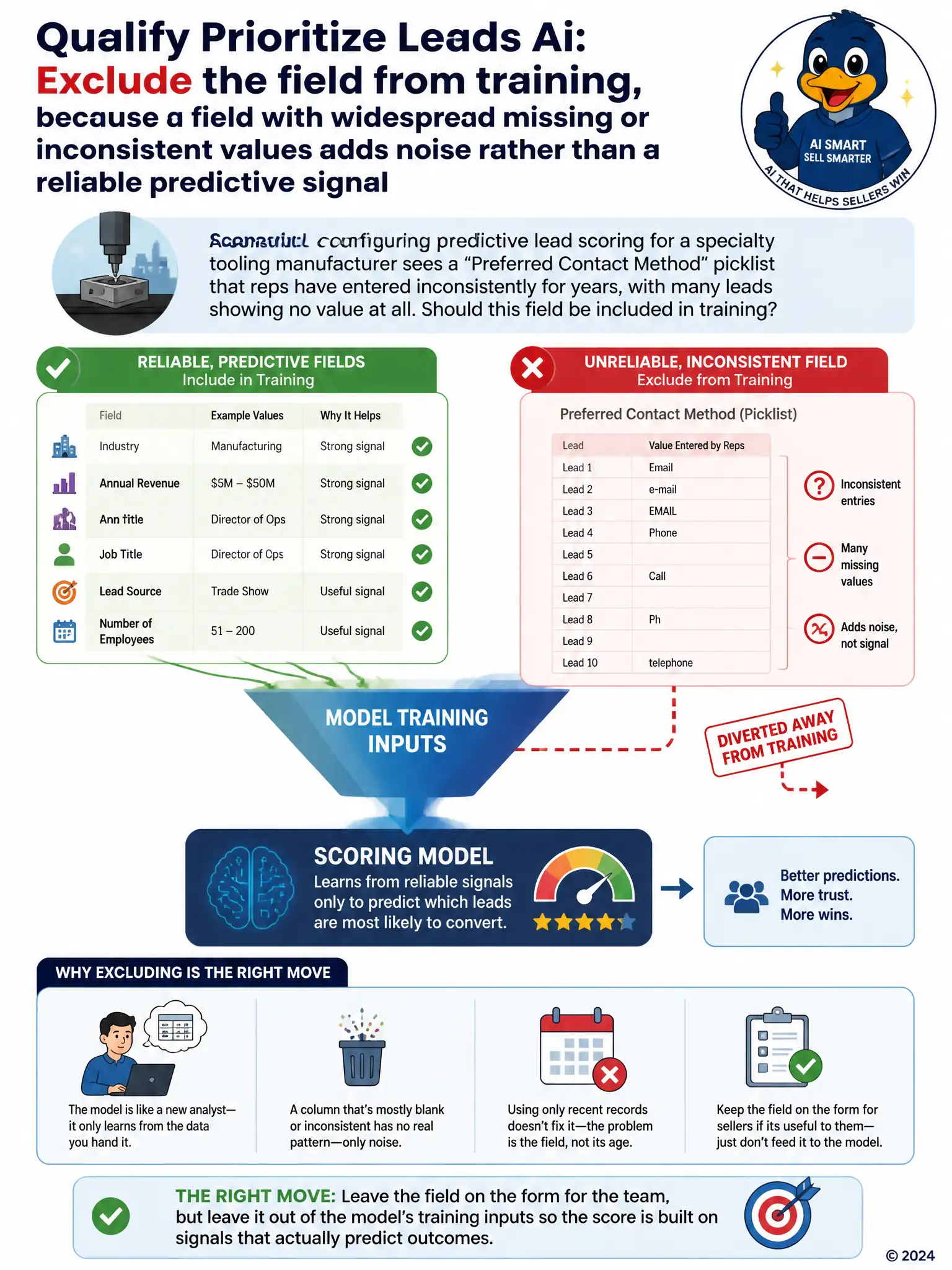
A consultant configuring predictive lead scoring for a specialty tooling manufacturer notices the wizard's field-selection step lists a 'Preferred Contact Method' picklist that sales reps have entered inconsistently for years, with many leads showing no value at all. The client asks whether to include this field when training the model. What should the consultant recommend?
Select an answer to reveal the explanation.
Short Explanation
You should leave the field out of the model's training inputs. If it's mostly blank or filled in inconsistently, it's just noise, not a reliable signal. Keep it on the form if reps want it, but don't let it drag down the score.
Full Explanation
The recommendation is to exclude the field from training because predictive lead scoring learns patterns from historical data, and a field where most leads have blank or inconsistent values does not carry a real relationship to which leads eventually convert; training on it just adds statistical noise that can drag down the model's accuracy. The option to include the field anyway is wrong because predictive scoring does not impute or fill in missing values on the training data's behalf; it works with whatever has actually been recorded, so a sparsely populated field stays sparse and unreliable. The option to include the field only for leads created in the last 30 days is wrong because field inclusion in model training is not scoped by a rolling date window tied to when the lead was created; the training window and the choice of which fields to include are separate configuration decisions, and limiting a field to recent leads does not fix the underlying inconsistency. The option to exclude the field entirely from the lead form is wrong because removing the field from the lead form entirely is an overreaction: an optional form field does not by itself degrade scoring, and reps may still have legitimate reasons to capture the value even if it should not feed the model. The fix belongs in the field-selection step of the scoring configuration, not in the form design.