
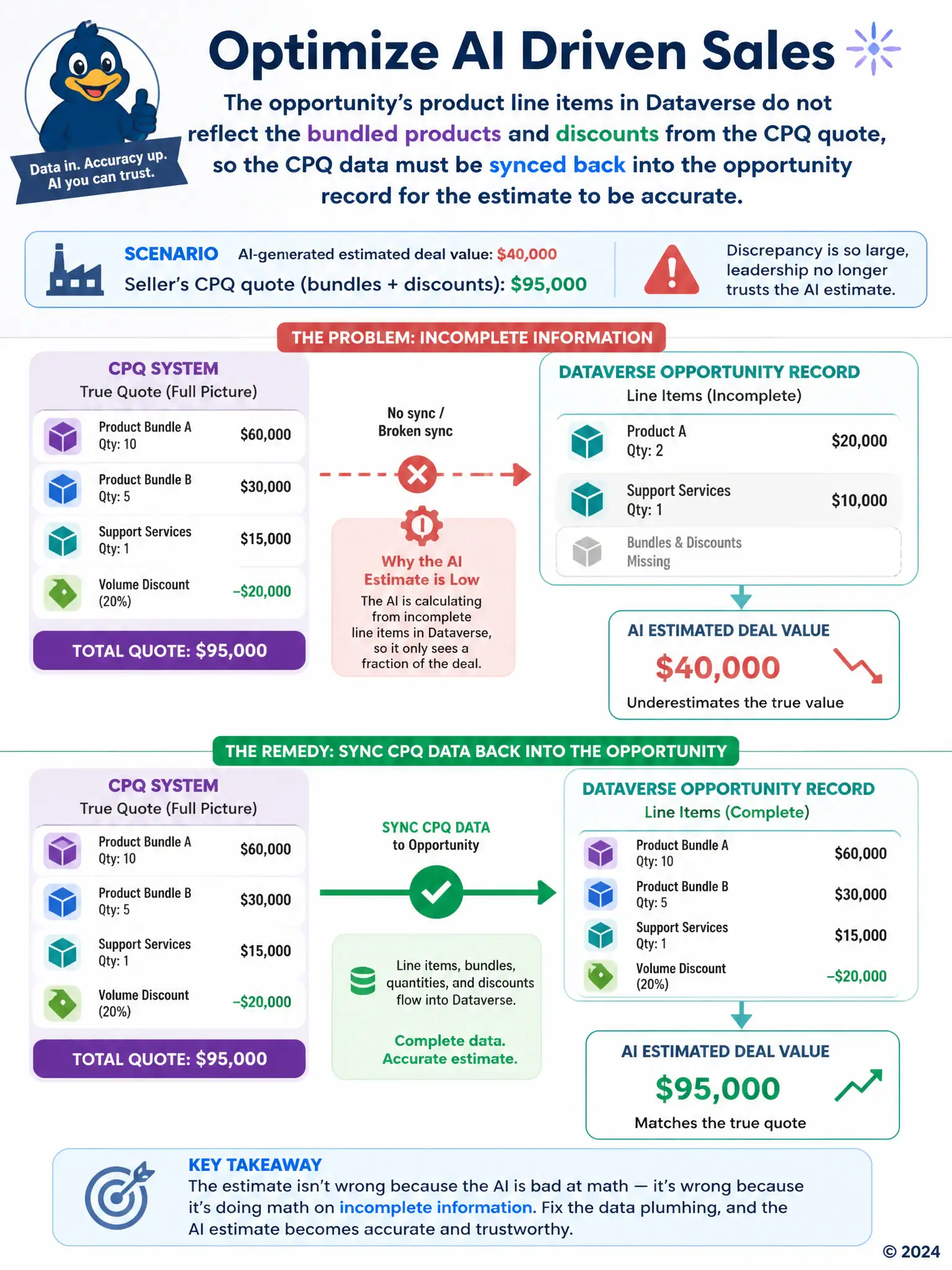
A consultant reviews an opportunity in Dynamics 365 Sales for a manufacturing client where the AI-generated estimated deal value is $40,000, but the seller's actual quote, built in a separate CPQ system, totals $95,000 once product bundles and volume discounts are applied. The discrepancy is large enough that sales leadership no longer trusts the AI-generated value on any opportunity. What is the most likely cause and correct remedy?
Select an answer to reveal the explanation.
Short Explanation
The estimate isn't wrong because the model is bad at math — it's wrong because it's doing math on incomplete information. If the real deal, bundles, discounts, and all, only exists inside a separate quoting tool and never makes it back into the opportunity's line items, you're estimating from whatever's left on the CRM side. That's a plumbing problem: get the quote data flowing back into the opportunity record, and the estimate catches up automatically.
Full Explanation
The AI-generated estimated deal value is calculated from the opportunity's product line items as recorded in Dataverse, so if the bundled products and volume discounts that make up the seller's actual $95,000 quote were built and finalized in a separate CPQ system without being synced back into the opportunity, the estimate will reflect only the partial or list-price data still on the record, producing the large gap leadership is seeing. Syncing the CPQ output back into the opportunity's line items closes that gap. The idea that the estimation model needs to be manually retrained on this specific client's historical deal sizes is incorrect because the estimation model does not require per-client manual retraining to account for a given deal's pricing; the issue here is missing input data, not an untrained model. The idea that estimated deal value should be disabled organization-wide is incorrect because concluding the feature only works for simple, non-discounted deals overgeneralizes from one data-sync failure and discards a capability that works correctly once line items are complete. The idea that the seller must manually overwrite the estimated value field on every opportunity going forward is incorrect because having sellers manually overwrite the estimated value field on every opportunity is not sustainable across a full pipeline and does not fix the underlying integration gap causing the mismatch.