
A distributor completes an acquisition of a smaller competitor and merges its customer base into the parent company's Dynamics 365 Sales environment. The acquired unit has only three months of deal history in the system. Within weeks, the AI-driven opportunity scoring model begins assigning most of the acquired unit's opportunities a score near the middle of the range, regardless of deal specifics, while scores for the parent company's long-established pipeline remain sharply differentiated. A consultant is asked why the acquired unit's scores are not useful for prioritization. What should the consultant recommend?
Select an answer to reveal the explanation.
Short Explanation
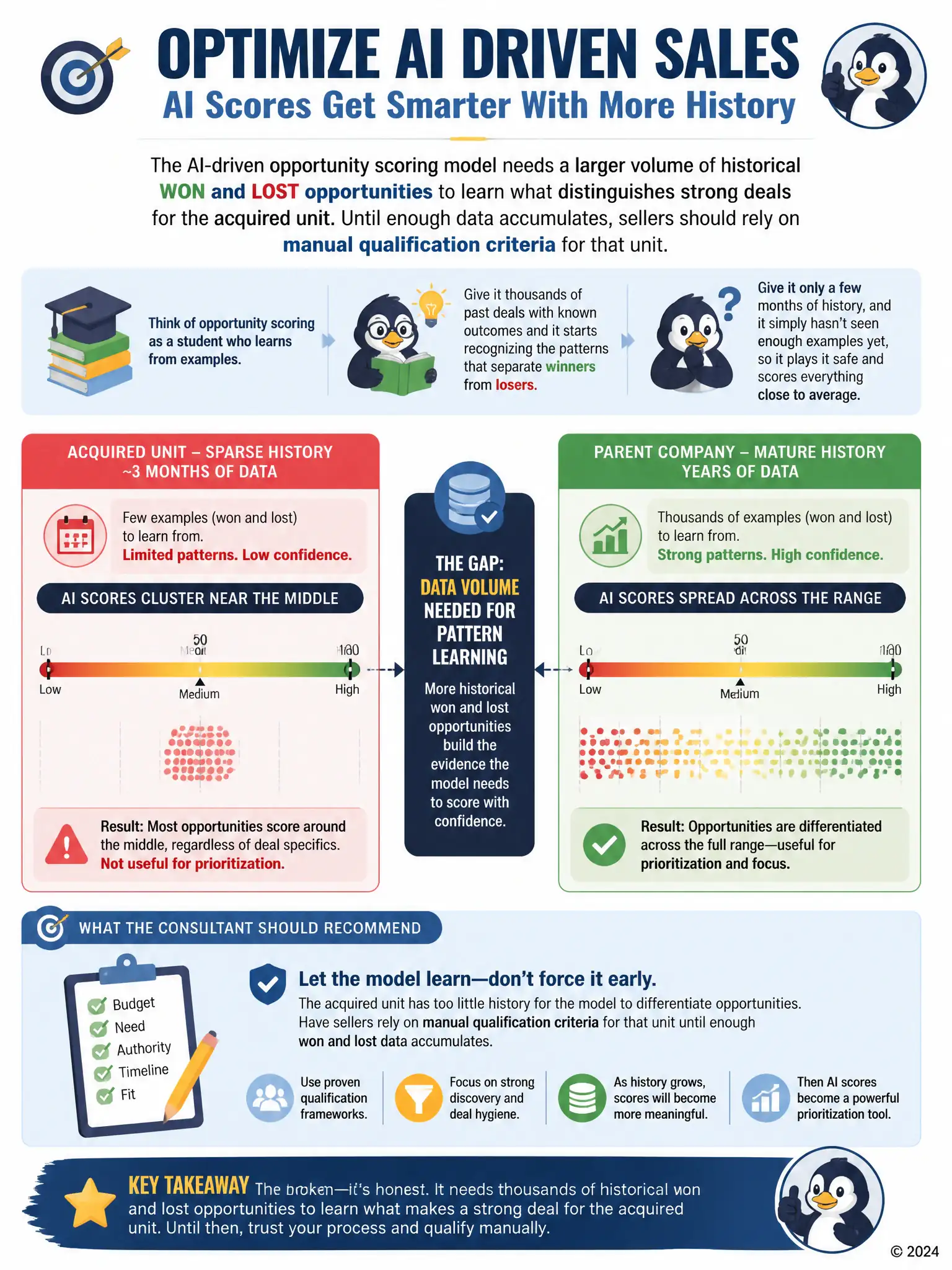
Think of opportunity scoring as a student who learns from examples. Give it thousands of past deals with known outcomes and it starts recognizing patterns that separate winners from losers. With only three months of history, the acquired unit hasn't given it enough examples, so scores cluster near average; you should let sellers use manual qualification until enough data builds up.
Full Explanation
The correct recommendation is to explain that the model needs a larger volume of historical won and lost opportunities to learn what distinguishes strong deals for the acquired unit, and to have sellers rely on manual qualification criteria for that unit until enough data accumulates. AI-driven opportunity scoring learns to differentiate strong and weak deals by finding patterns in a large set of historical won and lost opportunities. With only three months of history, the acquired unit has not yet given the model enough examples to learn what separates a deal likely to close from one unlikely to close, so scores cluster near the middle rather than spreading out. The consultant should explain this data-volume limitation and recommend that sellers on the acquired unit fall back on manual qualification criteria until enough deal history accumulates for the model to produce meaningful differentiation. Retraining the scoring model immediately using only the acquired unit's three months of opportunity history is incorrect because retraining on only three months of data does not solve a cold-start problem; the model still lacks the volume of outcomes needed to learn reliable patterns, so retraining now would not improve the acquired unit's scores. Disabling AI-driven opportunity scoring across the entire Dynamics 365 Sales environment until the acquired unit's pipeline has caught up in volume is incorrect because the parent company's long-established pipeline is already producing useful, differentiated scores, and disabling scoring organization-wide would remove value from users where the model is working. Manually assigning a fixed opportunity score to every acquired-unit record so sellers see consistent numbers until the issue is resolved is incorrect because assigning every acquired-unit record the same fixed score removes the value of scoring entirely and gives sellers no prioritization signal at all, which is worse than acknowledging the limitation and using manual criteria in the interim.