
A consultant is preparing to enable AI-driven opportunity scoring for a sales organization that has just migrated to Dynamics 365 Sales from a legacy CRM. Before turning the feature on, the consultant checks the environment against Microsoft's stated prerequisites. (Select TWO.) Which two conditions must be met for the scoring model to function reliably?
Select all correct answers, then click Submit.
Short Explanation
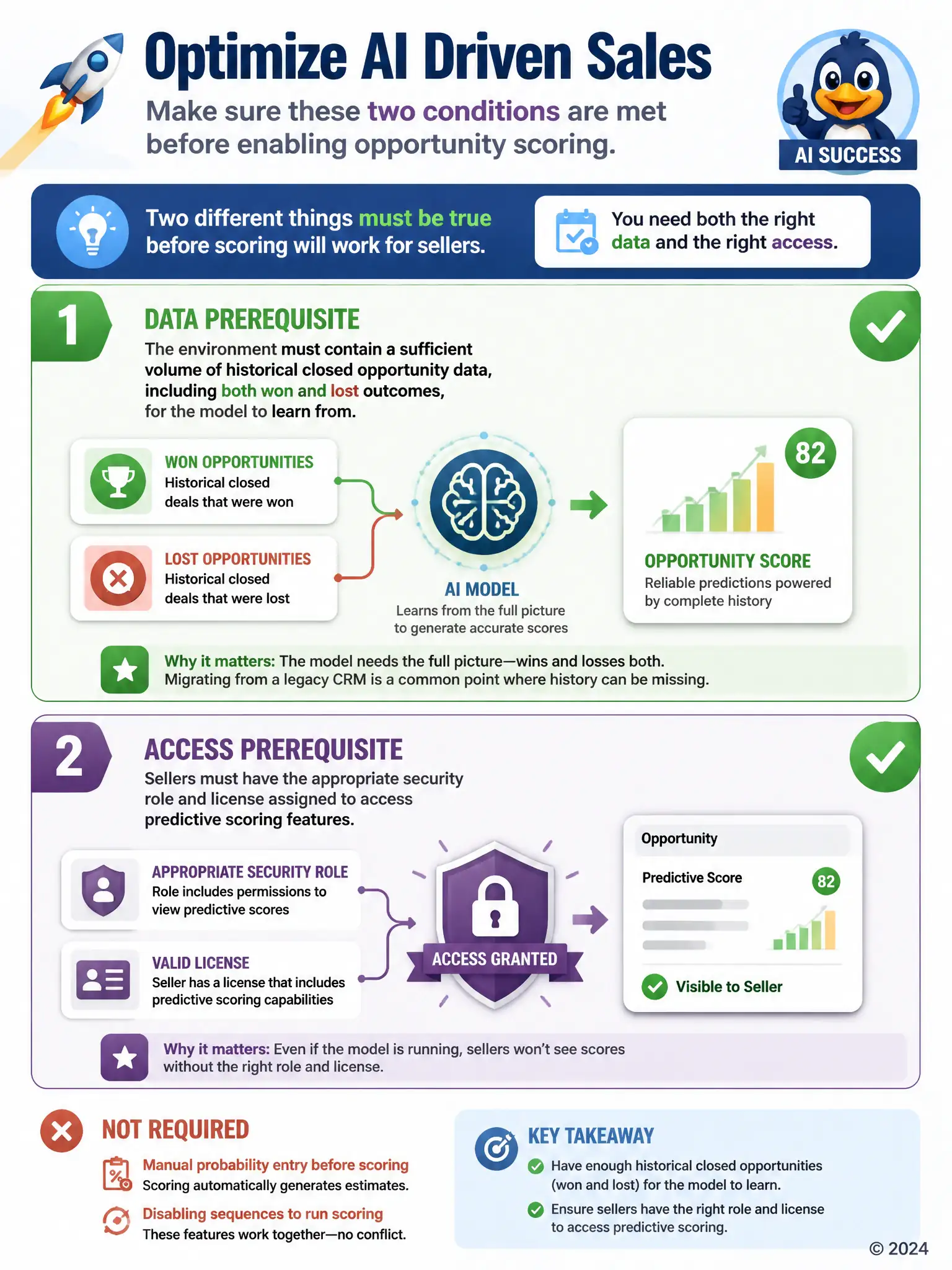
You need enough closed-won and closed-lost opportunity history for the model to learn from, especially after a migration. You also need sellers to have the right security role and license, or they won't see the scores. You don't need to disable sequences or make everyone hand-enter probability before scoring works.
Full Explanation
The two conditions are that the environment must contain a sufficient volume of historical closed opportunity data, including both won and lost outcomes, for the model to learn from, and that sellers must have the appropriate security role and license assigned to access predictive scoring features. AI-driven opportunity scoring learns patterns from historical outcomes, so it needs a sufficient volume of closed opportunities, spanning both wins and losses, to identify what separates a deal likely to close from one likely to stall; without that history the model has nothing reliable to learn from, which is a real risk right after a migration from a legacy CRM where that history may not have carried over cleanly. Separately, predictive scoring is a feature gated by security role and license assignment, so sellers who lack the appropriate role or license will not see scoring even once the model itself is functioning. The condition that every open opportunity must have a manually assigned probability-to-close percentage before scoring can activate is incorrect because opportunity scoring is generated by the model itself and does not require every open opportunity to already carry a manually assigned probability-to-close percentage as a precondition; requiring that would defeat the purpose of automated scoring. The condition that the organization must disable Sales Accelerator sequences so scoring calculations do not conflict with sequence logic is incorrect because Sales Accelerator sequences and opportunity scoring operate independently and are not in conflict, so there is no reason to disable one to enable the other, and no such prerequisite exists in the product.