
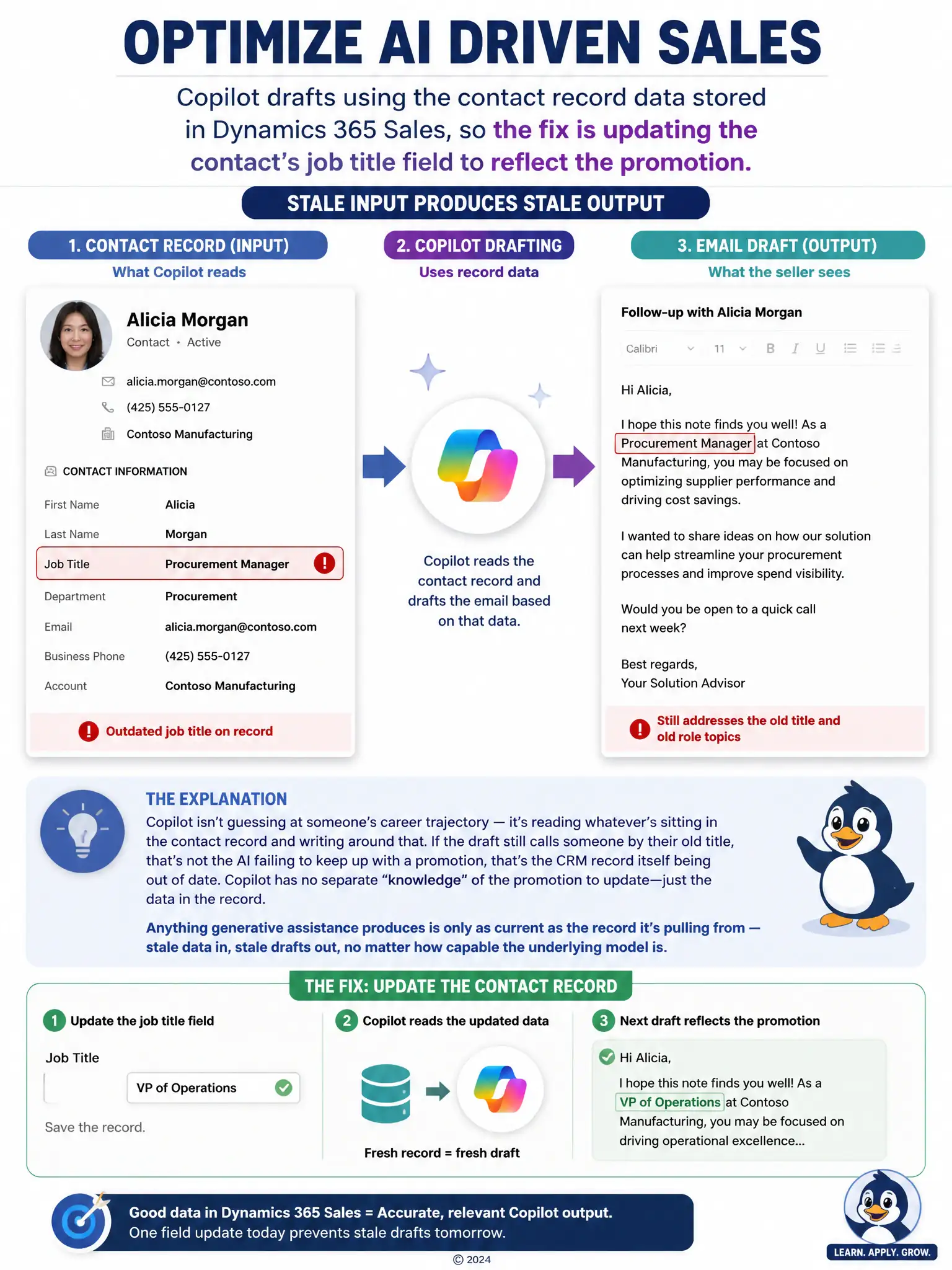
A seller uses Copilot's email drafting assistance to write a follow-up to a contact who was recently promoted from Procurement Manager to VP of Operations. The generated draft still addresses the contact as 'Procurement Manager' and references topics relevant to the old role. The seller reports this to a consultant, believing Copilot's language model is unable to track career changes. What is the most accurate explanation and fix?
Select an answer to reveal the explanation.
Short Explanation
Copilot isn't guessing at someone's career trajectory — it's reading whatever's sitting in the contact record and writing around that. If the draft still calls someone by their old title, you're not dealing with an AI that can't keep up with a promotion; you're dealing with a stale CRM record. Update the job title field, and the very next draft reflects reality, because there was never a separate knowledge of the promotion to update, just a data point.
Full Explanation
The accurate explanation is that Copilot's email drafting assistance generates content using the contact and account information stored in Dynamics 365 Sales, so an outdated job title in a draft reflects a stale contact record rather than a limitation in the generative model's reasoning. Updating the contact's job title field is the direct fix, and it will also correct future drafts, summaries, and any other Copilot output referencing that field. The explanation that Copilot's generative model needs retraining on the account's industry vertical before it can recognize title changes is incorrect because Copilot does not require per-industry retraining to recognize a title change; it reads current record data at generation time rather than learning static facts about a role through a training process. The explanation that the organization must purchase an additional Copilot license tier that includes real-time LinkedIn synchronization is incorrect because there is no separate licensing tier for real-time LinkedIn synchronization within this workflow, and inventing one misdiagnoses a data-entry gap as a licensing gap. The explanation that email drafting assistance should be disabled for this contact until the next scheduled data refresh cycle is incorrect because disabling drafting assistance for the contact removes a useful capability without addressing the actual problem, and waiting for a scheduled refresh cycle delays a fix that a simple field update resolves immediately.