
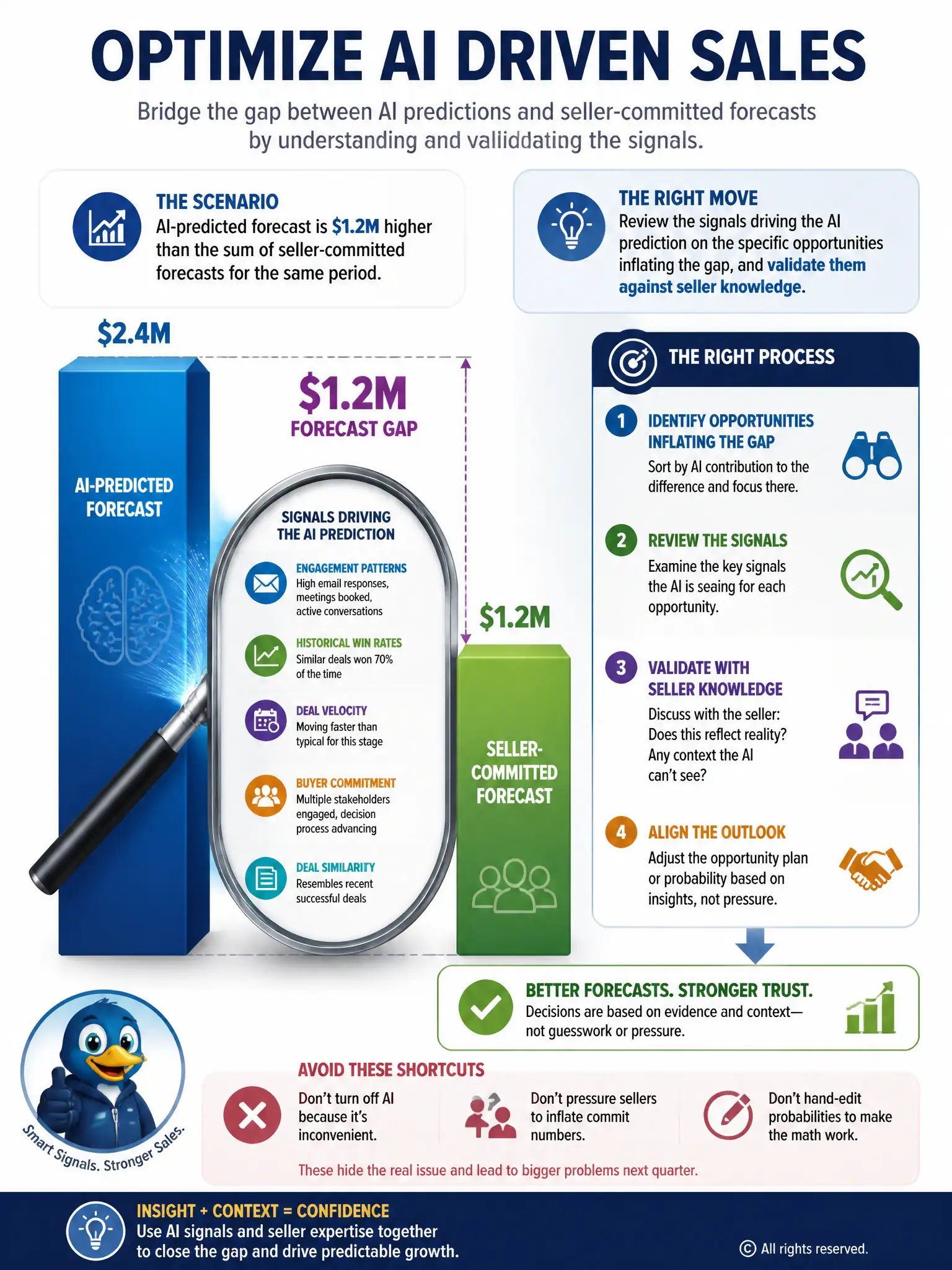
A sales director notices that the Dynamics 365 Sales AI-predicted forecast for a business unit totals $1.2 million higher than the sum of what individual sellers marked as their committed forecast category for the same period. Several sellers say their committed numbers are accurate and reflect deals they are confident will close. The director asks a consultant how to reconcile this without simply telling sellers to raise their commit numbers. What should the consultant recommend?
Select an answer to reveal the explanation.
Short Explanation
When the machine's number and the human's number don't match, don't pick sides. Review the signals driving the prediction on the deals inflating the gap, like engagement patterns and historical win rates, and validate them against what sellers know. That tells you whether the model caught real momentum or is leaning too hard on patterns that don't fit.
Full Explanation
The correct recommendation is to review the signals, such as engagement patterns and historical win rates for similar deals, driving the predictive forecast on the specific opportunities inflating the gap, and validate them against seller knowledge. When machine-predicted forecasts diverge sharply from seller-committed numbers, the productive path is to examine which specific opportunities are driving the gap and what signals the model is weighing on those deals, then compare that against what sellers actually know about the account. This surfaces whether the model is catching real momentum sellers have not yet logged, or whether it is overweighting patterns that don't apply here, letting the director act on evidence rather than gut feel. The recommendation to disable predictive forecasting entirely is incorrect because it discards signals that may be catching genuine deal movement sellers haven't recorded, and does nothing to explain the current gap. The recommendation to instruct sellers to move more opportunities into the committed category is incorrect because pressuring sellers to inflate their committed numbers to match the machine figure risks creating inaccurate commitments that will look worse when deals slip, rather than resolving the underlying disagreement. The recommendation to increase the opportunity close probability field manually on each deal until totals align is incorrect because manually adjusting close probability fields to force alignment manipulates the data rather than investigating why the model and the sellers disagree, and provides no lasting reconciliation process.