
A consultant builds a custom AI Builder prediction model to score leads based on the client's unique qualification criteria and successfully trains it in a sandbox environment. When the consultant tries to publish the model to the production environment, the operation fails with a capacity error. What is the most likely configuration gap?
Select an answer to reveal the explanation.
Short Explanation
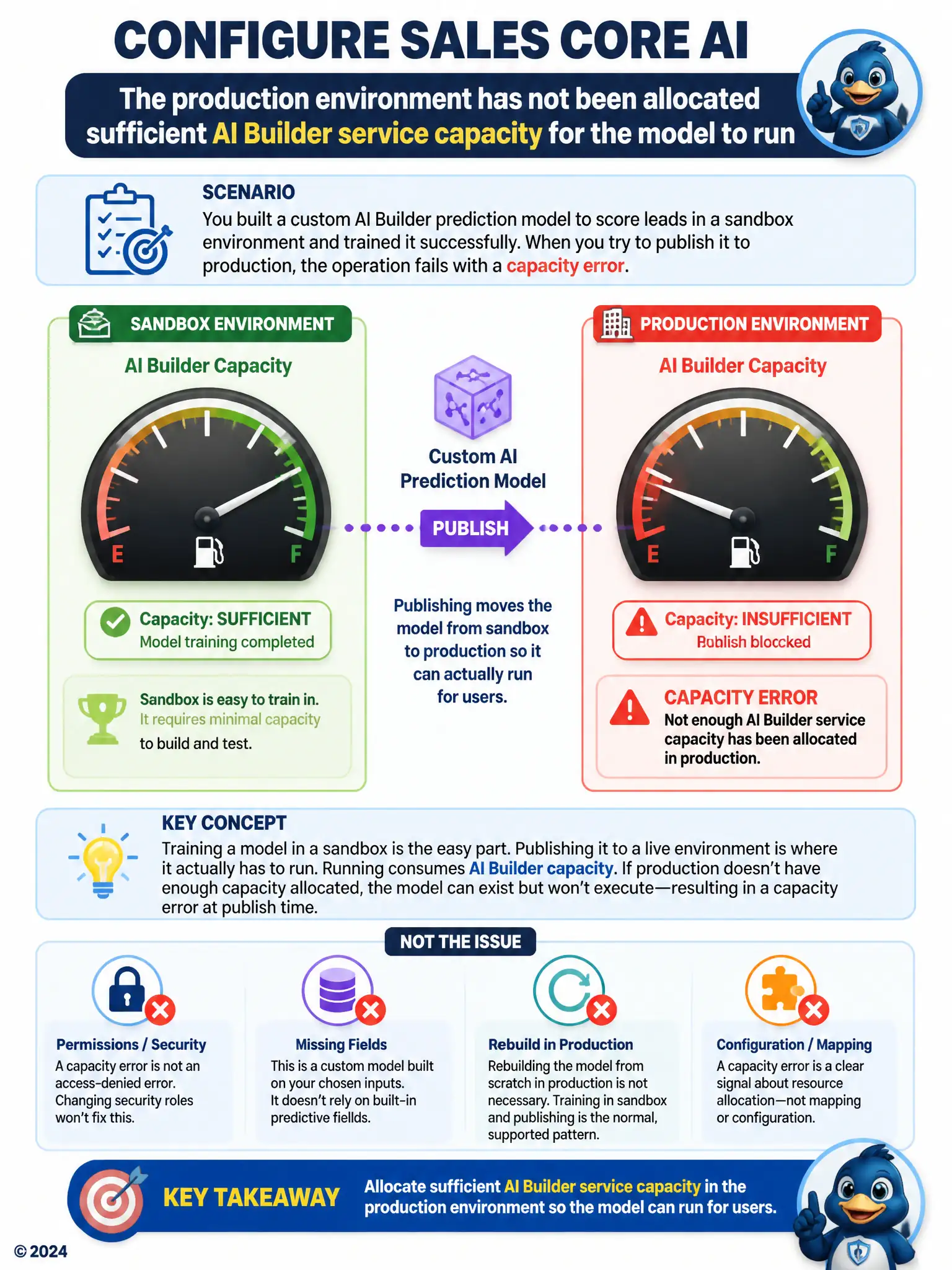
Training in a sandbox is the easy part—publishing is where the model actually has to run. If production hasn't been allocated enough AI Builder capacity, it'll let the model exist but refuse to execute it, throwing a capacity error. So check the production environment's AI Builder capacity allocation.
Full Explanation
The correct answer is that the production environment has not been allocated sufficient AI Builder service capacity for the model to run. Publishing an AI Builder model to run in a given environment requires that environment to have sufficient AI Builder service capacity allocated to it; a sandbox used purely for training and testing may not have been provisioned with the same capacity as production. When the model is published to production without adequate capacity, the operation fails specifically with a capacity error, which matches what is described. The fix is to allocate or purchase additional AI Builder capacity for the production environment. The idea that the custom model was trained in the wrong environment and must be rebuilt directly in production is incorrect because training a model in one environment and publishing it to another is a normal, supported workflow; nothing requires rebuilding the model directly in production. The idea that the lead entity is missing the out-of-the-box predictive lead scoring fields required by AI Builder is incorrect because a custom AI Builder model trained on the client's own qualification criteria is built around whatever fields the consultant selected during training, not the out-of-the-box predictive lead scoring fields, so their absence would not cause this failure. The idea that the consultant's security role lacks the System Administrator privilege needed to publish models is incorrect because insufficient privileges typically surface as an access-denied or permissions error rather than a capacity error, and the scenario explicitly describes a capacity failure.