
A consultant enables Dynamics 365 Sales Premium's predictive opportunity scoring feature in a newly provisioned environment that has been live for three weeks. The environment already contains 60 open opportunities actively being worked, but the scoring column on the opportunity list still shows 'Insufficient data' for every record. What should the consultant do to get the model producing scores?
Select an answer to reveal the explanation.
Short Explanation
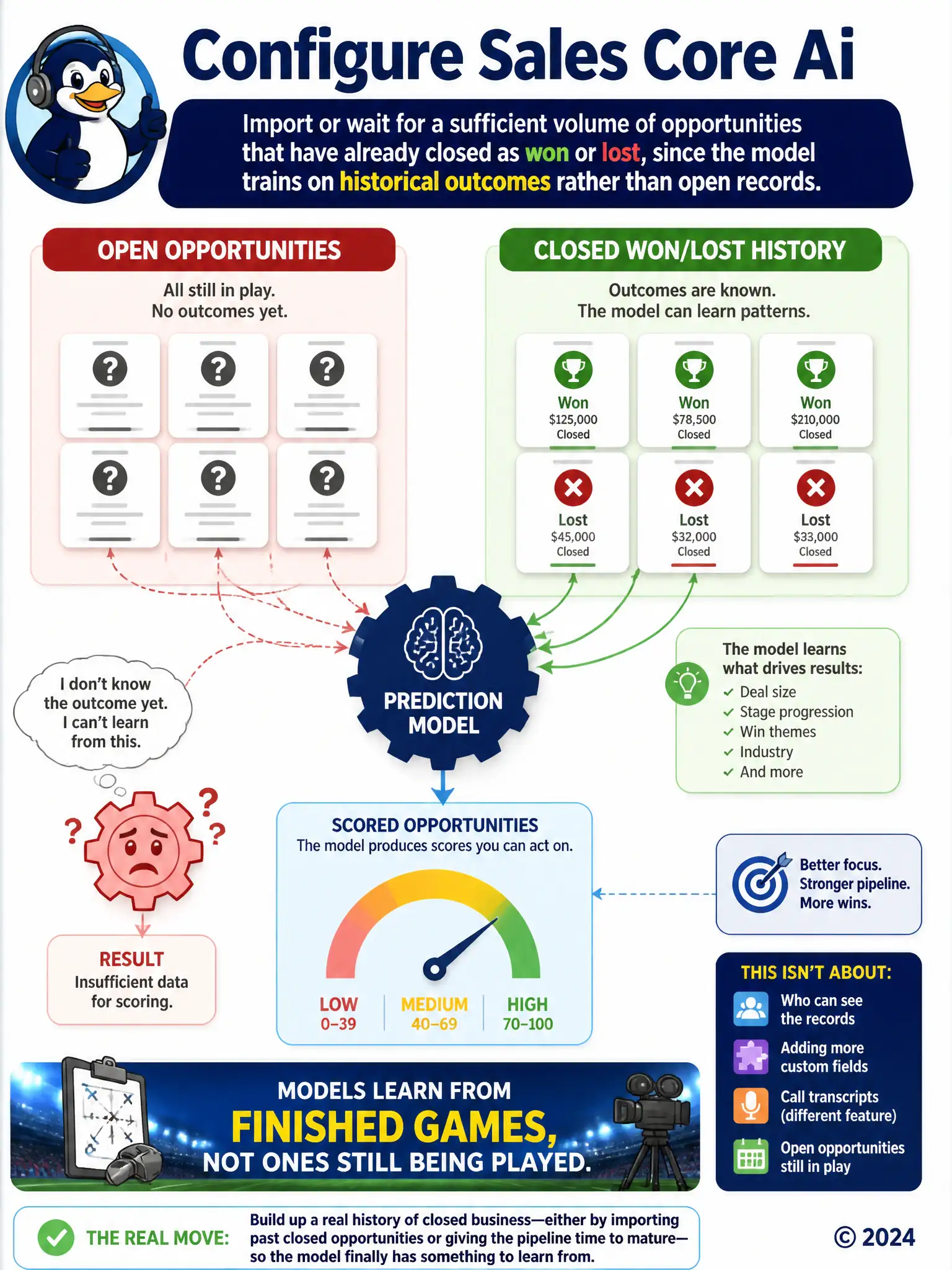
The scoring model needs finished deals to learn from, not just open opportunities. Import past closed-won or closed-lost opportunities, or wait until enough of your current pipeline closes. Extra access, custom fields, or call transcripts won't create the history the model needs.
Full Explanation
The correct approach is to import or wait for a sufficient volume of opportunities that have already closed as won or lost, because predictive opportunity scoring is a supervised model: it learns which combination of attributes tends to precede a win versus a loss, which means it needs a meaningful volume of opportunities that have already been closed as won or lost. An environment with sixty open opportunities and no closed history gives the model nothing to train on, so every record shows as insufficient data regardless of how active the pipeline looks. The fix is to build up that closed-opportunity history, either by importing historical closed records from the client's prior system or by letting the new pipeline mature until enough deals have closed. The security-role option is incorrect because security roles control who can see or edit records, not what data the scoring model has available to train on; granting broader access does not create closed-opportunity history. The custom-fields option is incorrect because adding custom fields increases the number of signals available on open records but does nothing to supply the labeled outcomes the model actually needs to learn from. The Conversation Intelligence option is incorrect because Conversation Intelligence analyzes call recordings and transcripts for a separate set of signals; predictive opportunity scoring is based on opportunity record attributes and historical outcomes, not on whether calls have been transcribed.