
A consultant is building a custom Copilot Studio topic that lets prospects on a self-service portal ask configuration-dependent pricing questions, such as how price changes when they add optional modules. The pricing logic depends on a multi-step calculation involving base price, module surcharges, and volume tiers that live in a connected pricing engine, not in a simple lookup table. What is the most effective way to structure this topic?
Select an answer to reveal the explanation.
Short Explanation
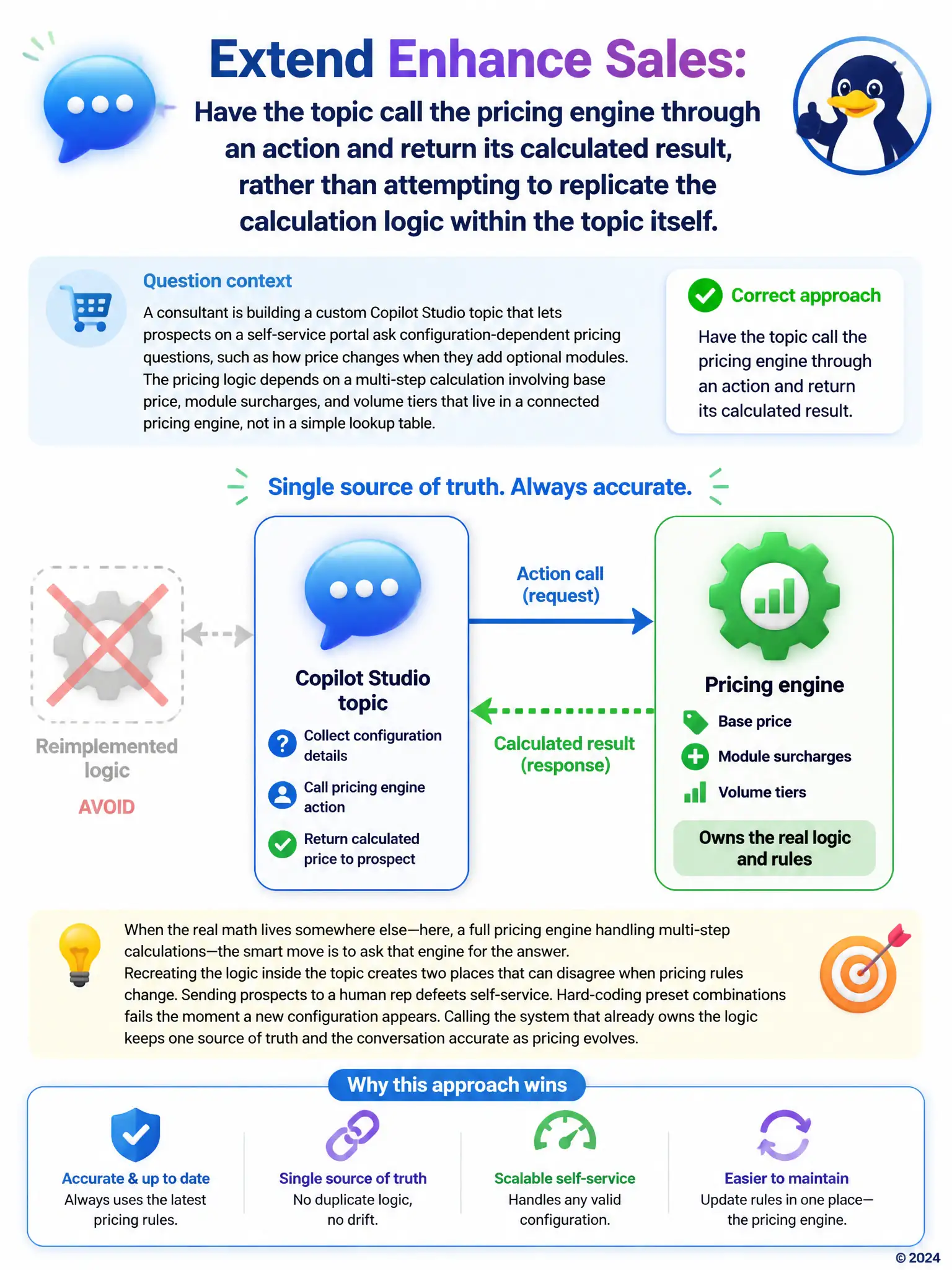
When the pricing math lives in a connected pricing engine, you should have the topic call that engine through an action and return its result. Don’t rebuild the calculation inside the chat flow, because then you’ve got two places that can drift apart. Keep one source of truth so the answers stay accurate as pricing changes.
Full Explanation
The most effective structure is to have the topic call the pricing engine through an action and return its calculated result, rather than attempting to replicate the calculation logic within the topic itself. Since the pricing logic is genuinely multi-step and lives in a connected pricing engine, the topic should surface the engine’s result and keep the calculation logic in the single system designed to own it, ensuring answers stay accurate as pricing rules change. The option that reimplements base price, surcharge, and volume tier logic inside the topic is incorrect because it duplicates business logic in a second place, creating a maintenance burden and a real risk that the two calculations drift out of sync over time. The option that tells every prospect to contact a sales rep for any pricing question involving modules is incorrect because it abandons the stated goal of self-service pricing answers, pushing every configuration question back to a human rep and defeating the purpose of building the topic at all. The option that hard-codes a small set of common module combinations and their resulting prices directly into the topic’s response text is incorrect because it cannot scale to the full range of module and volume-tier permutations, and it will silently produce wrong or missing answers as soon as a prospect’s configuration falls outside the hard-coded set.