
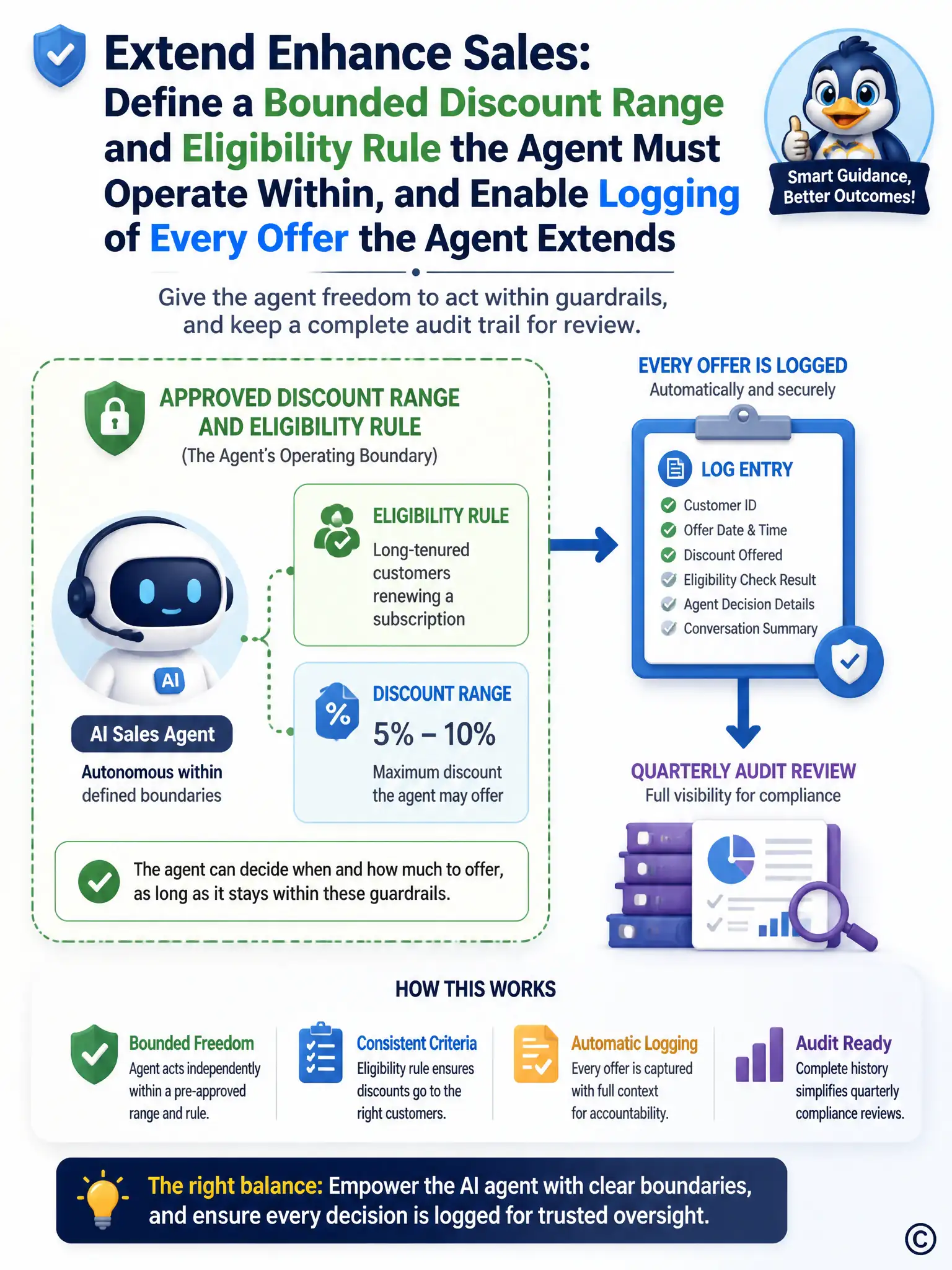
An organization piloting an autonomous AI seller agent wants the agent to independently offer a small loyalty discount to long-tenured customers renewing a subscription, but only within a pre-approved range, and wants every offer logged for a quarterly compliance audit. Which configuration achieves this while keeping the agent's discretion bounded?
Select an answer to reveal the explanation.
Short Explanation
You want the agent to act on its own inside a fenced-in discount range and eligibility rule, with every offer logged for audit. That keeps discretion bounded and gives you a paper trail. Free rein, manager sign-off on every offer, or no discounting don't meet the ask.
Full Explanation
The correct configuration is the one that defines a bounded discount range and eligibility rule the agent must operate within, and enables logging of every offer the agent extends for later review. This constrains the agent's autonomy to exactly the scope the organization approved, and it satisfies the requirement for a quarterly audit trail without adding a human bottleneck to each transaction. The unrestricted discount authority option is incorrect because relying on customers to report discounts they consider unfair provides no bound on the agent's behavior in advance and no systematic audit record. The real-time manager approval option is incorrect because requiring approval before every offer removes the autonomy the organization is piloting, turning the pilot into a human-approval workflow rather than an autonomous agent operating within guardrails. The disable discounting option is incorrect because routing all renewal offers through a human rep abandons the pilot's stated goal of having the agent independently extend loyalty discounts, rather than achieving it within safe bounds.