
A consultant is enhancing the Sales Qualification Agent for a subscription-box retailer. Marketing wants leads who abandon checkout after adding a promo code to be scored higher than leads who abandon without one, because promo-code abandoners convert at twice the rate once re-engaged. The retailer's e-commerce platform is not connected to Dataverse, and the abandonment event lives only in that platform's own event log. What should the consultant do first to make this signal usable by the agent?
Select an answer to reveal the explanation.
Short Explanation
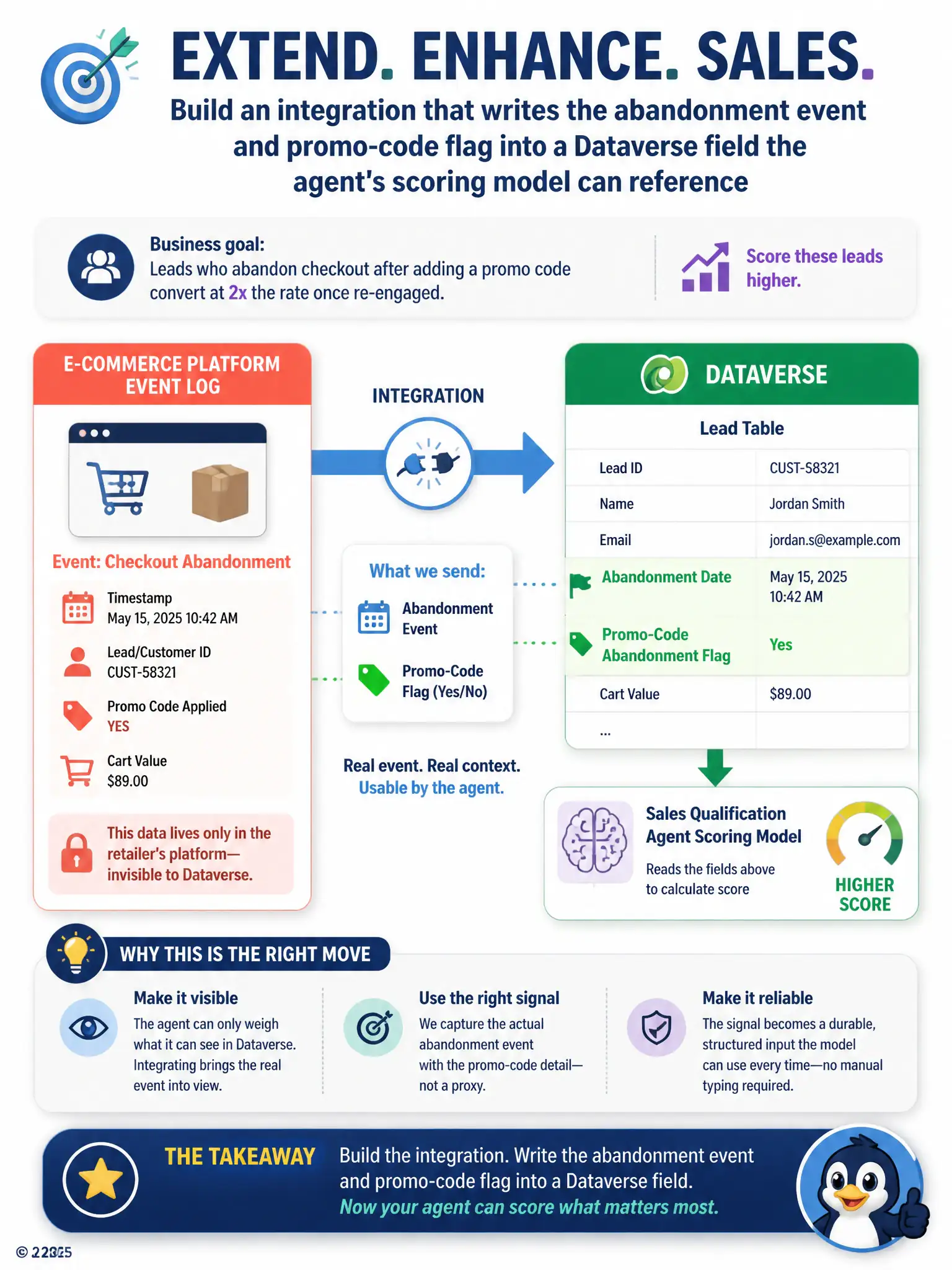
The agent can only score what it can see in Dataverse, so you need to pipe the promo-code abandonment event into a Dataverse field it can read. Don't make reps remember it or swap in a vague proxy; integrate the real signal so it's structured and durable.
Full Explanation
The correct choice is to build an integration that writes the abandonment event and promo-code flag into a Dataverse field the agent's scoring model can reference. The Sales Qualification Agent scores leads using signals available in Dataverse; a promo-code abandonment event that lives only in the e-commerce platform's event log is invisible to the model until it is integrated. Writing the event and flag into a Dataverse field the scoring model can reference makes the signal a durable, queryable input rather than something the agent has to infer indirectly. The manual flagging approach is incorrect because manual flagging by reps is unreliable at volume, introduces inconsistent tagging, and does not scale as a data pipeline the way an integration does. The email engagement weighting approach is incorrect because email engagement is a proxy at best; substituting a loosely correlated signal for the actual promo-code event discards the specific business insight marketing identified and produces a noisier score. The Copilot Studio topic approach is incorrect because a Copilot Studio topic that interrogates the rep during a conversation does not solve the underlying data-availability problem for the scoring model itself, and it adds friction for something that should be captured automatically from the e-commerce event rather than recalled by a human.