
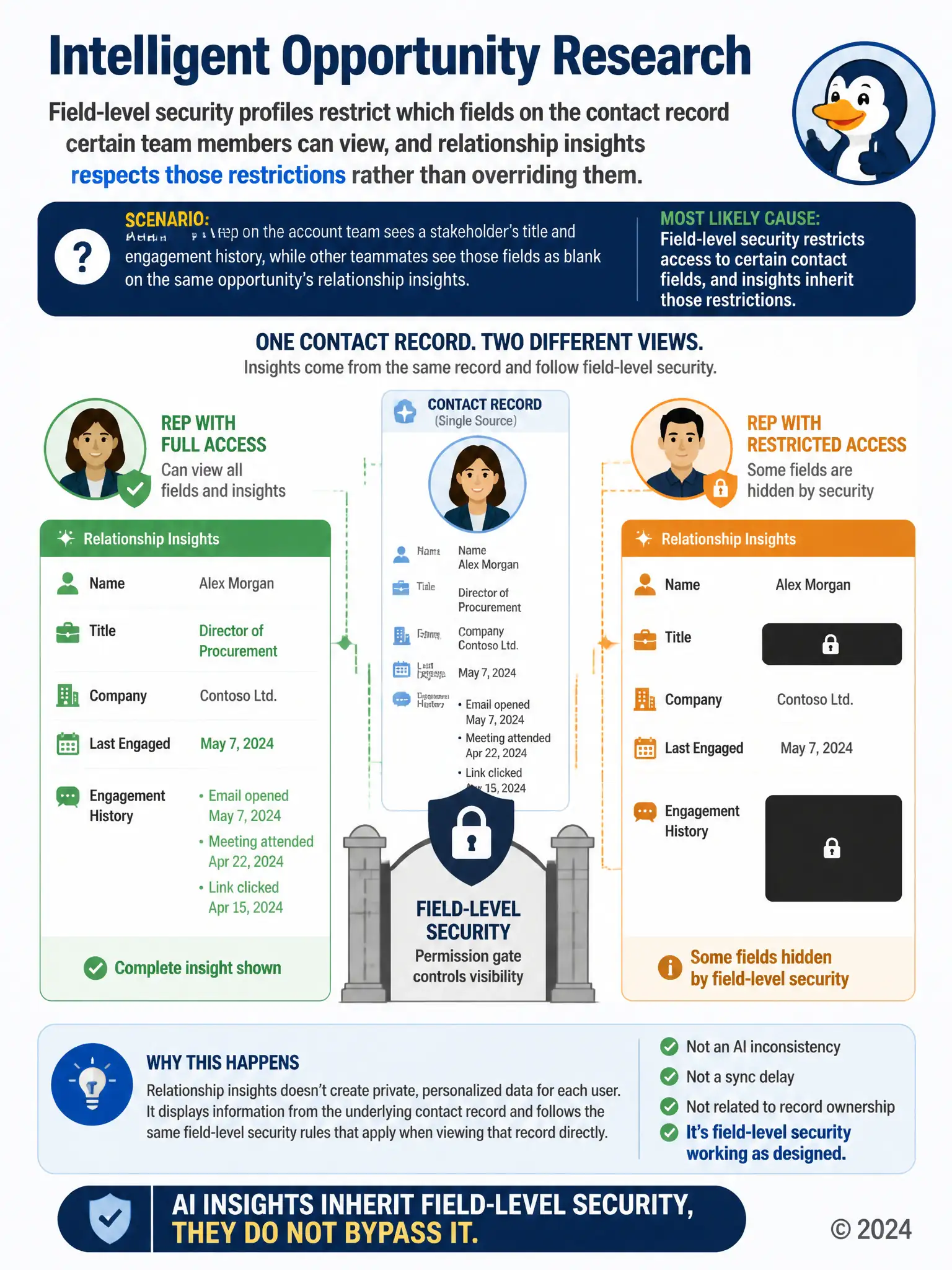
A consultant configures relationship insights so an account team can see which stakeholders are actively engaged on a strategic opportunity. After rollout, a rep on the account team reports that a stakeholder's title and engagement history are visible to some teammates but blank for others viewing the same opportunity record. What is the most likely cause?
Select an answer to reveal the explanation.
Short Explanation
When you see the same insight look different depending on who's viewing it, suspect field-level security, not feature inconsistency. Relationship insights doesn't build a private view from each rep's own call history or wait for indexing; it respects the contact record's field permissions, so restricted fields stay blank for users who can't see them.
Full Explanation
The likely cause is that field-level security profiles restrict which fields on the contact record certain team members can view, and relationship insights respects those restrictions rather than overriding them. Relationship insights surfaces engagement patterns and contact details it derives from underlying Dataverse records, and it honors the same field-level security profiles applied to those records. If certain fields on the contact, such as title or engagement history, are restricted for some team members through field-level security, those fields will appear blank to them even though the insight itself was calculated correctly, while teammates with broader field access see the full picture. The idea that relationship insights recalculates independently for each user based on that individual's personal call history with the stakeholder is incorrect because relationship insights is not a personalized calculation per viewer's own call history; it draws on the account team's shared captured data, not a private view. The suggestion that the stakeholder's record has not finished indexing for teammates who see blank fields and will populate within a day is incorrect because there is no indexing delay mechanism described here that would explain a permanent, consistent blank field for specific users rather than a temporary one for everyone. The claim that relationship insights only displays stakeholder details to users who are listed as the opportunity owner is incorrect because visibility is not restricted to the opportunity owner; multiple account team members can see relationship insights, and ownership is not the access control at play, field-level security is.