
A field sales team uses a sales accelerator sequence for enterprise prospects. A consultant adds a step that pauses the sequence for seven days once a prospect replies with 'not right now, check back later.' The manager wants reps notified only if the prospect has not engaged again through any channel by day seven, but not to lose the lead from active tracking during the pause. Which configuration meets this requirement?
Select an answer to reveal the explanation.
Short Explanation
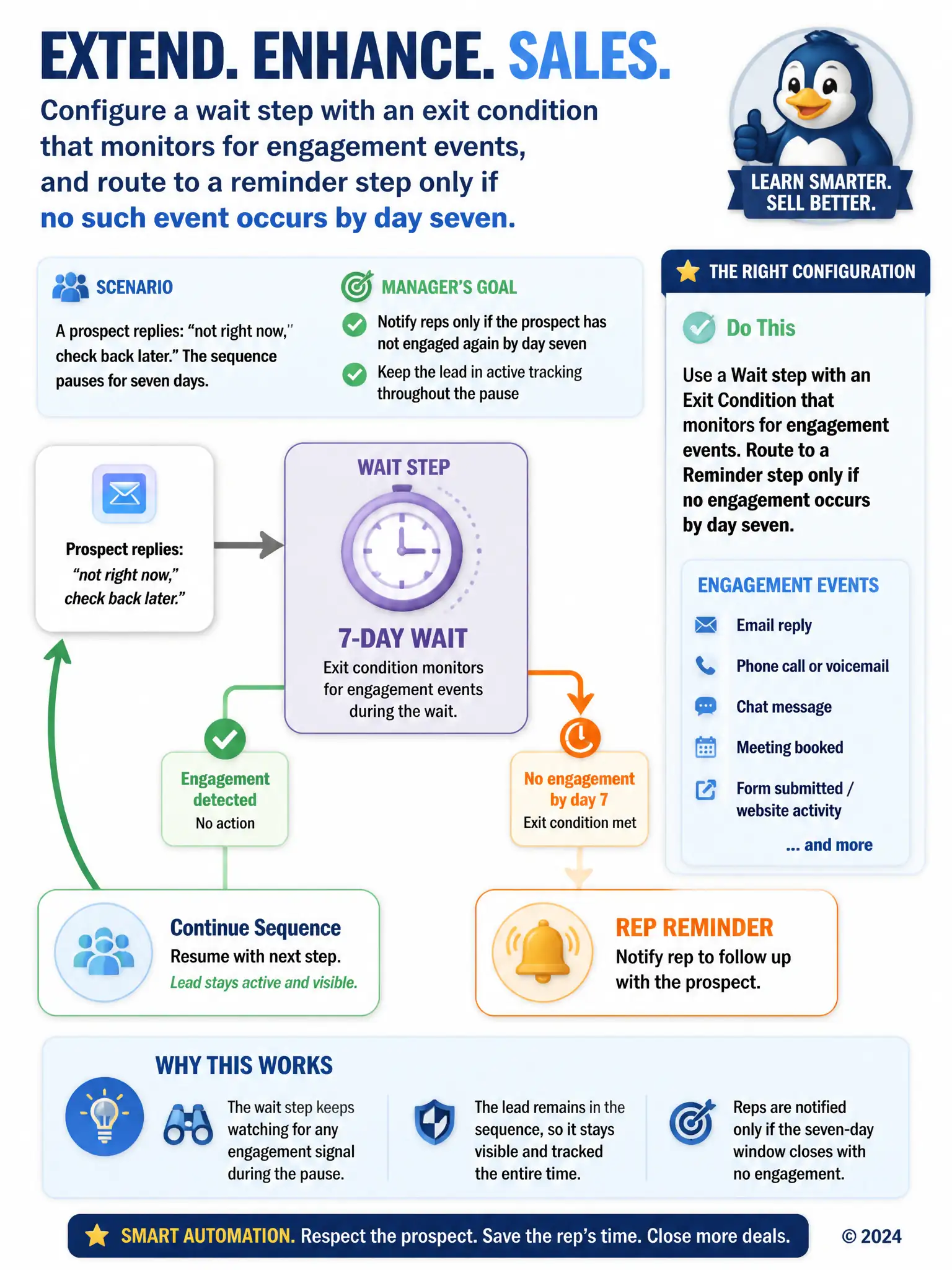
You need a wait step that keeps watching for engagement during the seven-day pause and only sends a reminder if nothing happens. That keeps the lead in active tracking without bothering reps when the prospect already responded. Pulling the lead out, blindly resuming, or manually checking every week all miss the mark.
Full Explanation
The correct configuration is a wait step with an exit condition that monitors for engagement events and routes to a reminder step only if no such event occurs by day seven. It keeps the lead inside the sequence, so it remains under active tracking, while letting the sequence branch based on whether the prospect engages again before the seven-day mark. If engagement occurs, the sequence can react accordingly; if not, it routes to a reminder step that notifies the rep exactly when the manager wants it. Removing the lead from the sequence entirely during the pause is incorrect because it falls out of active tracking, which the manager explicitly wants avoided. Setting the sequence to wait seven days and then automatically resume the next step, without checking for any interim engagement, is incorrect because an unconditional resume ignores engagement entirely, so a rep could be notified, or the sequence could advance, even though the prospect already replied through another channel, defeating the purpose of the pause. Having the manager manually review the prospect list every seven days and decide case by case which sequences to resume is incorrect because manual case-by-case review at scale is exactly the kind of repetitive checking the sequence automation is meant to eliminate, and it does not reliably produce the exit condition the manager described.