
(Select TWO.) A sales operations lead is rolling out predictive opportunity scoring across the sales team and wants to prevent reps and managers from treating the score as a substitute for their own judgment about deal health. Which two actions support this goal?
Select all correct answers, then click Submit.
Short Explanation
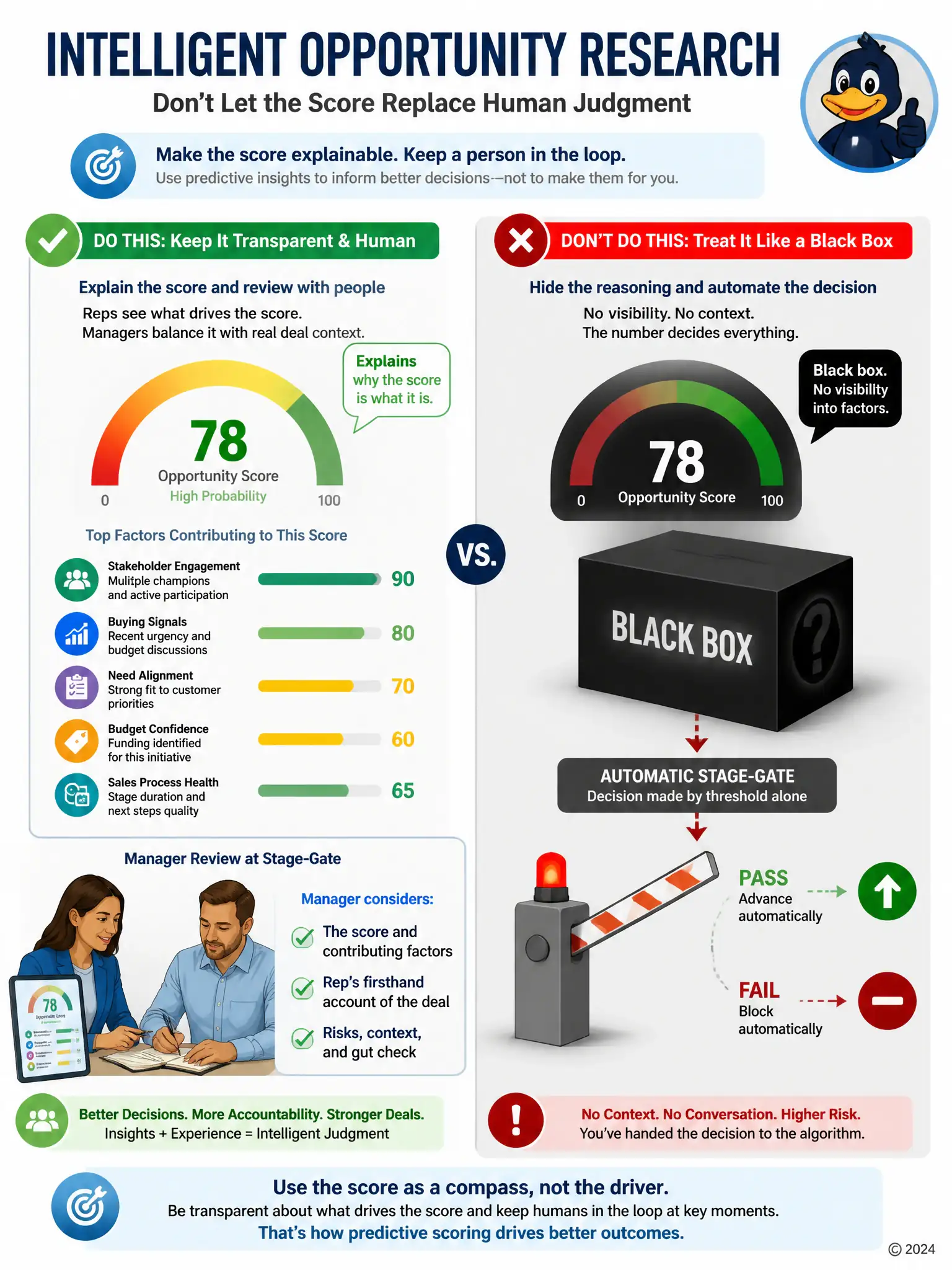
If you want reps not to treat the score as gospel, show them what drives it and keep a manager in the loop. When reps can see the reasoning, they can push back with real deal knowledge, and when a manager weighs the score against the rep's firsthand account, the number stays an input, not the final answer.
Full Explanation
The correct choices are the option that communicates which factors contribute most to each opportunity's score and the option that requires a manager to review opportunities approaching a stage-gate by considering the score alongside the rep's firsthand account. Sharing which factors drive a score turns it from an opaque number into something reps can reason about alongside their own knowledge of the deal, and requiring a manager to weigh the score together with the rep's firsthand account keeps a human judgment step in every stage-gate decision, both of which directly support treating the score as one input rather than a final answer. The option that hides the underlying contributing factors is incorrect because it does the opposite of the stated goal; it makes the score more of a black box, which pushes people toward either blindly trusting it or dismissing it, rather than reasoning about it critically. The option that replaces the manager's stage-gate review with an automatic advance or block driven solely by whether the score is above or below a fixed threshold is incorrect because it removes human judgment from the decision entirely, which is precisely the outcome the sales operations lead is trying to avoid. The two correct choices keep a person actively interpreting the score in context, while the two incorrect choices each remove that interpretive step in a different way, one by concealing information and the other by automating the decision outright.