
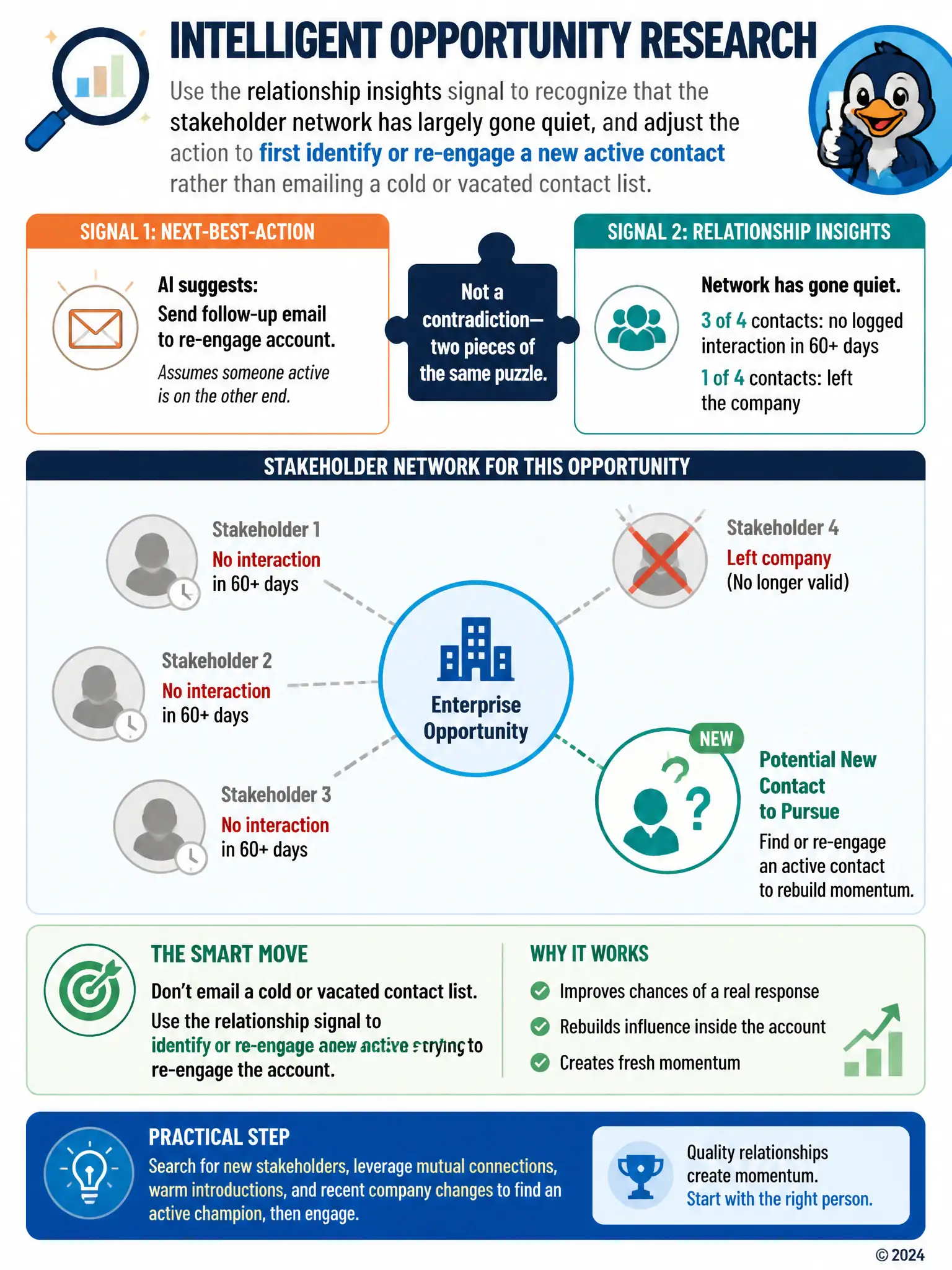
A rep working a stalled enterprise opportunity receives an AI-generated next-best-action suggesting a follow-up email to re-engage the account. Separately, relationship insights for the same opportunity show that three of the four previously active stakeholder contacts have had no logged interaction in over two months, and the fourth left the company recently. How should the rep weigh these two signals before acting?
Select an answer to reveal the explanation.
Short Explanation
Two signals pointing different ways aren't a contradiction; they're context. If the relationship data says the stakeholder network has gone quiet or lost contacts, don't just fire off the suggested follow-up email into a cold room. Use that insight to find or re-engage an active contact before trying to re-engage the account.
Full Explanation
The correct response is to use the relationship insights signal to recognize that the stakeholder network has largely gone quiet, and adjust the action to first identify or re-engage a new active contact rather than emailing a cold or vacated contact list. Relationship insights reveals that the stakeholder network behind the opportunity has largely disengaged: one contact departed and three others have gone quiet, so the rep should use that context to adjust the suggested action, first working to identify or re-engage a live contact, rather than sending a generic re-engagement email into a network that is mostly cold. The suggestion to follow the next-best-action immediately, because it is generated specifically to move stalled opportunities forward and takes priority over other signals, is incorrect because following the suggestion without considering the relationship context defeats the purpose of having relationship insights available; a next-best-action generated from opportunity-level signals does not automatically account for the specific state of each stakeholder relationship. The suggestion to disregard the next-best-action entirely, because any conflicting signal from relationship insights means next-best-action recommendations cannot be trusted going forward, is incorrect because it overgeneralizes from a single instance of conflicting signals to a blanket conclusion that next-best-action recommendations cannot be trusted at all, which is an overreaction rather than a reasoned response to this specific case. The suggestion to escalate the opportunity to sales leadership for reassignment, because a next-best-action and a relationship insight signal that disagree indicates the opportunity should be reassigned to a different rep, is incorrect because disagreement between two signals on one opportunity does not, by itself, justify reassigning the deal to a different rep; that conclusion jumps well past what the situation actually supports and ignores that the rep can simply adjust their approach. The sound response is to read both signals together and act accordingly.