
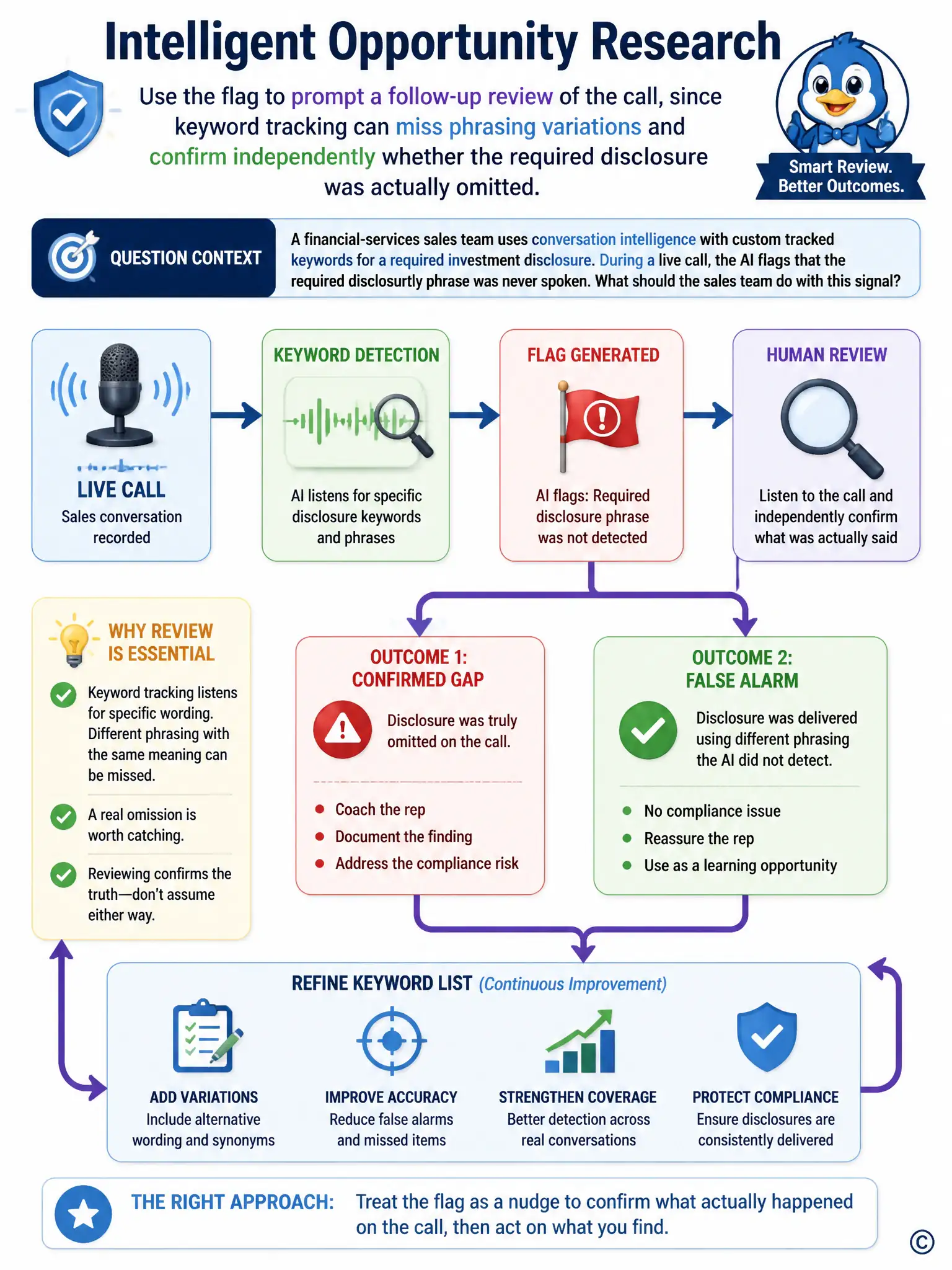
A consultant configures conversation intelligence for a financial-services sales team, adding custom tracked keywords tied to a compliance disclosure that must be spoken during any call discussing investment products. During a live call, the AI flags that the required disclosure phrase was never spoken. What should the sales team do with this signal?
Select an answer to reveal the explanation.
Short Explanation
Use the flag to prompt a follow-up review of the call. Keyword tracking can miss phrasing variations, so you need to confirm independently whether the required disclosure was actually omitted.
Full Explanation
The correct response is to use the flag to prompt a follow-up review of the call, since keyword tracking can miss required language when a rep phrases the disclosure slightly differently than the tracked term. The flag is best treated as a prompt to review the actual call and confirm independently whether the disclosure was genuinely omitted, rather than as a final determination either way. Treating the flag as conclusive proof of a compliance violation and escalating the call to legal without further review is incorrect because it treats automated keyword detection as infallible and skips the verification step, which risks escalating a false positive as if it were a confirmed violation when the rep may have used acceptable alternate wording. Ignoring the flag unless it recurs on three consecutive calls with the same customer is incorrect because it sets an arbitrary threshold, waiting for three occurrences, that has no basis in the scenario and would let a genuine single compliance gap go unaddressed while waiting for repetition that may never come. Disabling keyword tracking for this compliance term going forward is incorrect because it overreacts to one instance by abandoning the tracking capability entirely, discarding a useful early-warning signal rather than simply verifying and, if needed, refining how the phrase is matched. The appropriate response keeps the human review step in the loop rather than trusting or dismissing the automated signal outright.