
A consultant configures the similar-opportunities recommendation for a client that sells capital equipment with sales heavily concentrated in the fourth quarter each year. To keep the training data current, the consultant scopes the model's historical opportunities to only the most recently closed quarter. Reps working Q4 deals report that the recommendations feel generic and fail to surface the client's own past Q4 wins as comparable opportunities. What is the most likely cause?
Select an answer to reveal the explanation.
Short Explanation
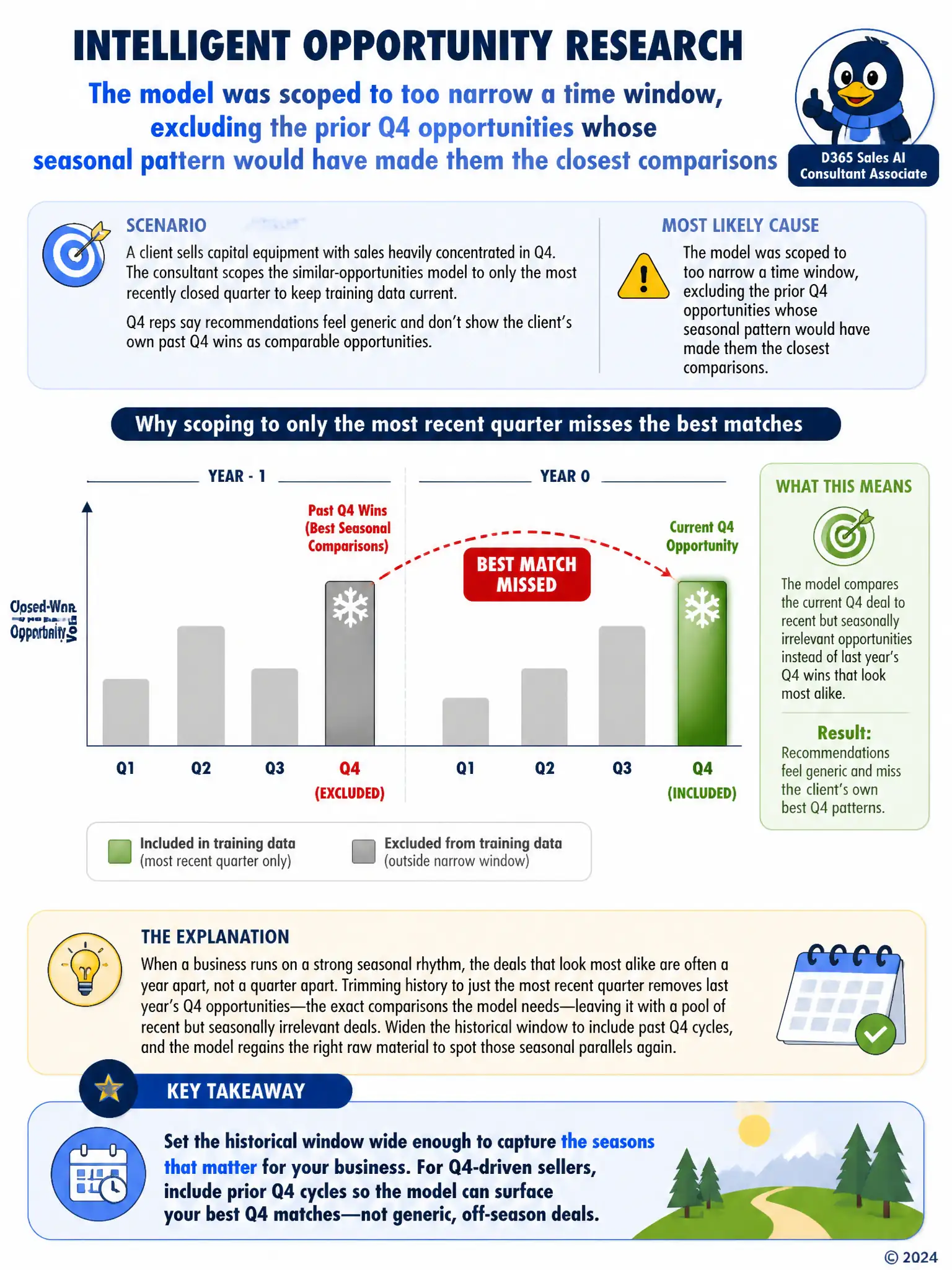
You trimmed the training window to the most recent quarter, so you threw away last year's Q4 wins—the deals that would have matched this client's seasonal pattern. That leaves recent but seasonally irrelevant history, so the recommendations feel generic.
Full Explanation
The most likely cause is that the model was scoped to too narrow a time window, excluding prior Q4 opportunities whose seasonal pattern would have made them the closest comparisons. For a capital-equipment business with sales concentrated in the fourth quarter, current Q4 deals are most similar to past Q4 wins, not just to the immediately preceding quarter. When the historical opportunities are limited to only the most recently closed quarter, the model has nothing seasonally relevant to draw on and falls back to generic matches. The claim that similar-opportunities recommendations only compare deals within the same fiscal quarter as the current date is incorrect because there is no such fixed same-quarter matching rule built into the capability; the behavior reps are seeing is a direct consequence of the narrow scoping choice, not an inherent constraint of the feature. The product-catalog mismatch explanation is incorrect because it points to an unrelated cause, and the scenario gives no indication that the reps' deals fall outside the trained catalog; the actual change made was the time window, which is the more direct explanation. The requirement for at least two connected business units is incorrect because the recommendation capability does not require multiple connected business units to function; a single Dynamics 365 Sales instance can generate similar-opportunity comparisons on its own, so this requirement does not exist. The fix is broadening the historical window to include prior seasonal cycles, not addressing catalog scope or business-unit count.