
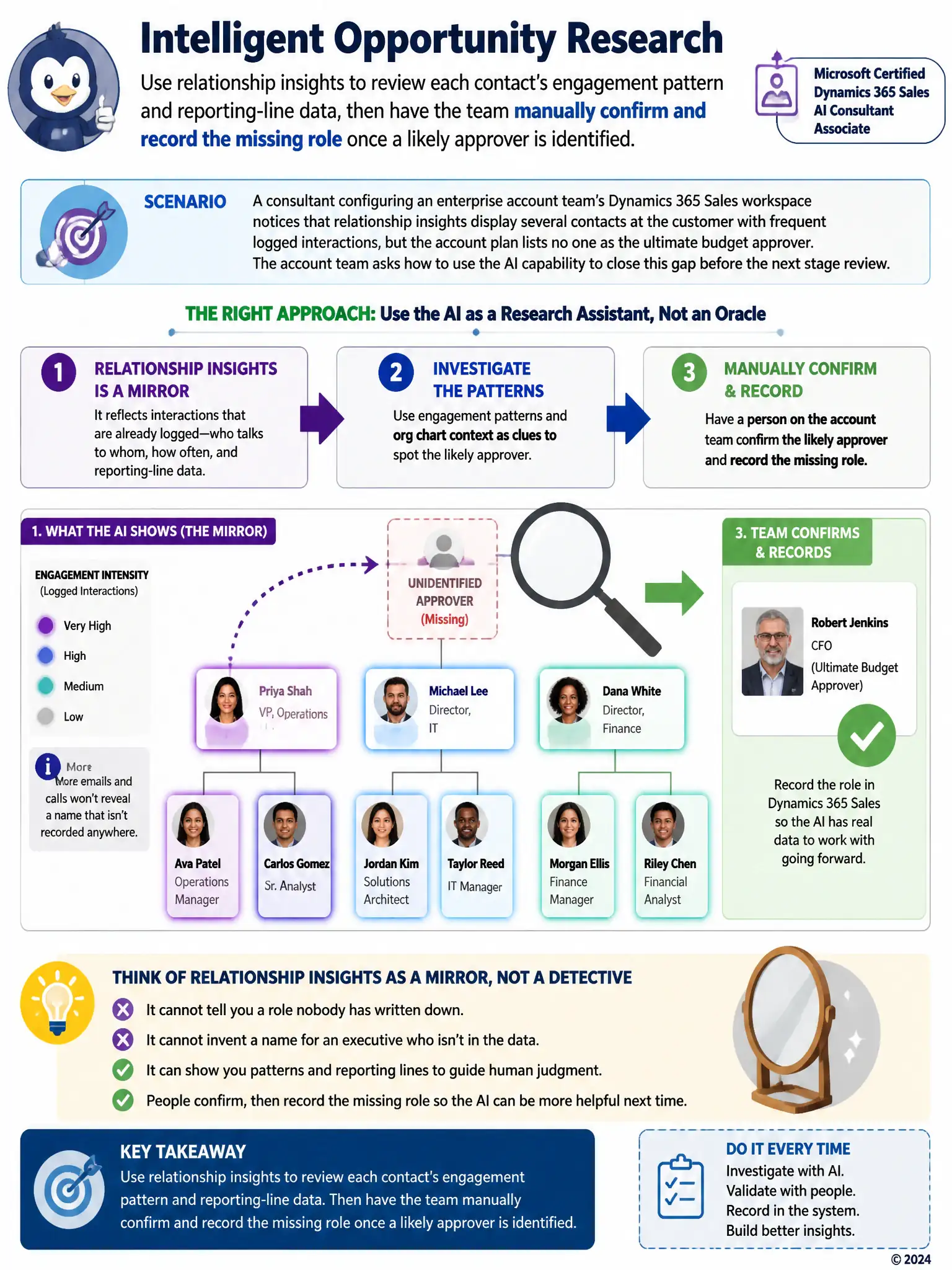
A consultant configuring an enterprise account team's Dynamics 365 Sales workspace notices that relationship insights display several contacts at the customer with frequent logged interactions, but the account plan lists no one as the ultimate budget approver. The account team asks how to use the AI capability to close this gap before the next stage review.
Select an answer to reveal the explanation.
Short Explanation
Think of relationship insights as a mirror, not a detective. It shows who’s talking and how often, but it can’t name a budget approver nobody recorded. Use those engagement and reporting-line clues, then have the account team confirm and log the likely approver.
Full Explanation
The correct approach is to use relationship insights to review each contact's engagement pattern and reporting-line data, then have the team manually confirm and record the missing role once a likely approver is identified. Relationship insights surfaces engagement patterns and organizational signals drawn from existing interactions, but it does not assign or confirm formal roles on its own; someone on the account team still has to interpret that data and record the missing role, which closes the gap before the stage review. The relationship-insights-only approach is incorrect because passively waiting does not resolve a gap where no one has even been tagged as a candidate; interaction volume alone does not create role identification. The increased auto-capture approach is incorrect because increasing capture frequency produces more raw interaction data, not automatic title or role inference, so it does not address the actual problem of an unconfirmed role. The next-best-action recommendation approach is incorrect because next-best-action recommends actions based on data already associated with the opportunity, such as follow-ups or escalations, and is not built to invent or name individuals who have not been identified anywhere in the system. The task here requires a human step, using the AI's engagement signals as input, not a purely automated fix.