
A sales enablement lead wants to determine whether Copilot's email drafting assistance in Dynamics 365 Sales actually improves seller outcomes before expanding it beyond a 10-person pilot group. (Select TWO.) Which two actions would produce a valid basis for that decision?
Select all correct answers, then click Submit.
Short Explanation
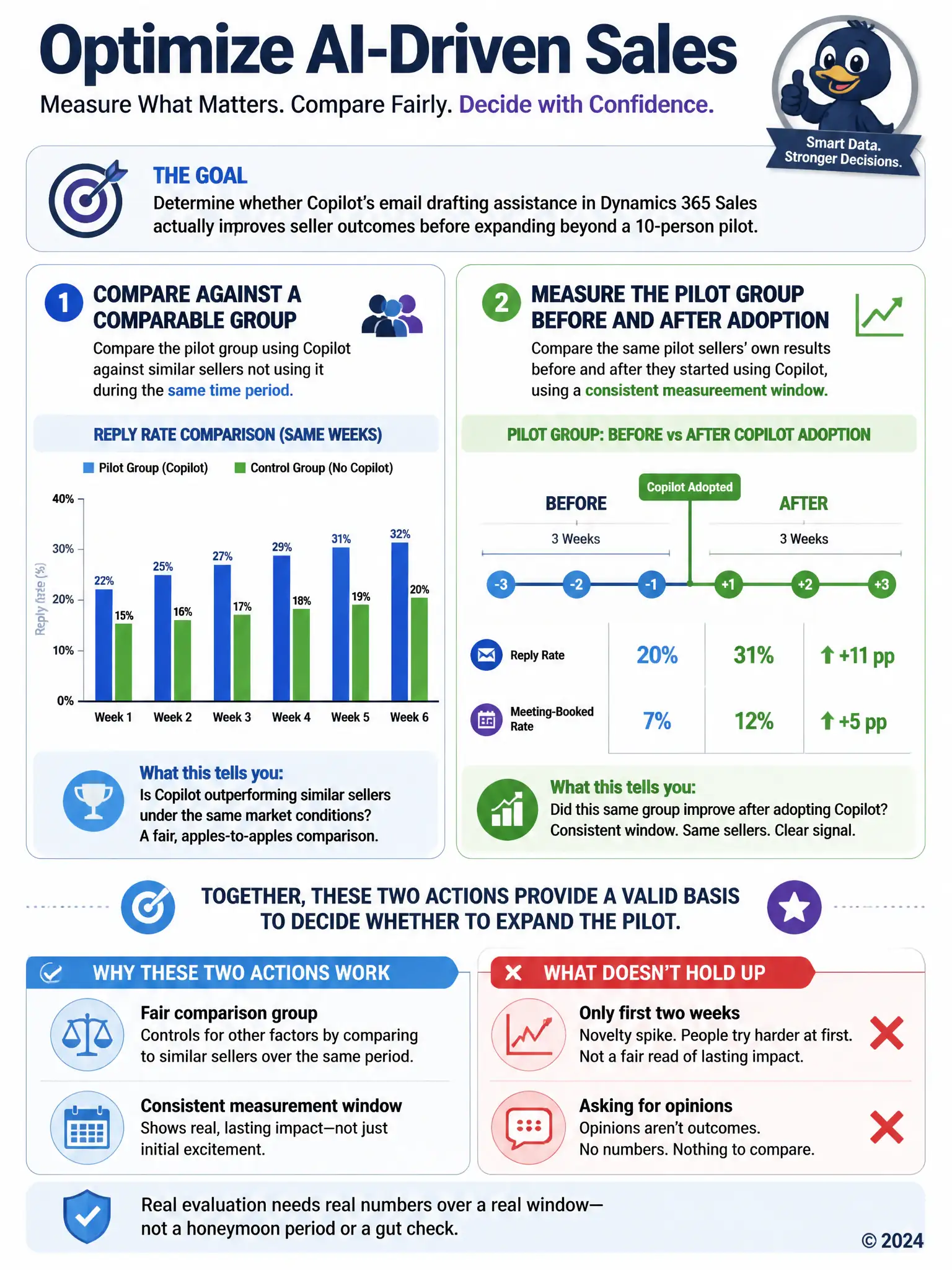
If you're trying to prove Copilot drafting actually moves reply and meeting-booked rates, you need real numbers over a fair window: compare the pilot sellers against similar sellers who aren't using it, and compare their own results before and after adoption. Don't rely on hallway opinions or the first two weeks after launch, because that's just hype, not proof.
Full Explanation
The correct actions are measuring the pilot group's own reply and meeting-booked rates before and after adopting Copilot's email drafting assistance in Dynamics 365 Sales using a consistent measurement window, and comparing reply and meeting-booked rates for the pilot group's Copilot-assisted emails against a comparable group of sellers not using the feature during the same period. Comparing the pilot group's outcomes against a comparable group not using the feature over the same period controls for external factors like seasonality or market conditions, while comparing the pilot group's own before-and-after performance over a consistent window isolates the effect of adopting the feature on the same sellers' behavior. Using both approaches together gives the enablement lead a defensible basis for deciding whether to expand the rollout. Tracking the pilot group's metrics only for the two weeks immediately following the initial announcement of the pilot is incorrect because it captures a novelty effect, where participants engage more enthusiastically simply because the program is new, which does not reflect sustained impact. Asking pilot participants in an informal hallway conversation whether they personally like the suggestions is incorrect because it produces no measurable outcome data and cannot be compared across time periods or against a control group, making it unsuitable as evidence for an expansion decision. Sound evaluation requires objective, outcome-based metrics measured over a stable window, either against a comparable baseline group or against the same group's own prior performance, not a short novelty window or anecdotal impressions.