
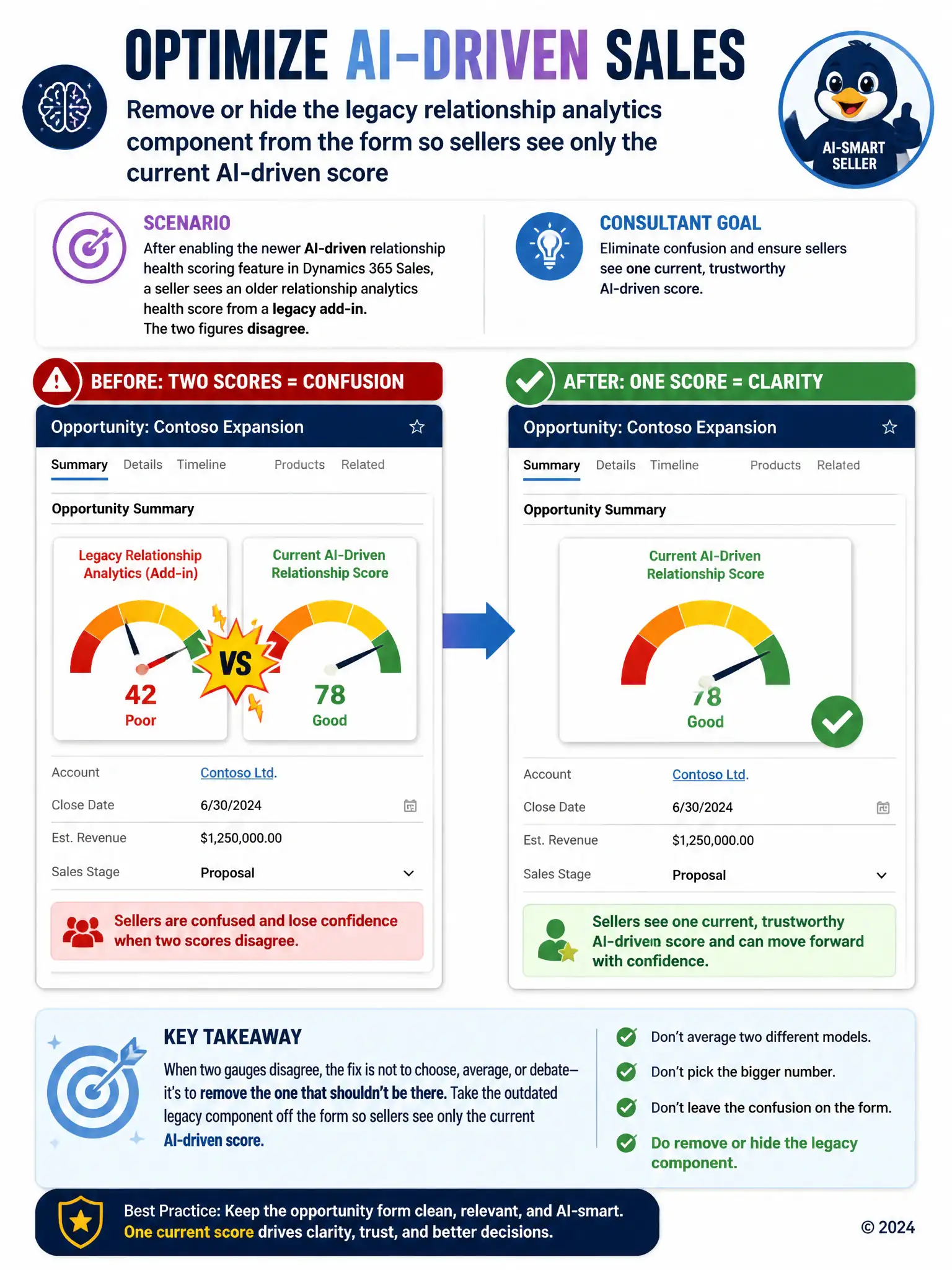
After enabling the newer AI-driven relationship health scoring feature in Dynamics 365 Sales, a seller notices an older relationship analytics health score from a legacy add-in still displayed on the same opportunity form, and the two figures disagree. A consultant is asked to resolve the discrepancy for the sales team. What should the consultant do?
Select an answer to reveal the explanation.
Short Explanation
When two gauges on the same dashboard disagree, remove the gauge that shouldn't be there anymore. Here, an old legacy scoring add-in is still sitting on the form next to the new AI-driven score, and they disagree because they were never built to agree. Take the outdated component off the form so sellers see one current, trustworthy score instead of two competing ones.
Full Explanation
The correct approach is to remove or hide the legacy relationship analytics component from the form so sellers see a single, current, AI-driven score. The disagreement exists because two separate, unrelated scoring mechanisms are both displayed on the same form, and removing the redundant legacy component eliminates the source of confusion rather than working around it. Averaging the two scores together is incorrect because averaging two scores produced by different models with different inputs and methodologies yields a number with no coherent meaning; it does not represent either model's actual assessment. Instructing sellers to always trust whichever score is higher is incorrect because it introduces an arbitrary bias that has nothing to do with which score is more accurate, and could systematically favor overconfident readings. Leaving both scores visible and letting sellers decide case by case is incorrect because it perpetuates the exact ambiguity the sales team is already struggling with, forcing each seller to make an inconsistent, case-by-case judgment call rather than resolving it at the configuration level. The right fix addresses the root cause, which is a redundant legacy component still occupying the form, not the sellers' interpretation of conflicting numbers.