
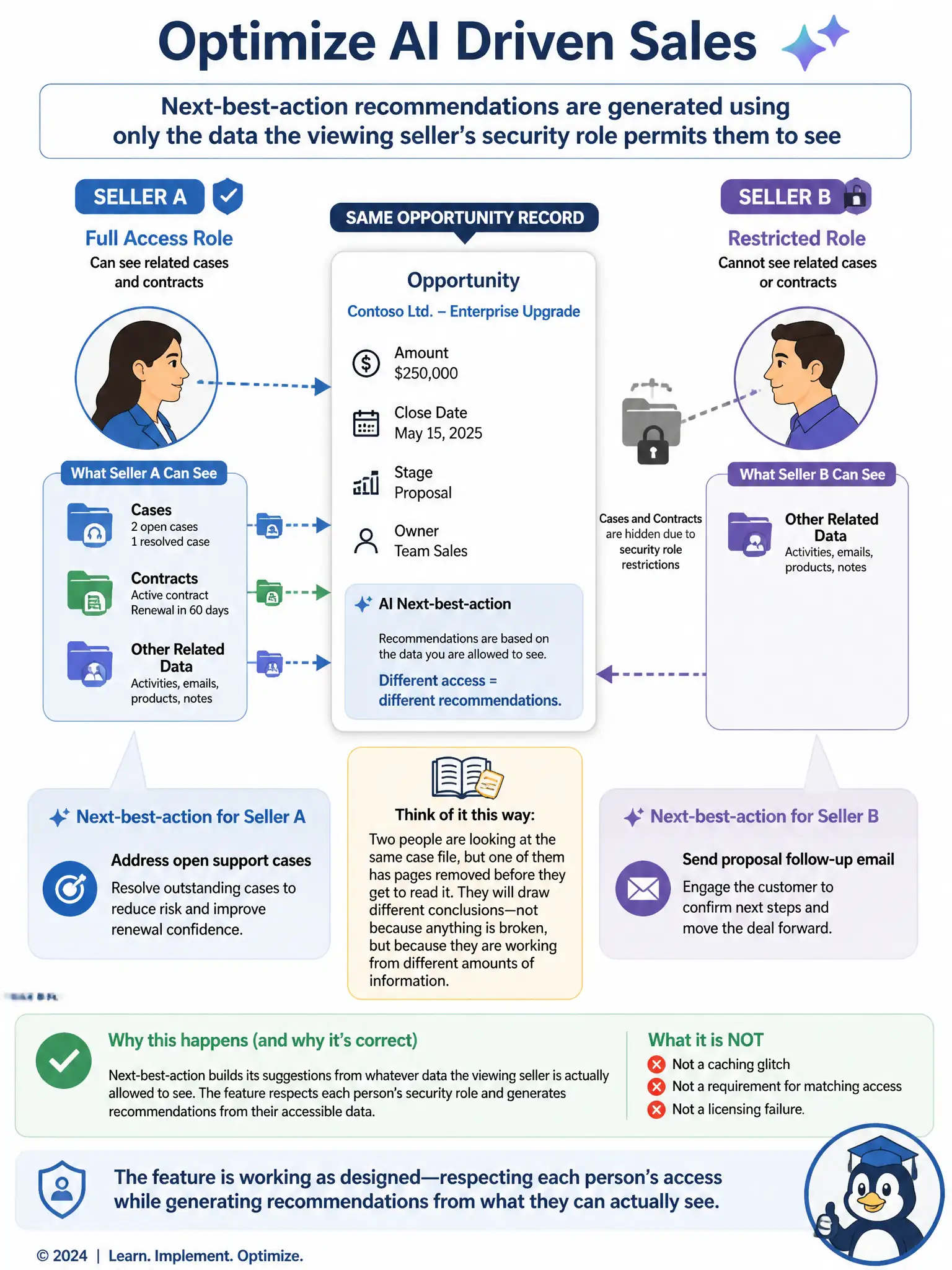
Two sellers with different security roles open the same opportunity record and see different next-best-action recommendations from Copilot. One seller has full read access to the account's related cases and contracts; the other has a restricted role that hides those tables. A consultant investigating this behavior should explain to the sales manager that:
Select an answer to reveal the explanation.
Short Explanation
You're seeing different recommendations because next-best-action builds suggestions from only the data the viewing seller's security role permits them to see. The seller who can't see related cases and contracts gets different suggestions, not a broken feature. It's not a stale cache, a role-matching requirement, or a licensing problem.
Full Explanation
The correct explanation is that next-best-action recommendations are generated using only the data the viewing seller's security role permits them to see, so a seller with a restricted role that hides related cases and contracts will see recommendations built without that context, while a seller with full access sees recommendations informed by it. This is expected, security-respecting behavior rather than a defect. The stale cached opportunity explanation is incorrect because the difference is not a caching artifact; both sellers are seeing current recommendations, just generated from different visible data sets. The identical security roles requirement explanation is incorrect because there is no requirement that all sellers share identical security roles for next-best-action to function; the feature is designed to work correctly across varying role configurations by respecting each user's access. The licensing misconfiguration explanation is incorrect because both sellers are actually receiving AI-generated recommendations, which rules out a licensing failure that would typically block the feature outright for one user. The consultant's role here is to correctly diagnose the behavior as security-driven personalization rather than a bug, so the manager does not pursue an unnecessary technical fix.