
A consultant sets up a Sales Accelerator work queue for an SDR team and configures an assignment rule to distribute inbound leads evenly using round-robin logic. After go-live, one SDR's queue fills far faster than teammates', even though the rule treats all SDRs equally. Reviewing the SDR's user record in Sales Accelerator, the consultant finds their capacity value set much higher than the rest of the team's. What should the consultant do to fix the imbalance?
Select an answer to reveal the explanation.
Short Explanation
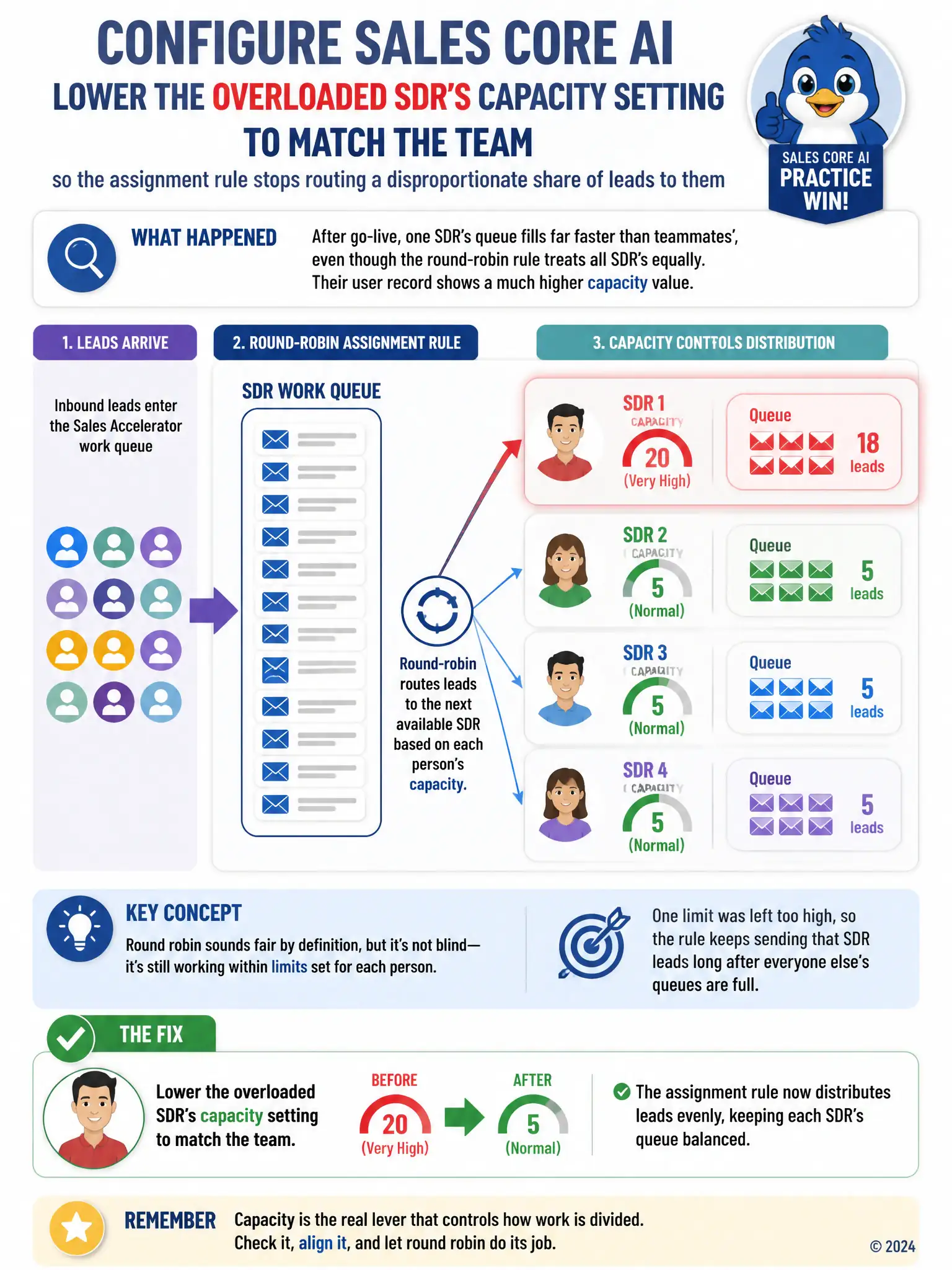
Round-robin isn't magic; it still honors each rep's capacity. If one SDR's capacity is way too high, the rule keeps stuffing their queue while others stay balanced. Lower that capacity to match the team and the distribution evens out.
Full Explanation
The fix is to lower the overloaded SDR's capacity setting to match the team so the assignment rule stops routing a disproportionate share of leads to them. In Sales Accelerator, each rep's capacity setting caps how many open items the assignment engine will route to them at once; round-robin logic still respects that cap, so a rep with an unusually high capacity value keeps receiving new leads long after teammates with normal capacity have filled up, producing the imbalance the consultant observed. Lowering that value back in line with the rest of the team restores the even distribution the rule was designed to produce. Switching the assignment rule from round-robin to manual assignment so a manager distributes leads by hand is incorrect because it removes automation entirely and does not address the actual misconfiguration; it just shifts the same imbalance onto a manager's judgment. Removing the SDR from the work queue and creating a second identical queue just for that person is incorrect because it fragments reporting and does not fix the capacity value causing the overload; the same imbalance would reappear in the new queue. Reducing the priority score on the sequence so fewer leads qualify for automatic routing is incorrect because sequence priority affects which leads qualify for entry into the sequence; it has no effect on how the assignment rule divides workload across reps within the same queue.