
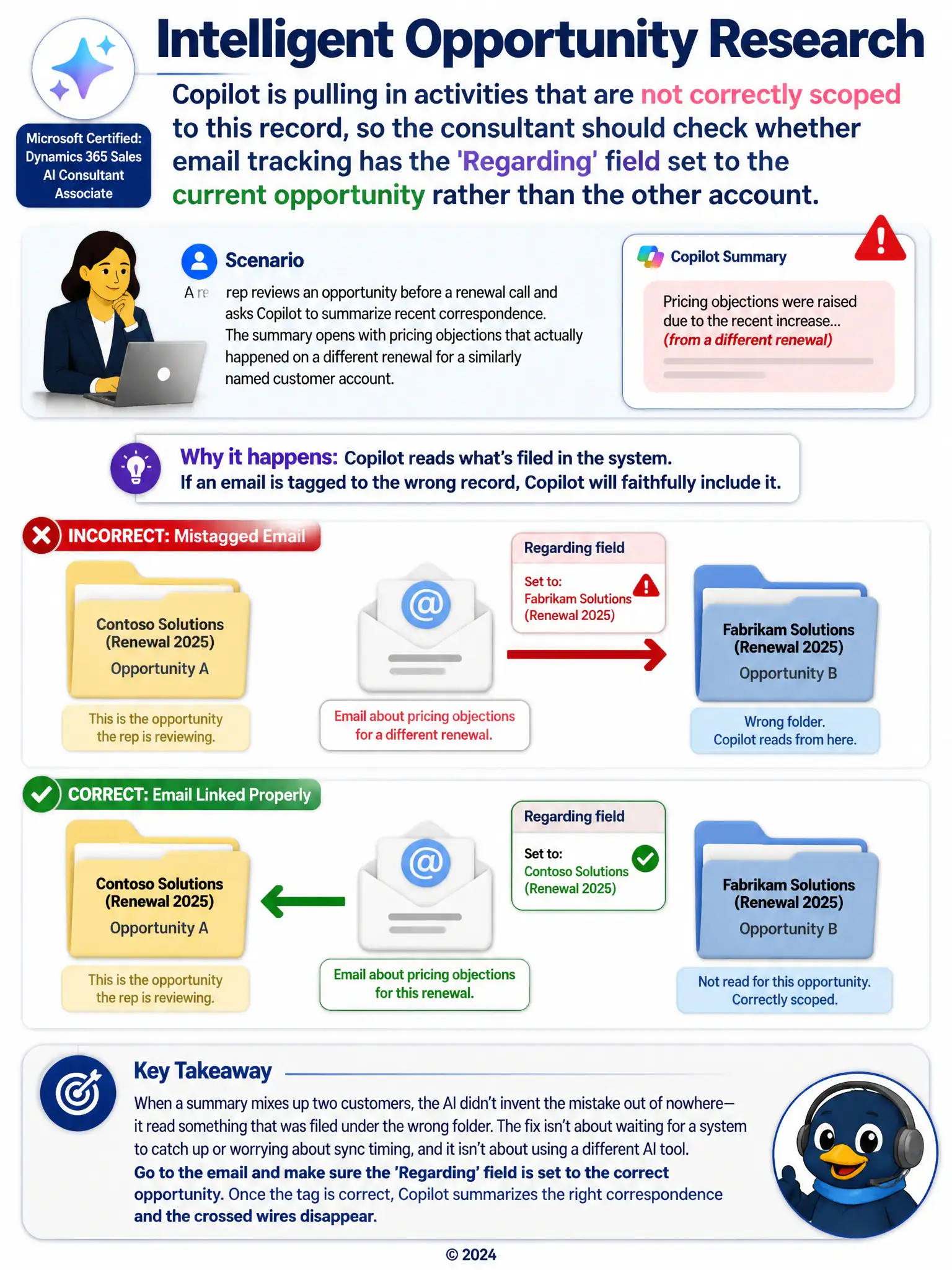
A rep at a software company reviews an opportunity record before a renewal call and asks Copilot to summarize recent correspondence with the customer. The summary Copilot returns opens with a paragraph about pricing objections that actually happened on a different renewal, for a similarly named customer account. What is the most likely cause, and what should the consultant check?
Select an answer to reveal the explanation.
Short Explanation
When a summary mixes up two customers, the assistant didn't invent the mistake out of nowhere; it read something filed under the wrong folder. Every email gets tagged to a record behind the scenes, so if that tag points at the wrong account, the assistant faithfully repeats whatever's in that mistagged email as if it belongs to the deal being reviewed. Go back to the email and make sure it's linked to the right opportunity; once the tagging is correct, the summary pulls from the right pile of correspondence.
Full Explanation
Copilot's record summaries are built from activities linked to the specific record being viewed, so if an email from the similarly named account was tracked without its 'Regarding' field pointing at the right opportunity, Copilot can pull that stray email into the wrong summary. Checking and correcting the regarding association on tracked emails resolves the mismatch. The monthly-training-lag explanation is incorrect because Copilot works from activities already present in Dynamics 365 Sales rather than running on a delayed training cycle; there is no monthly ingestion lag that would explain content from an unrelated account appearing. The mailbox-sync-frequency explanation is incorrect because mailbox sync frequency affects how quickly new emails appear in Dynamics, not which record an already-tracked email is associated with, so it would not cause cross-account contamination. The conversation-intelligence explanation is incorrect because summarizing written correspondence on a record is exactly what the Copilot opportunity summary is designed to do; conversation intelligence instead analyzes spoken calls, so it is not a substitute feature and switching to it would not address the underlying data-linking problem.