
A consultant is enabling predictive opportunity scoring for a manufacturing holding company whose Dynamics 365 Sales instance serves two business units: a direct-sales industrial unit with six years of consistently tracked opportunity history, and a distributor-channel unit that was onboarded four months ago with only a handful of closed opportunities. Leadership wants one dashboard showing scores for every open opportunity across both units. What should the consultant do?
Select an answer to reveal the explanation.
Short Explanation
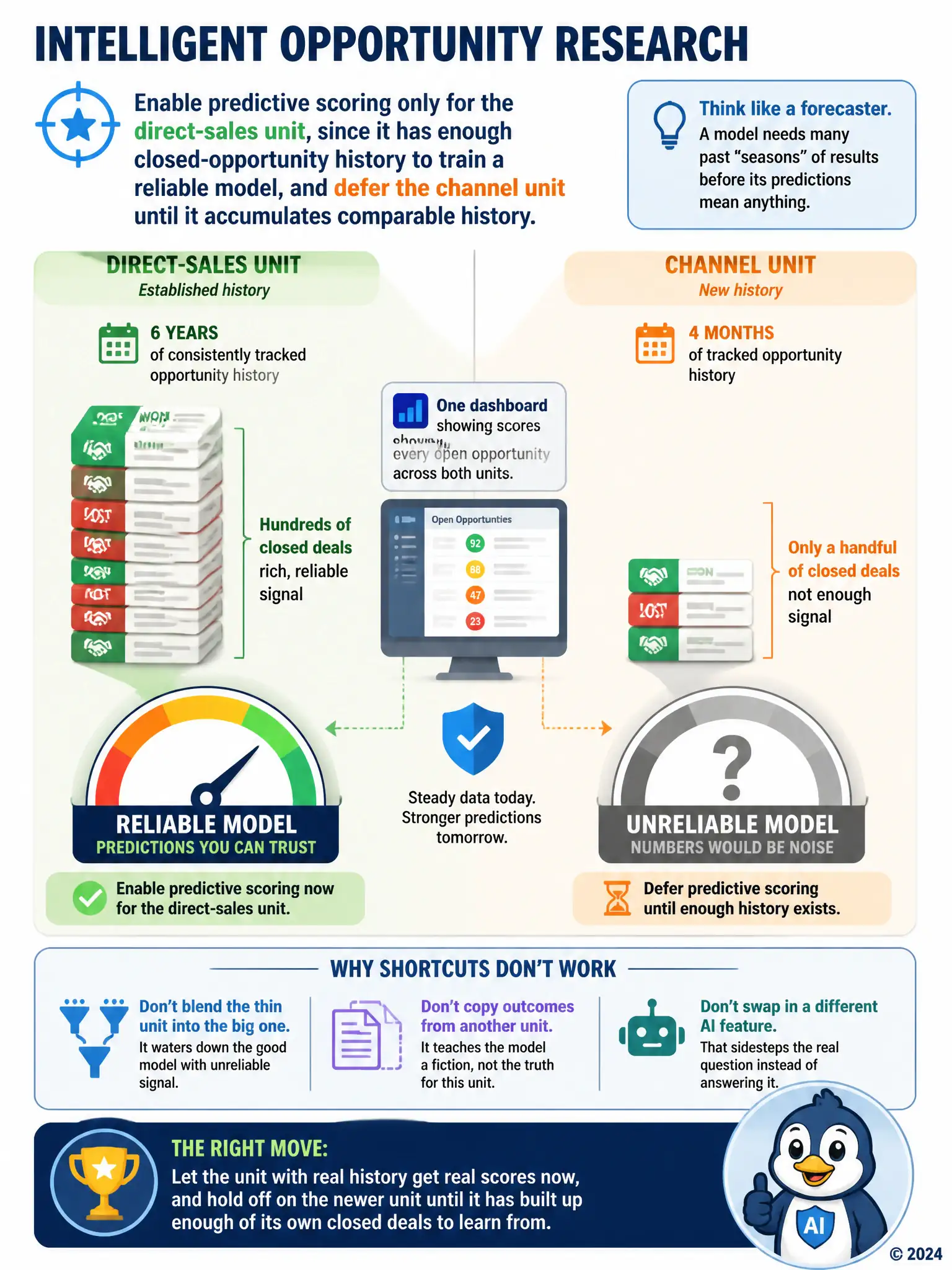
Here's the deal: a scoring model needs a long run of past closed deals before its predictions mean anything. You should score only the direct-sales unit now, because it has years of history, and hold off on the channel unit until it has enough of its own closed opportunities. The shortcuts just water down the model, fake history, or swap in a different feature instead of solving the data problem.
Full Explanation
The correct approach is to enable predictive scoring only for the direct-sales unit, since it has enough closed-opportunity history to train a reliable model, and defer the channel unit until it accumulates comparable history. Predictive opportunity scoring learns from a segment's own closed won and lost opportunities, and the channel unit has not generated enough of that history yet; scoping the model to the direct-sales unit, which has six years of consistent data, keeps scores meaningful while the channel unit matures. The organization-level approach is incorrect because pooling the channel unit's thin, recent data into an organization-wide model would dilute the training set and produce scores that look confident but do not reflect either unit's actual patterns. The manual back-fill approach is incorrect because copying another unit's outcomes into the channel unit's records fabricates history rather than reflecting what actually happened there, corrupting the model and misleading anyone who reviews that unit's pipeline. The Copilot opportunity-summary approach is incorrect because it substitutes a different capability for the one leadership asked about; Copilot's opportunity summary condenses activity on a single record and was never meant to replace a scoring model across a whole unit's pipeline, so it does not solve the underlying data-volume problem.