
A consultant configures the similar-opportunities recommendation for a client that sells industrial equipment across several unrelated verticals, food processing, mining, and pharmaceuticals, through one Dynamics 365 Sales instance. Reps in the mining division report that the similar-opportunities suggestions on their deals mostly reference unrelated food-processing deals with little practical relevance. What should the consultant adjust?
Select an answer to reveal the explanation.
Short Explanation
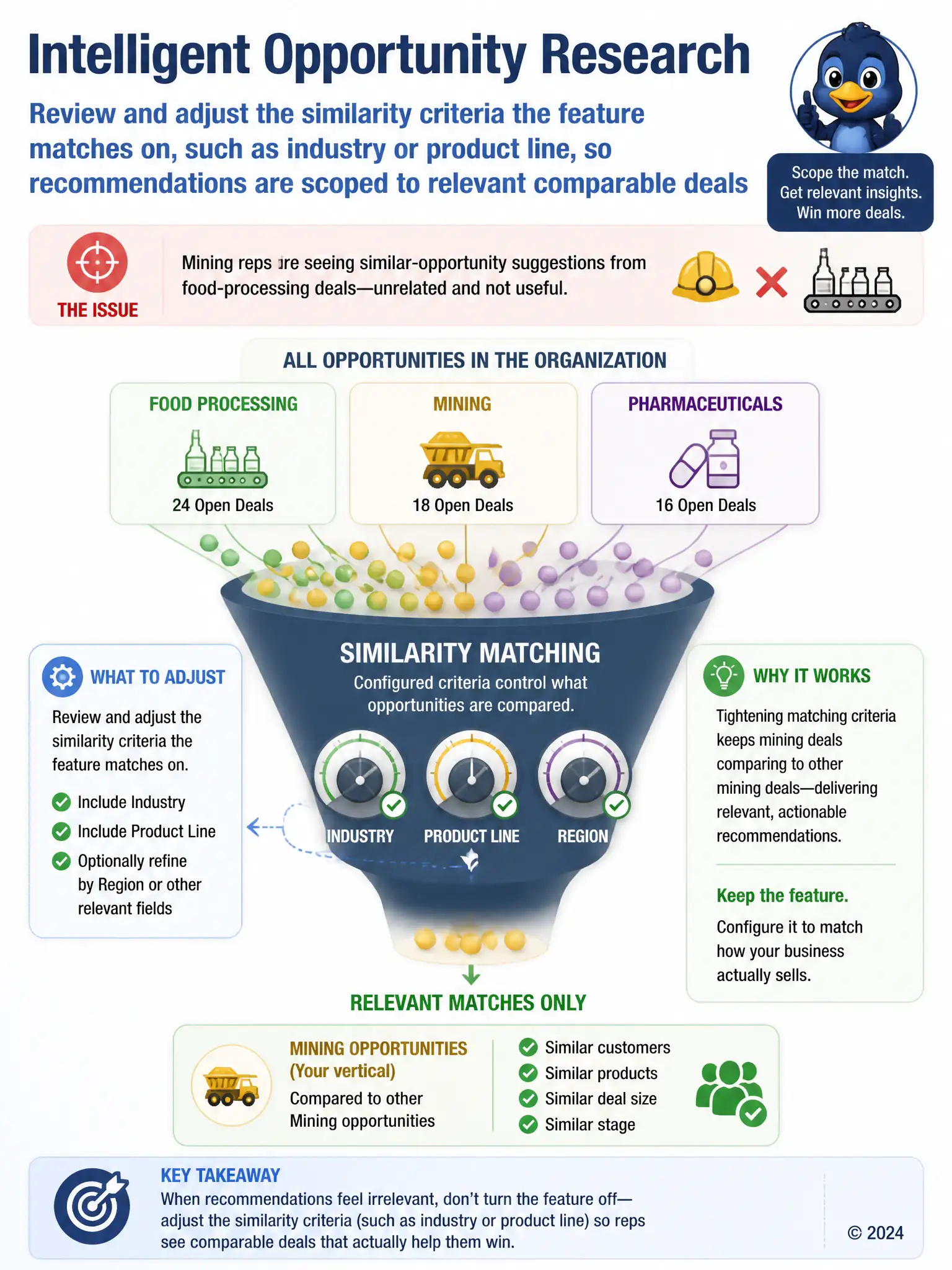
When similar-opportunities suggestions keep pulling in unrelated verticals, you shouldn't disable the feature or split environments. You should review and adjust the similarity criteria, such as industry or product line, so mining deals compare against other mining deals. Manually flagging bad suggestions won't train it.
Full Explanation
The correct approach is to review and adjust the similarity criteria the feature matches on, such as industry or product line, so recommendations are scoped to relevant comparable deals. The similar-opportunities recommendation compares deals using configurable matching criteria, and when reps in one vertical keep seeing suggestions from a completely unrelated vertical, the fix is to review and adjust which fields, such as industry or product line, the feature uses to judge similarity so results are scoped to genuinely comparable deals. The proposal to disable the similar-opportunities feature company-wide is incorrect because it assumes the feature has no scoping controls and must always blend results across verticals, which is not accurate; the matching criteria can be adjusted rather than requiring the feature to be turned off entirely. The proposal to create a separate Dynamics 365 Sales environment for each vertical is incorrect because splitting the client into separate environments per vertical is a drastic structural change unnecessary for what is fundamentally a configuration adjustment, and it further wrongly claims the similarity fields cannot be reconfigured, contradicting the actual fix. The proposal to have reps manually flag each mismatched suggestion as not similar is incorrect because the feature does not learn from individual reps manually flagging suggestions as not similar in the way described; that is not how its matching mechanism operates, so this approach would not change future recommendations.