
A sales operations lead is rolling out predictive opportunity scoring and wants to prevent reps and managers from treating the score as a mechanical override of judgment. The lead asks the consultant how the score should factor into forecast category decisions. What guidance should the consultant give?
Select an answer to reveal the explanation.
Short Explanation
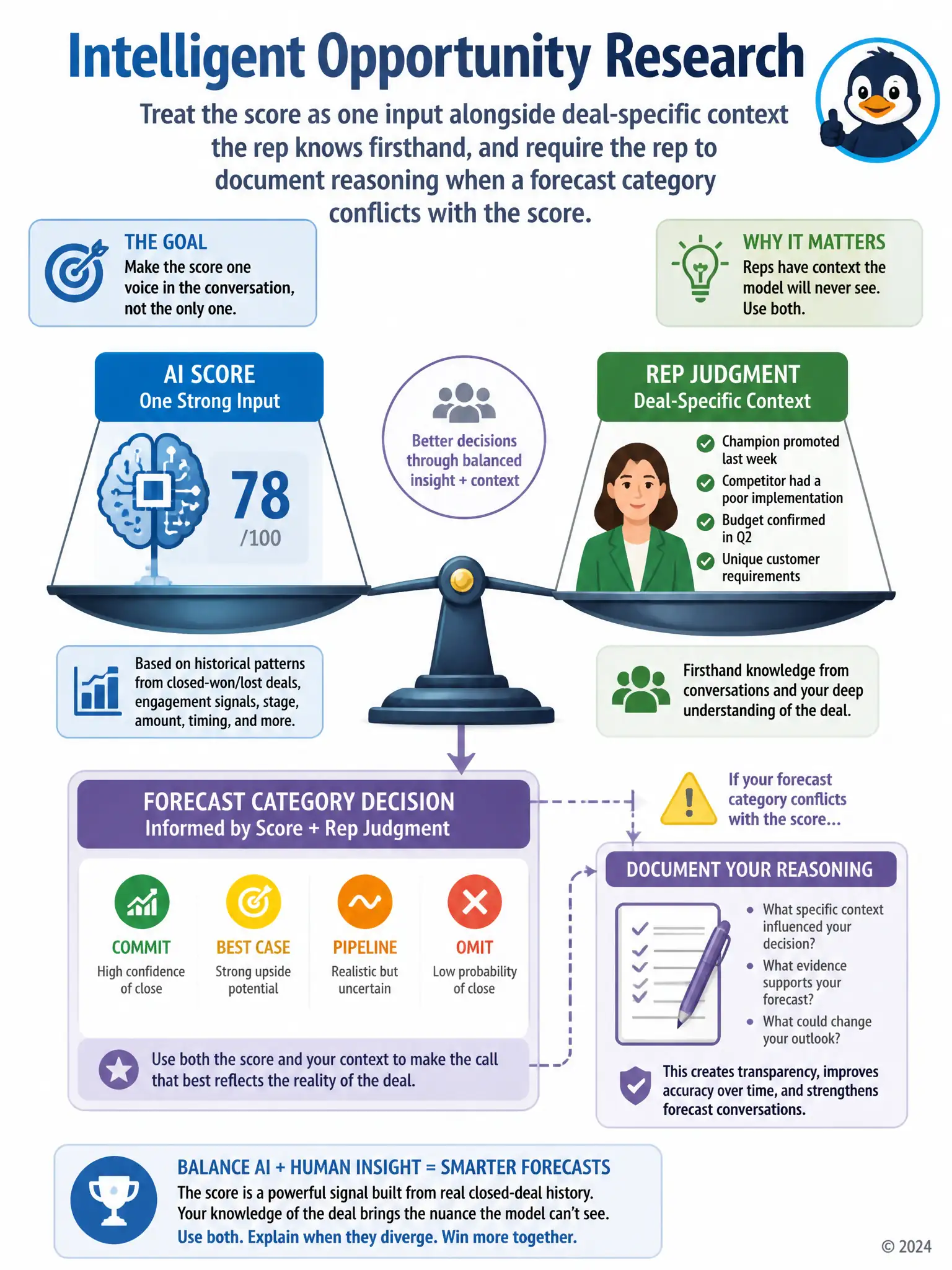
You should treat the predictive score as one input alongside deal-specific context the rep knows firsthand, and require the rep to document reasoning when a forecast category conflicts with the score. Don't let a threshold flip the forecast automatically, don't ignore the score, and don't hide it from reps.
Full Explanation
The correct guidance is to treat predictive opportunity scoring as a decision-support signal, not a mechanical trigger, so the appropriate governance treats it as one input a rep weighs alongside firsthand context the model cannot see, such as a champion's private commitment or a competitor's recent misstep. Requiring documentation when a rep's forecast category diverges from the score keeps the score influential without letting it override judgment silently. The proposal to set the forecast category field to update automatically whenever the predictive score crosses a threshold is incorrect because it removes the rep from the decision entirely, the opposite of the balance the sales operations lead is asking for. The proposal to instruct managers to disregard the score entirely because the model cannot account for account-specific circumstances is incorrect because it discards a genuinely useful signal built from real pipeline history, overcorrecting against the risk of over-reliance rather than managing it. The proposal to hide the score from reps and only show it to managers during pipeline reviews is incorrect because reps are closest to the deal and best positioned to reconcile the score with what they know, so hiding it reduces the score's usefulness without solving the stated concern about mechanical override.