
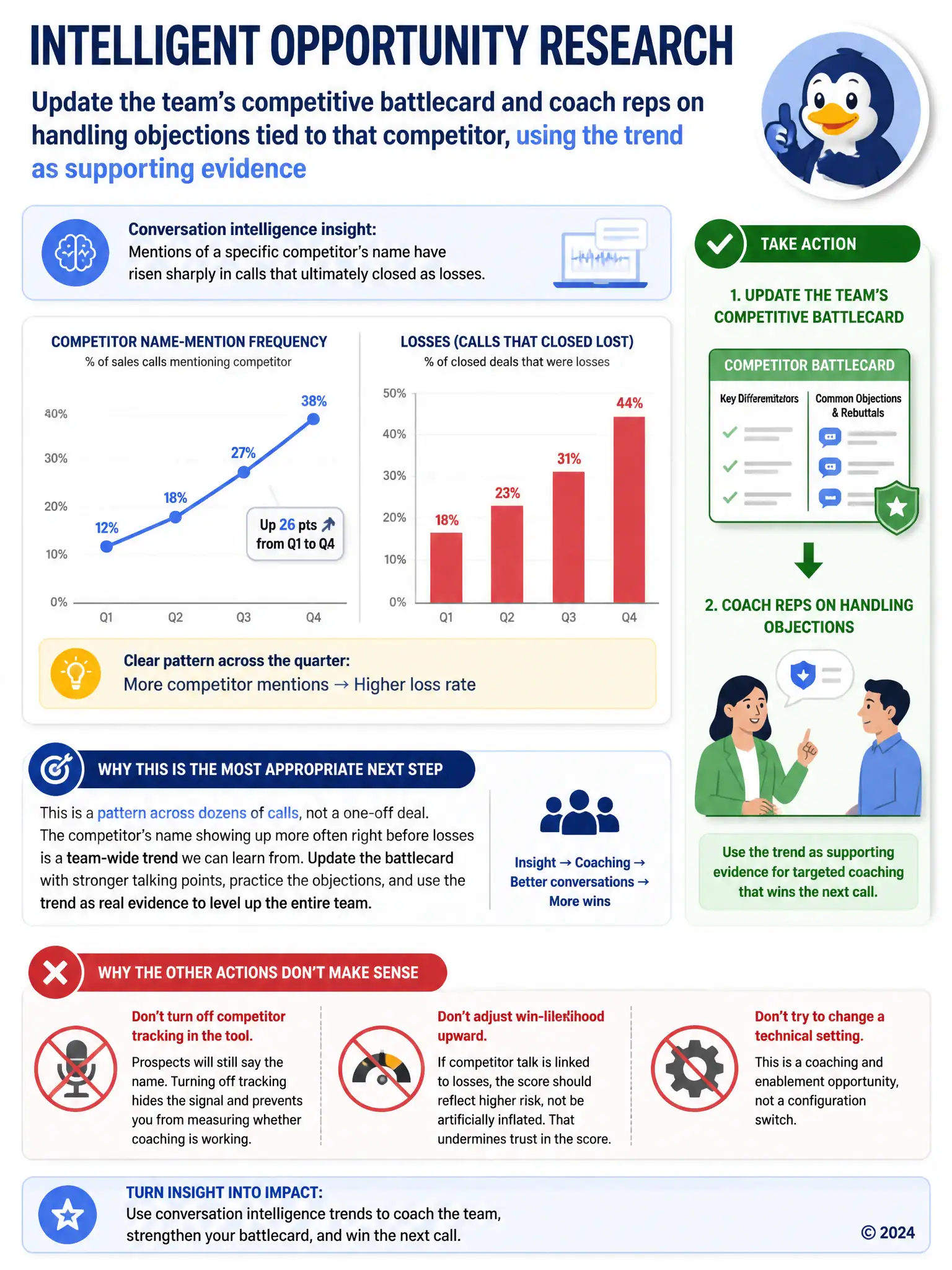
A sales enablement manager reviews a conversation intelligence report aggregated across the team's Teams calls for the quarter and notices that mentions of a specific competitor's name have risen sharply in calls that ultimately closed as losses. The manager wants to act on this pattern for the whole team, not just one deal. What is the most appropriate next step?
Select an answer to reveal the explanation.
Short Explanation
When a competitor's name keeps popping up in lost deals across the team, you treat that as coaching material, not a switch to flip. Update the battlecard and rehearse the objection handling so reps have better answers next time. Don't try to silence the keyword or turn off the tracking; you need the data to see if the fix works.
Full Explanation
The appropriate response is to update the team's competitive battlecard and coach reps on handling objections tied to that competitor, using the trend as supporting evidence. Aggregated conversation intelligence data across many calls is meant to surface team-level patterns that individual call reviews would miss, and a rising correlation between competitor mentions and losses is exactly the kind of signal that should inform battlecards and coaching, not automated system changes. Automatically blocking the competitor's name from being mentioned during calls is incorrect because conversation intelligence cannot block words from being spoken on a call, and even if it could, silencing the mention would not address the underlying competitive pressure driving the losses. Disabling conversation intelligence for calls involving that competitor is incorrect because it would remove the ongoing visibility needed to track whether the pattern continues or improves after coaching, undermining the very insight that prompted the review. Increasing the predictive opportunity score weighting for every open deal that mentions the competitor is incorrect because manually inflating the predictive opportunity score misuses the model; the score is meant to estimate likelihood to win based on trained signals, and artificially raising it for at-risk deals would make the forecast less accurate, conflating urgency with probability of winning.