
A consultant is configuring Dynamics 365 Sales for a mid-market client whose marketing team wants to identify which inbound leads are worth converting to opportunities, while the sales team separately wants to know which active opportunities are most likely to close. The client asks whether one AI model can serve both needs. What should the consultant recommend?
Select an answer to reveal the explanation.
Short Explanation
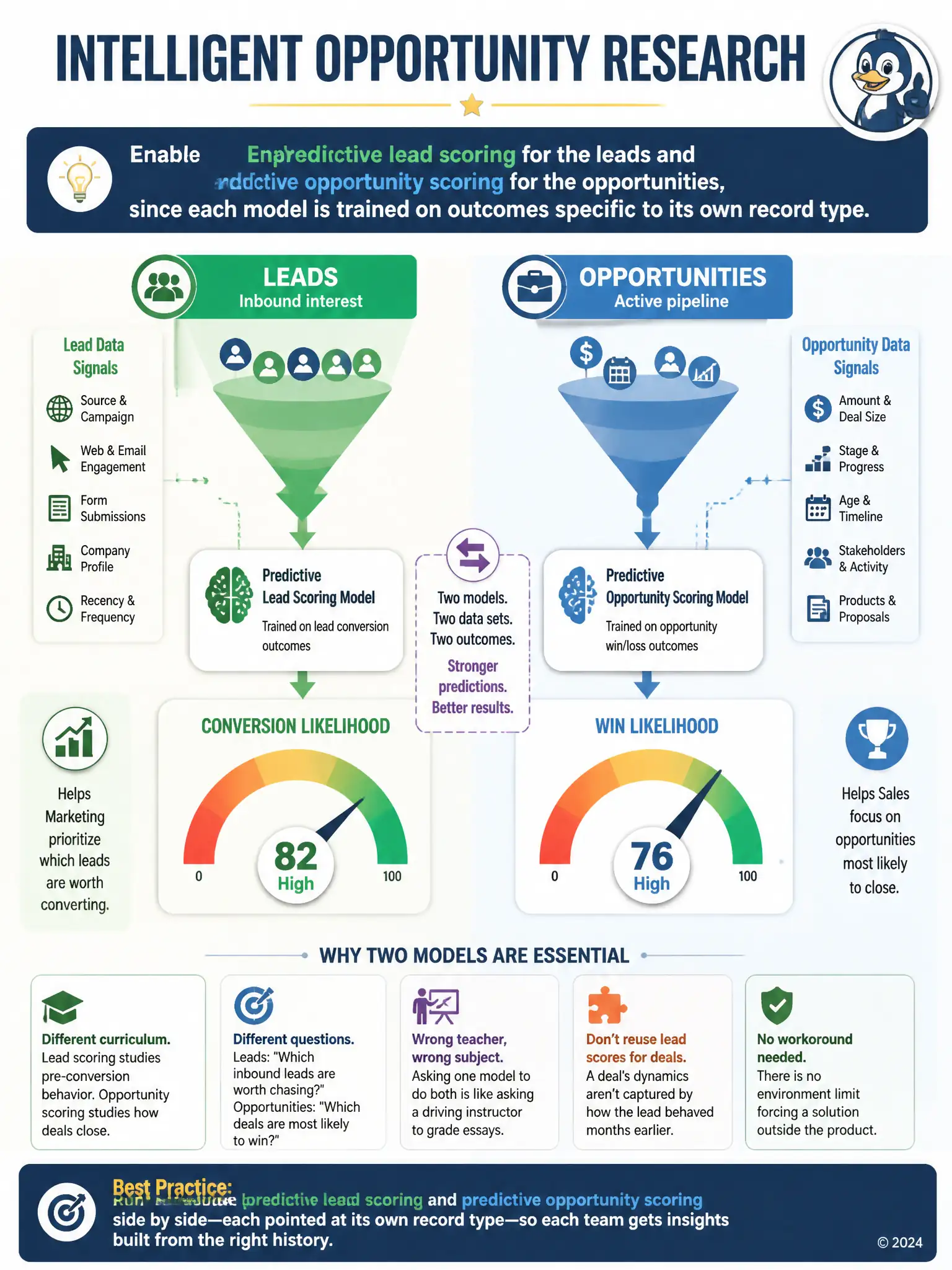
You need both models: predictive lead scoring for leads and predictive opportunity scoring for opportunities. Each one learns from the record type it scores, so marketing gets lead-qualification insight and sales gets close-likelihood insight. Trying to reuse one score across record types just doesn't match the training data.
Full Explanation
The recommendation is to enable predictive lead scoring for lead records and predictive opportunity scoring for opportunity records because each model is trained on outcomes specific to its own record type. Predictive lead scoring predicts conversion likelihood from lead attributes and marketing engagement, while predictive opportunity scoring predicts win likelihood from opportunity-stage activity and deal characteristics. Running both gives the marketing team a lead-qualification signal and the sales team a close-likelihood signal, matching what each group asked for. The approach that enables only predictive opportunity scoring and configures it to run against lead records is incorrect because opportunity scoring is not designed to evaluate lead records; the two entities carry different fields and historical outcome data, so pointing the opportunity model at leads would not produce a valid score. The approach that enables only predictive lead scoring is incorrect because a lead's score does not transfer to the opportunity created from it; once a lead converts, the opportunity needs its own predictive opportunity score built from opportunity-stage data. The approach that builds a single custom model outside Dynamics 365 Sales to score both leads and opportunities uniformly is incorrect because it assumes native Dynamics 365 Sales AI scoring is limited to a single entity per environment, which is false; both models can run in the same environment against their respective entities without a custom external solution.