
A consultant is designing lead routing for a regional distributor that already has territory-based assignment rules driving who receives each new lead. The sales director asks whether predictive lead scoring should replace those territory rules so leads route directly to whichever seller is most likely to close them. What should the consultant recommend?
Select an answer to reveal the explanation.
Short Explanation
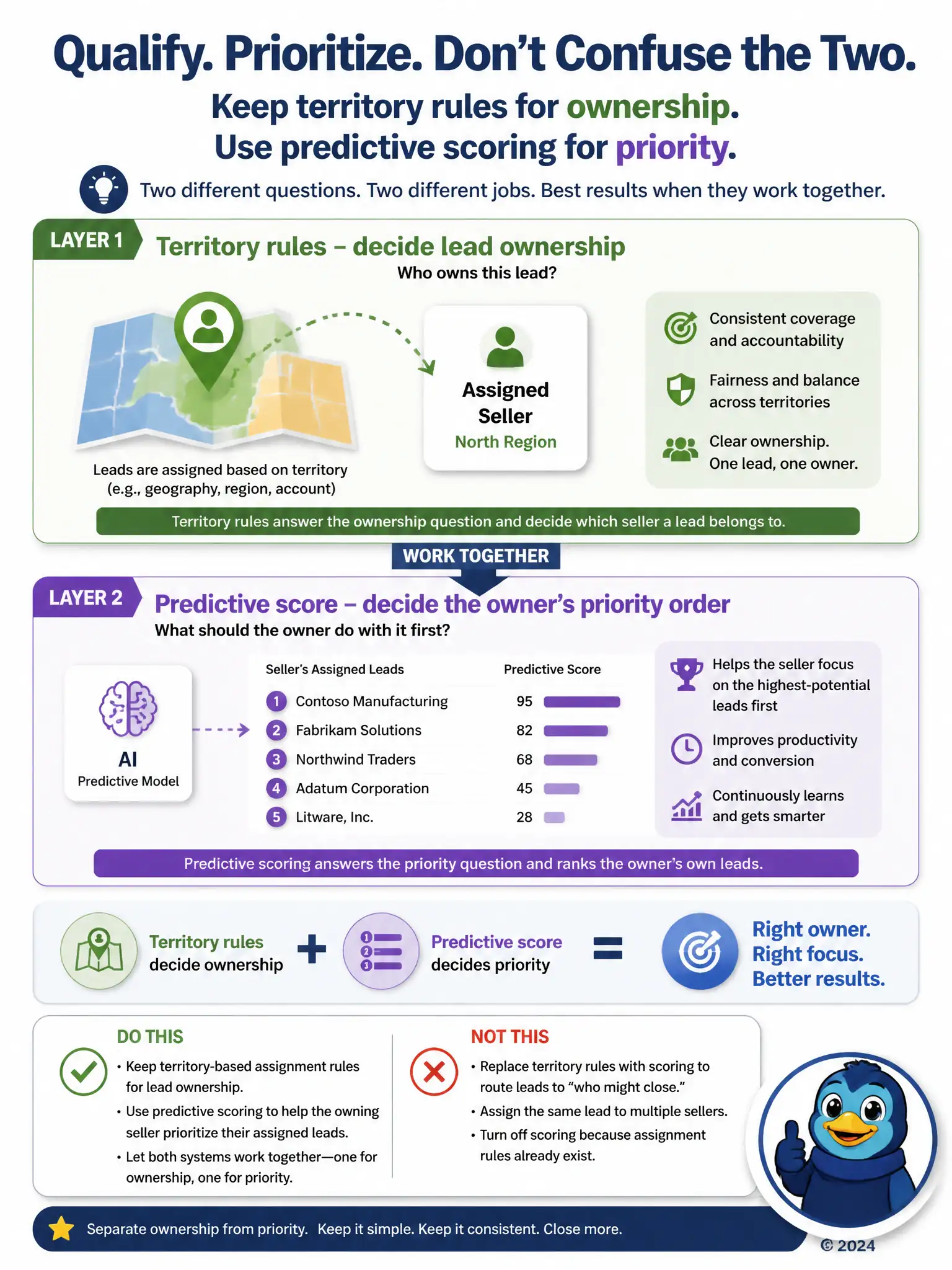
You've got two different jobs here. Territory rules decide who owns the lead, and predictive scoring helps that owner prioritize their own work. Don't swap them or double-assign leads; that just creates confusion.
Full Explanation
The recommended approach is to keep the territory-based assignment rules to determine who owns each lead, and to use predictive scoring to help the owning seller prioritize their own assigned leads rather than reroute leads between sellers. Territory-based assignment rules determine who owns a lead, which is an operational and organizational decision, while predictive lead scoring is a prioritization signal that helps the seller who already owns a lead decide where to focus first; the two serve different purposes and work best together rather than one replacing the other. The proposal to replace the territory rules entirely is incorrect because predictive lead scoring is not designed to assign ownership across the sales team; it produces a score and grade on leads that already have an owner, and it does not reroute or reassign them based on that score. The proposal to disable predictive lead scoring is incorrect because predictive scoring can run alongside any existing assignment or routing configuration; there is no conflict that requires disabling it. The proposal to run both systems independently so that a lead is assigned twice, once by territory rules and once by predictive scoring, and let the seller pick whichever assignment they prefer is incorrect because assigning the same lead twice through two independent mechanisms would create confusion over true ownership and duplicate work, rather than solving the director's question about which system should drive routing.