
A consultant ran a two-week proof-of-concept of Dynamics 365 Sales with a sales team, during which several sample and duplicate leads were entered purely to demonstrate features to stakeholders. Before turning on predictive lead scoring for the production rollout, the consultant reviews the historical data and finds those proof-of-concept leads are still present alongside real customer leads. What should the consultant do before enabling scoring?
Select an answer to reveal the explanation.
Short Explanation
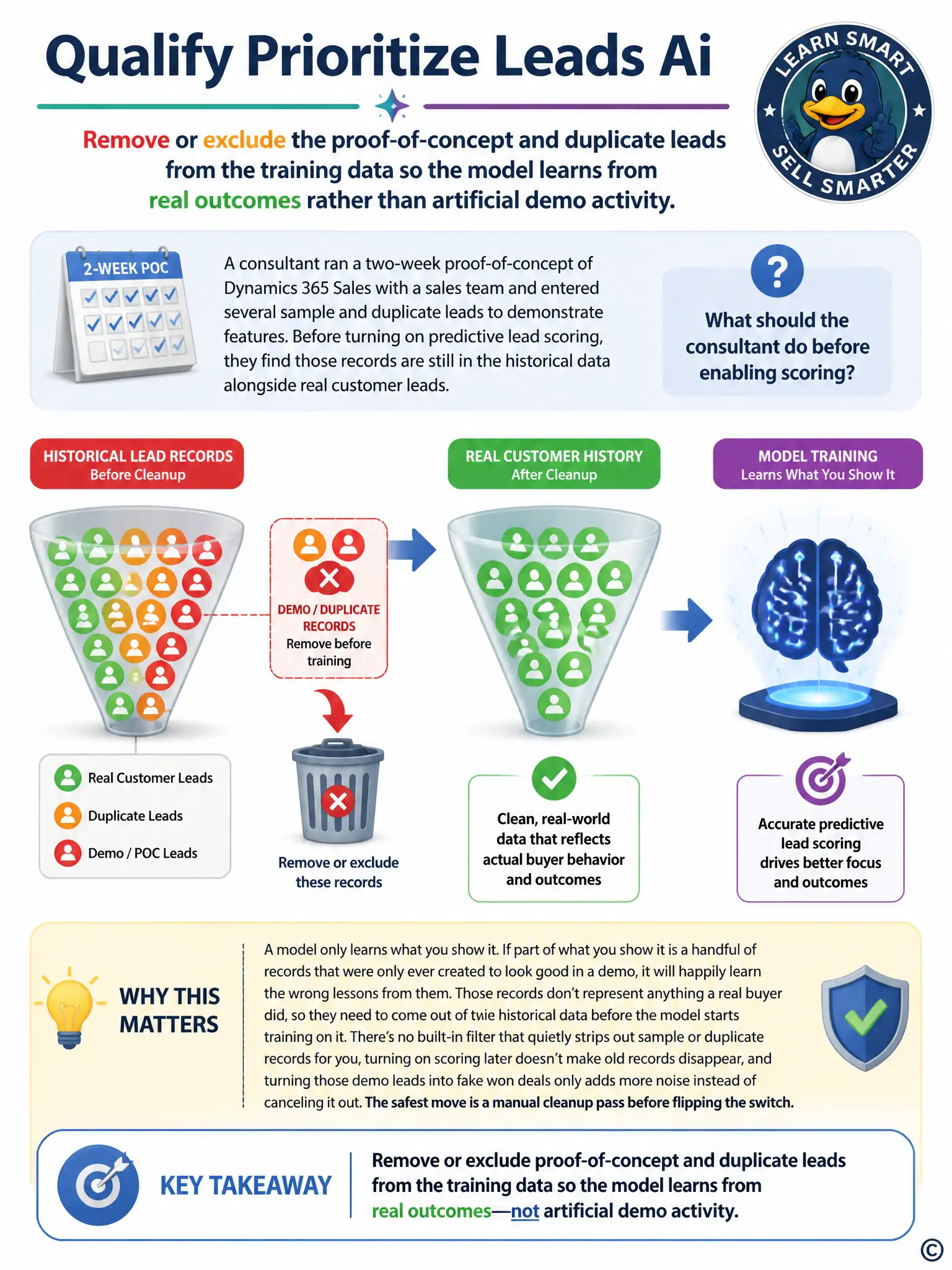
A model only learns what you show it, and if part of what you show it is a handful of records that were only ever created to look good in a demo, it will happily learn the wrong lessons from them. Those records don't represent anything a real buyer did, so they need to come out of the historical data before the model starts training on it. The safest move is a manual cleanup pass before flipping the switch.
Full Explanation
The right move is to remove or exclude the proof-of-concept and duplicate leads from the training data so the model learns from real outcomes rather than artificial demo activity. Predictive lead scoring learns from historical outcomes, so leaving demo and duplicate leads created purely to showcase the system during the proof-of-concept mixed in with genuine customer leads would teach the model from artificial patterns that have nothing to do with how real buyers behave, weakening its predictions once it goes live. The option suggesting you leave the sample leads in place is incorrect because there is no automatic filter that recognizes and excludes duplicate-flagged leads from model training; duplicate detection and predictive scoring are separate features. The option suggesting you enable scoring immediately is incorrect because the model trains on historical data regardless of when scoring is enabled, so leads created earlier, including the proof-of-concept records, remain in scope unless someone removes them. The option suggesting you convert every proof-of-concept lead into an opportunity is incorrect because that would not offset bias; it would compound it by feeding the model fabricated won deals that do not reflect real buying behavior, further distorting what the model learns.