
A distribution conglomerate sells enterprise software subscriptions through one division and low-cost retail hardware through a separate division, and both divisions share a single Dynamics 365 Sales environment. A consultant enabling predictive lead scoring notices that a single scoring model trained across both divisions performs poorly, because the buying signals that predict a software deal have little relationship to what predicts a hardware sale. What should the consultant recommend?
Select an answer to reveal the explanation.
Short Explanation
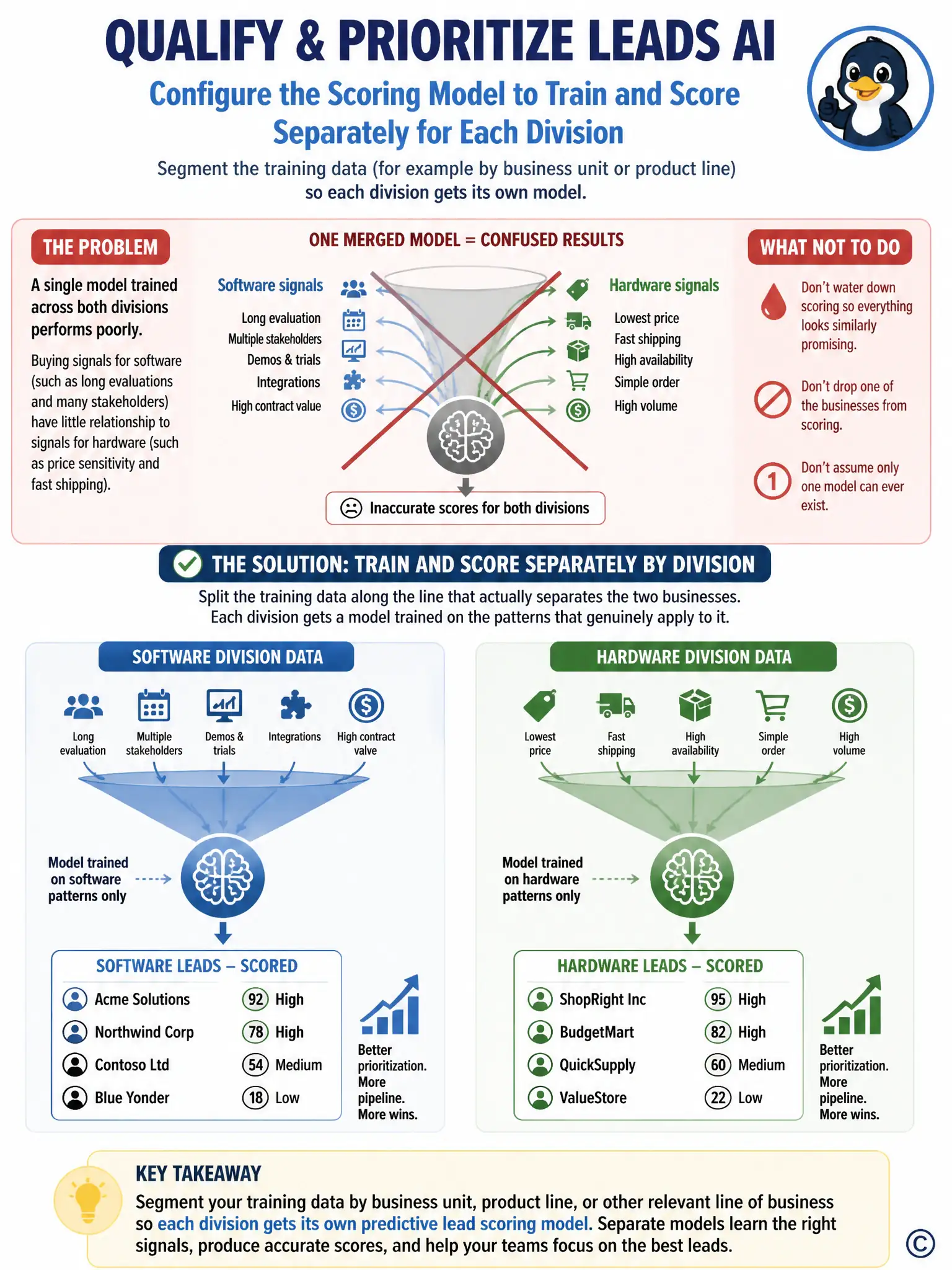
You need to split the training data along the line that actually separates the businesses, such as by business unit or product line, so each division gets its own model. A single model trained across both mixes unrelated buying signals and predicts poorly. Don't water down the scoring, drop a division, or assume only one model can exist.
Full Explanation
The correct recommendation is to configure the scoring model to train and score separately for each division by segmenting the training data, for example by business unit or product line, so each division gets its own model. Because the software division and the hardware division have fundamentally different buying signals, a single model trained across both blends unrelated patterns together and produces weaker predictions for each; segmentation lets Dynamics 365 Sales train and score a model that reflects the actual behavior of each division's buyers. The recommendation to keep one shared model, since Dynamics 365 Sales does not support more than one predictive scoring model per environment, is incorrect because predictive scoring is not limited to a single model per environment; segmentation is supported precisely for cases like this one. The recommendation to lower the model's confidence threshold so both divisions' leads are graded Hot regardless of how they actually perform is incorrect because lowering the confidence threshold would just make more leads across both divisions get graded Hot regardless of merit, masking the underlying problem instead of fixing the mismatch between divisions. The recommendation to remove the retail hardware division's leads from the model entirely and score only the software division going forward is incorrect because dropping the hardware division from scoring entirely leaves that team without any predictive prioritization at all, which is a worse outcome than giving each division its own properly trained model.